Allied Rebels Overrun Sudan Army Defenses Near South Kordofan Capital
Civilian Exodus from Besieged Cities of Kadugli and Dilling
Sudanese army defenses continue to break down around the cities of Kadugli and Dilling in South Kordofan, coinciding with an exodus of civilians amid famine and fears of imminent rebel attacks.
Army units in the area are outnumbered and facing shortages of critical supplies. Some soldiers are defecting or abandoning their positions. At present, there appears to be no ongoing army operation to relieve the imperiled cities. Past efforts to reinforce and resupply Dilling and Kadugli, launched from SAF-held territory in North Kordofan, were repulsed.
The Rapid Support Forces (RSF) have dispatched their prominent field commander, Colonel Saleh Al-Futi, who oversaw the successful assaults on the army’s 22nd Division (Babanusa) and 16th Division (Nyala), to lead operations in the Kadugli theater.
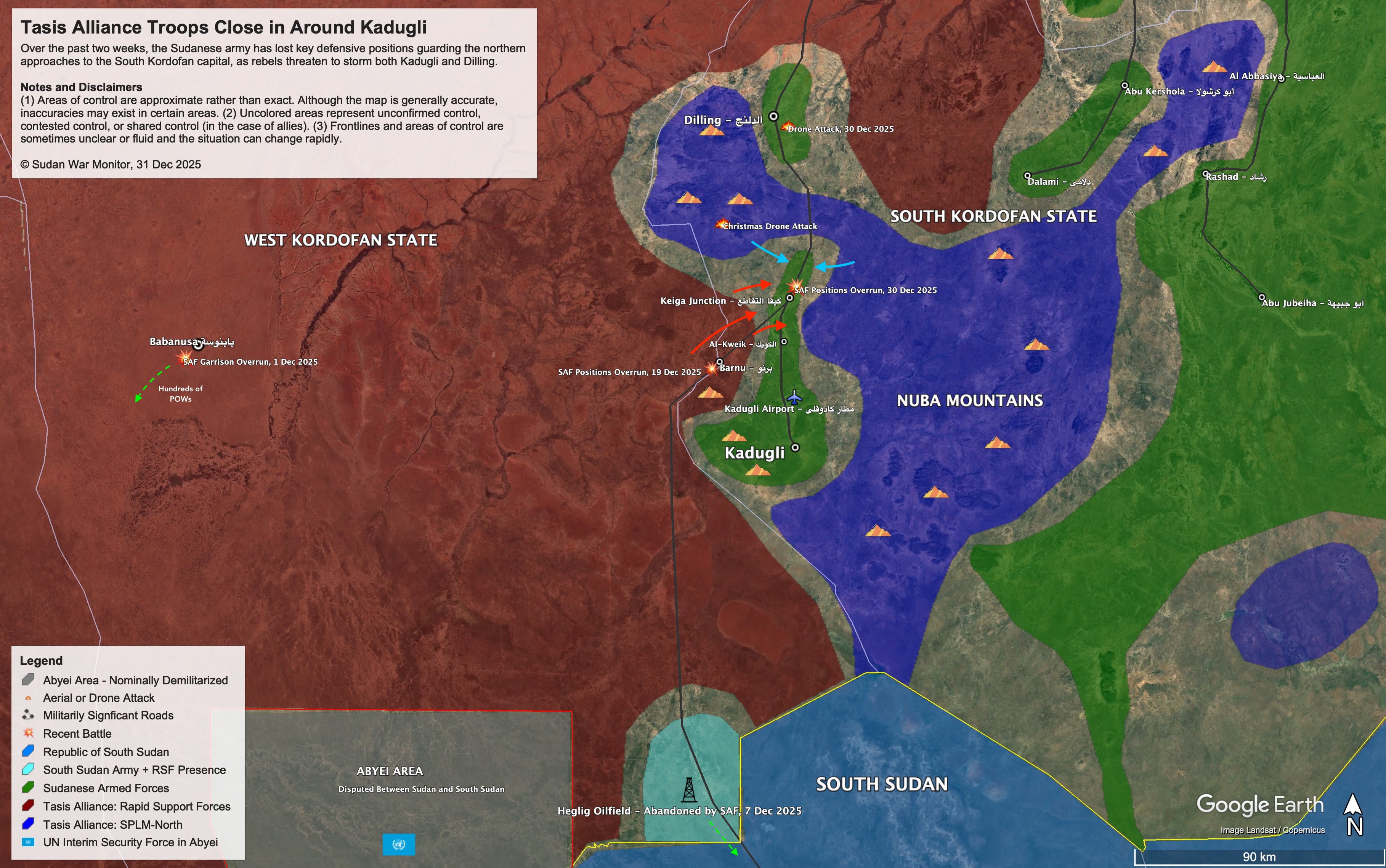
In the latest developments, on Tuesday morning, 30 December 2025, a joint operation by the RSF and the Sudan People’s Liberation Movement (North) overran Sudanese Armed Forces (SAF) positions along the Kadugli-Dilling road, including at Keiga Junction, Balif, and Hajar Daleib. This puts them within easy striking distance of Al-Kweik, Kadugli Airport, and Kadugli itself.
Open source information, including videos filmed by combatants, indicates that intense clashes took place at several hilltop and roadside positions. These videos show exchanges of heavy weapons fire, advancing RSF and SPLM-N units, abandoned SAF earthworks, and prisoners of war.
This offensive follows a Christmas Day drone strike by the Sudanese Armed Forces on worshippers in Julud. The attack killed 12 civilians and wounded 19 others, according to a statement by the SPLM-North, claims that are corroborated by graphic video evidence.
If Kadugli does fall, it will end the city’s more than 30-year reign as the military and administrative capital of South Kordofan. Located in the Nuba Mountains region, Kadugli evolved from a sleepy market town into a major army base and training center for mujahideen (‘Popular Defense Forces’) after the Sudanese government declared a jihad in the region in 1992.
This conflict between the government of Omar al-Bashir and the Sudan People’s Liberation Movement — which is remembered as the Second Sudanese Civil War — lasted until 2002, when the Bürgenstock Agreement initiated a period of calm, followed by a permanent peace in 2005.
Fighting resumed in South Kordofan in 2011-2018 after the independence of South Sudan triggered a rupture within the SPLM. This war ended inconclusively, with SPLM-North retaining control of many rural areas, while the Sudanese Armed Forces (SAF) controlled the larger cities. A short-lived peace — more of a truce — prevailed in 2019-2022, after protests in Khartoum toppled the Bashir government and temporarily reined in the military.
Then came a military coup and a new war between the Sudanese military and its former paramilitary ally, the RSF, which mutinied in April 2023. For more than a year, the SAF and RSF battled in Khartoum and other cities.
Initially, the SPLM-North were mostly bystanders. Not quite neutral, but not quite active participants either. They took advantage of SAF’s vulnerability to seize some territory and equipment, but mostly stayed out of the fighting.

That changed after the political leaders of the SPLM-North and RSF forged an alliance in February 2025. The political terms of this deal are public, but the military arrangements are confidential. SPLM-North appears to have received new funds and equipment as a result of the pact, allowing it to launch a major new recruitment and training campaign, swelling its ranks. In return, it has allowed RSF troops to operate in its territory and cooperated offensively.
South Kordofan now sits squarely along the east-west territorial division between the SAF and the RSF. It has become one of three major combat theaters, alongside North Kordofan and northwest Darfur (Dar Zaghawa).
Sudan War Monitor: Shining a light on Sudan’s crisis through independent reporting, mapping, and analysis. We cover the war’s military developments, political context, and humanitarian consequences.
Following yesterday’s fighting, SPLM-North issued a statement saying in part,
“After the capture of the garrisons at [Keiga] Junction, Balif Station, and Hajar Daleib, the liberation of Kadugli and Dilling is now only a matter of time. We renew our call on the militias of the Armed Forces to surrender the two cities to avoid bloodshed and destruction, and we urge civilians to evacuate and stay away from areas where enemy forces are present.”
Similarly, the RSF-led Tasis Alliance called the operation “a crucial step toward achieving strategic objectives in South Kordofan,” adding,
“Our forces declare their determination to liberate all military sites and areas and cleanse them of elements of terrorism and extremism, and to protect citizens, signaling the end of the Muslim Brotherhood’s dominance over national decision-making.”
For its part, the Sudanese military did not comment on the latest fighting.
Continuing fighting in the area threatens civilian lives and could drive a new wave of displacement. The International Organization for Migration, a UN agency that tracks displacement trends, reported that 495 people left Dilling between December 27 and 29, due to the deteriorating security situation.


Additionally, 375 people left Kadugli over the same period, heading mostly toward eastern localities of the state, where markets are more functional and humanitarian aid is more readily available. This follows earlier waves of displacement, including 3,100 people who left Kadugli between December 24 and 26, and between 1,500 and 2,000 people who left the Kweik area (a town north of Kadugli) between December 27 and 29.
These refugees must cross frontlines in order to reach safety. Some have reported being extorted by gunmen en route. Facing criticism, the SPLM-North yesterday issued a statement denying that it has imposed fees on travelers, looting property, and preventing displaced persons from traveling onward to South Sudan or SAF-held areas.
SPLM-North said these are rumors and fabrications: “These claims are completely false and reflect the poor psychological state and low morale of the Islamic movement’s forces and militias. Their purpose is to frighten citizens from fleeing to areas under the control of the SPLM-N.”
SPLM-North is historically a mostly rural guerrilla moment. It has never controlled a major city like Kadugli. It is therefore unclear how the movement would govern the South Kordofan capital, and what role the RSF would play.
The loss of Kadugli would be a blow to the military’s prestige and morale, and could trigger a cascade of additional territorial losses. However, SAF would remain firmly in control of eastern parts of the state, which can be more easily supplied and reinforced from White Nile, a SAF stronghold.
Despite claims by both sides, the fighting in Sudan is unlikely to end without a political settlement. Recent battlefield gains and losses, though locally significant in humanitarian terms — driving deaths, hunger, and mass flight — are only incrementally significant in strategic terms. They do not give either side a decisive advantage, pointing instead to a prolonged stalemate.


