Sudan’s warring parties have never sat for substantive peace negotiations, apart from a handful of meetings in Jeddah at the outset of the war. Those talks produced only days-long ceasefires that were repeatedly violated, and a shared “declaration of commitment to protect civilians,” which is now widely viewed as a meaningless, performative paper commitment.
Indirect, informal, or secret talks have taken place several times, but these initiatives did nothing to quell the violence. Despite efforts by various mediators or would-be mediators — the East African bloc IGAD, Saudi Arabia, Switzerland, the United States, Saudi Arabia, and others — the conflict has proven intractable, with no signs that either party is ready even to sit for a meeting, let alone agree to a full peace deal.
What explains the reluctance of the two sides to negotiate after nearly three full years of war, even as the battlefield situation remains largely stalemated?
This article examines the political considerations that are prolonging the conflict. Observers may differ over how much weight to assign to each factor. Taken together, they represent the most salient explanations, which are widely discussed or implicit in the discourse around the war.
Reasons Shared by Both Warring Parties
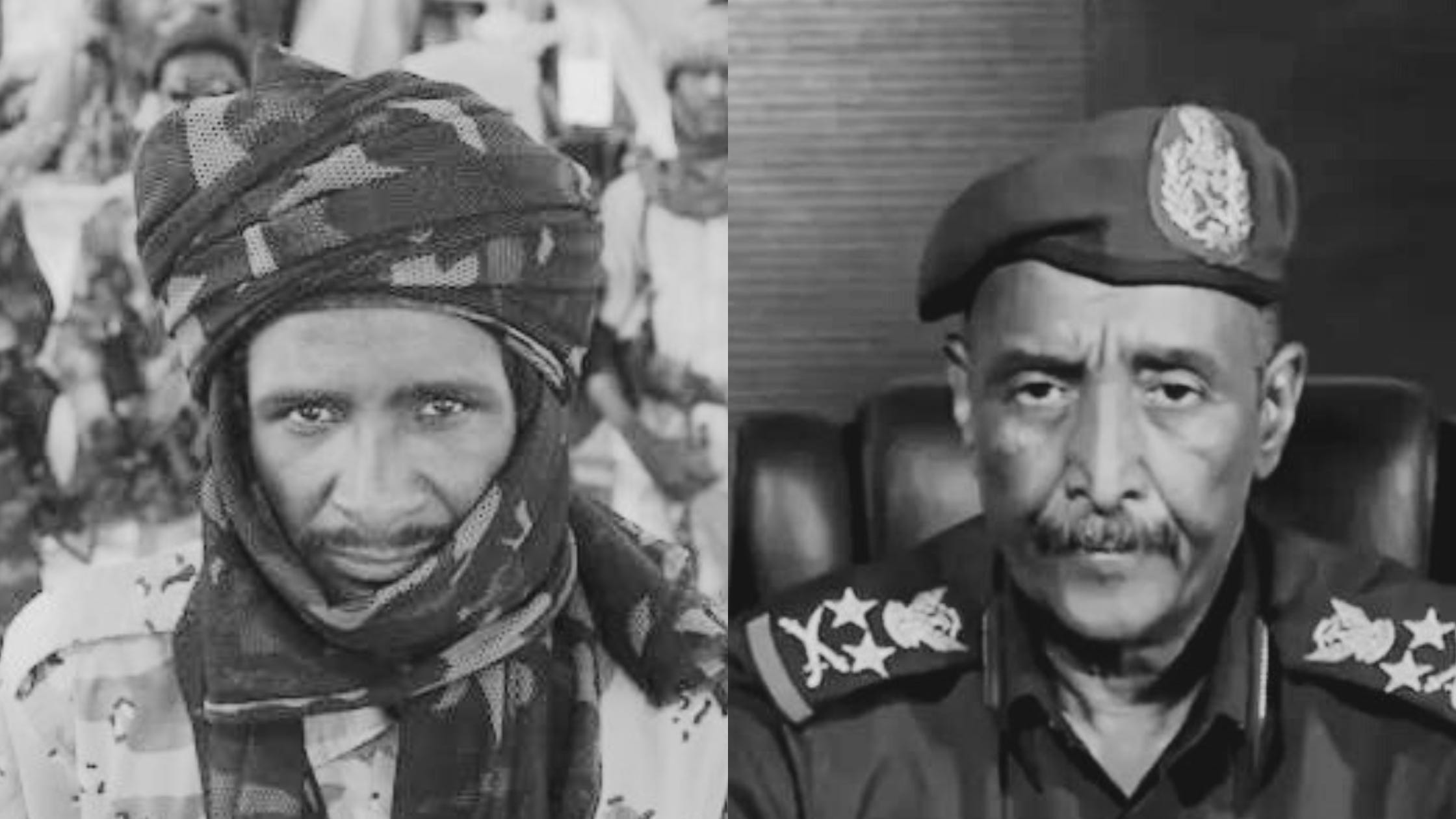
Internal power dynamics: Hardline elements within the Sudanese Armed Forces (SAF) and Rapid Support Forces (RSF) harshly criticize or even threaten the leadership whenever negotiations are considered. SAF and RSF leaders fear being toppled by rivals if they appear weak or conciliatory. Their fears of internal criticism far outweigh their fear of the diplomatic consequences of disengagement.
Prevalence of warmongering voices on social media: The information environment is important in shaping public opinion. The warring parties invest heavily in producing and spreading war propaganda that inflames emotions and justifies the continuation of the war. Relatedly, the algorithms of social media platforms often amplify the most divisive voices; pro-war posts go viral while pro-peace messages, neutral analysis, and third-party voices are usually drowned out.
Incompatible war aims: The two main parties to Sudan’s conflict previously shared power, for about a year after jointly toppling Sudan’s civilian government in a coup in 2021. However, now they embrace maximalist war aims that are incompatible with each other.
The RSF has declared itself a revolutionary force aiming to topple the “1956 state” — in other words, the entire state apparatus created after independence, which is now controlled by a junta of SAF officers.
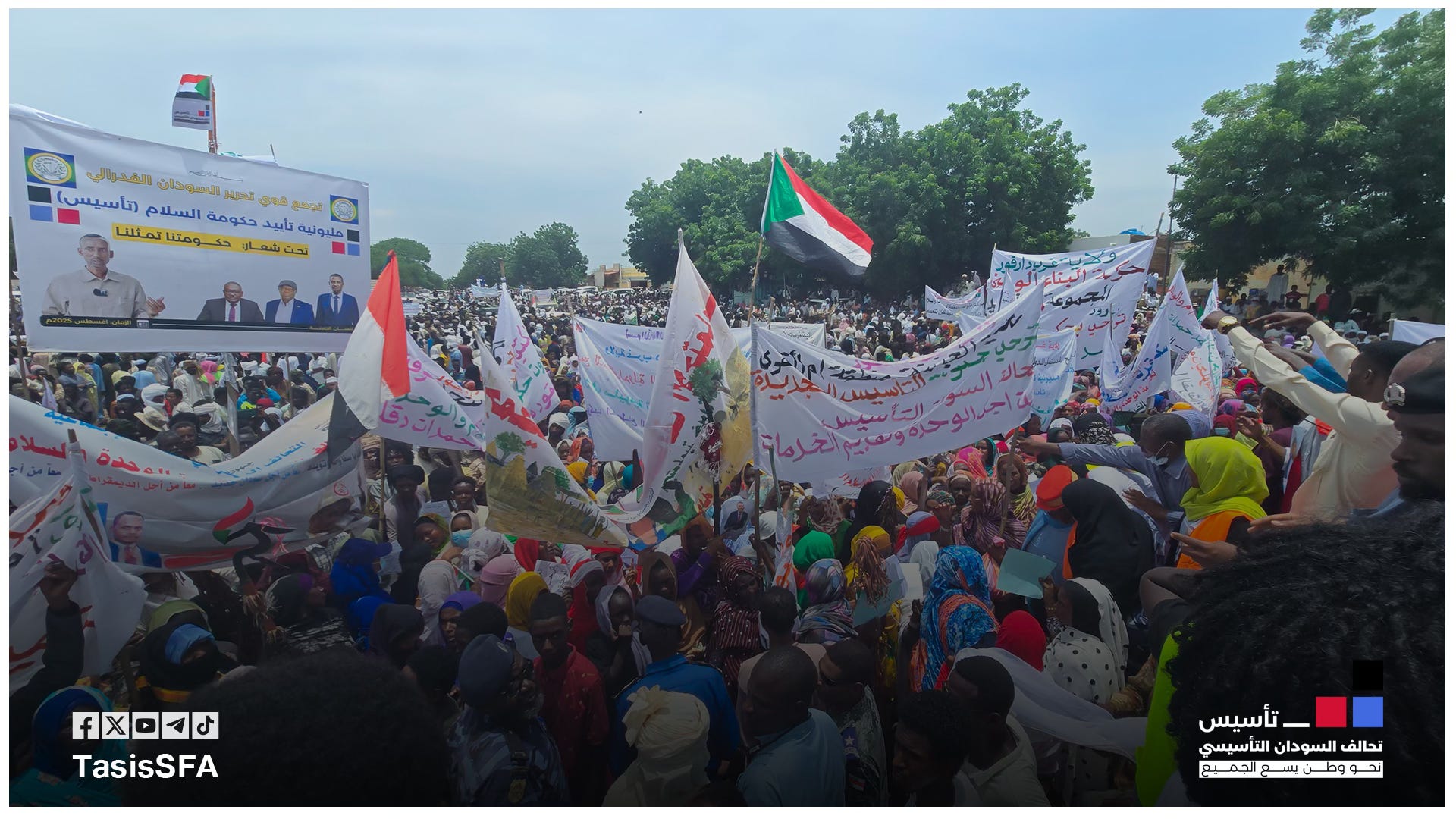
The RSF and its political allies have created a rival government, headquartered in Nyala, which claims to be the legitimate government of all Sudan. It has established some proto-government structures and waged a propaganda campaign to consolidate local support in rebel-held areas. It calls itself the Government of Peace and Unity, or Tasis for short (“Founding”), a name implying a re-founding of the nation.

Rally of the RSF-led Tasis Government in El Geneina, August 2025
Much like the Sudan People’s Liberation Movement (SPLM) of the 1980s and 1990s, which waged a rural insurgency in South Sudan while espousing national war aims (the creation of a “New Sudan” and overthrow of the Khartoum government), the RSF espouses national war aims while drawing on a strong regional base of support. Though originating in Darfur and West Kordofan, the RSF is neither regionalist nor separatist. This means that the conflict is driven partly by local grievances and ambitions, without having local solutions.
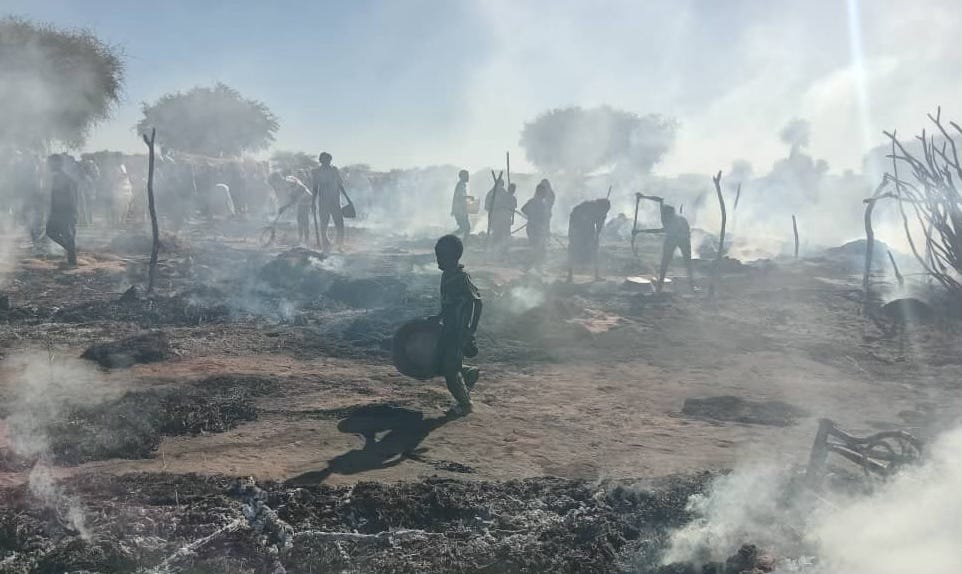
Sudan’s military likewise has embraced maximalist objectives. SAF leaders have called for the total extermination of the RSF and the expulsion of Darfur Arab tribes from the country. The Sudan Air Force has attempted to execute this objective by relentlessly bombing markets, water points, civil infrastructure, and residential areas in Arab parts of Darfur, killing and displacing thousands of people.
Vengeance vs. Justice: Each side views the other as culpable of committing unspeakable atrocities, while ignoring or excusing its own war crimes. Vengeance presents itself as a clear, immediate remedy, while legal justice mechanisms are perceived as abstract, implausible, and incommensurate with the depth of hurt and anger involved.
Child soldiers and youth: The rank-and-file of both warring parties are very young, usually teens to mid-20s, with the junior officer corps being only slightly older. Many fighters have been radicalized through years of exposure to violence and political turmoil.
Before the war, Sudan was already grappling with high youth unemployment, the economic and social shock of the Covid-19 pandemic, and prolonged political instability. Formal schooling has been repeatedly disrupted for years, and in many areas schools and universities closed altogether. As a result, large numbers of young men have come of age without meaningful peacetime experiences, whether professionally, educationally, or in terms of family formation, career development, or civic participation.
Sudan has one of the youngest populations in the world: the median age is around 19 years, and roughly 40–45 percent of the population is under 18. In a country of approximately 45–50 million people, this demographic reality means that adolescents and young adults constitute a vast reservoir of potential recruits. Teenagers constitute a large and growing proportion of the ranks of both sides, and child battlefield deaths have risen sharply over the past year.
Failed interventions in 2023: The short-term truces that were signed early in the first few weeks of the conflict were broken by both sides, due to poor command-and-control, distrust, and lack of political will to implement them. This history of broken agreements makes another ceasefire appear pointless. Whenever the prospect of a ceasefire is raised, the war supporters argue that the other side would just use the time to rearm and mobilize for a fresh round of fighting.
History of broken peace agreements: Additionally, many older peace agreements made throughout Sudanese history have been broken or implemented only in part. The long history of non-compliance with peace deals makes both sides distrustful of a prospective agreement. Each side expects that the other would dishonor the terms of a peace, attempt to repress or outmaneuver the other side during the transition to peacetime, and eventually abrogate the agreement in its entirety.
Ethnic hatred: Sudan’s ethnic composition and ethno-political dynamics are too complex to address here. But in brief, ethnic hatred is a significant conflict driver, though just one among many. Ethnic-related war crimes are regularly reported. The longer that the conflict goes on, the more entrenched the hatred becomes and the more difficult it is for the country to overcome it and to recover. Even if a high-level political agreement could be reached, societal animosities would persist.
Sudan War Monitor is an independent publication covering Sudan’s civil war through OSINT, reporting, Arabic-language sources, and political-military analysis. It publishes maps, verified videos, news, and investigative reporting. Please consider subscribing or sharing this article to help sustain our work.
Reasons Specific to the Sudan Armed Forces
Military disinformation: SAF invests heavily in creating disinformation. This leads the population to believe that a military victory over the RSF is achievable or even imminent, negating the need for peace talks.
Frequent tactics include fabricating military victories (or exaggerating real but minor ones), covering up or distracting from significant defeats, promoting martyr stories, exaggerating or fabricating stories of RSF atrocities, and spreading false news about RSF vulnerabilities.
Maps that misrepresent the military reality are widely circulated, casualty figures are suppressed, and independent analysis of military events is attacked as treasonous and unpatriotic.
War propaganda happens both online and offline. While the internet plays a major role, street art, public songs and performances, poetry, parades, radio, television, and military newspapers also play a role. Anti-war publications or protests are not permitted.
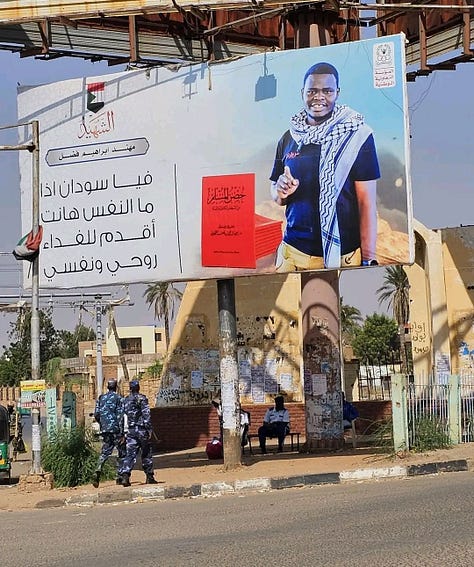
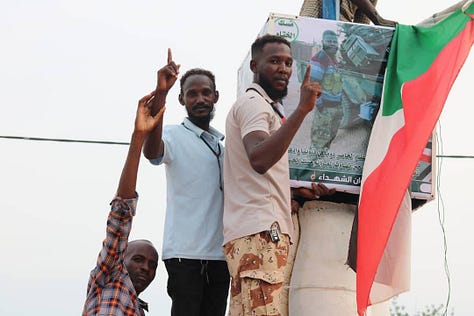

SAF war propaganda celebrating martyrs External support: The SAF’s most important external supporters are Egypt and Turkey, which have given unequivocal recognition to the SAF government, as well as practical assistance. Additionally, China, Iran, and Russia have played a role in legitimizing the military government internationally and supplying materiel essential to the war effort. These international dynamics disincentivize SAF from negotiating.
Dominant political forces support war: Sudan suffered wars for the entire 30-year reign of the National Islamic Front, aka the National Congress Party (1989-2019). These internal conflicts froze immediately upon the NIF’s downfall in 2019. After generals of the same regime retook power in a coup in 2021, war erupted again within just over a year. (Although the RSF is partly or largely to blame for the initial outbreak of the conflict in April 2023, SAF and its political backers also played a role in the escalation, and consistently rejected deescalation afterwards).
War is the government’s source of legitimacy: Sudan’s military regime believes in war as a governing principle. It cannot govern without it, and war has always been its stated purpose and its stated source of legitimacy.
The perpetual existence of a national emergency, which purportedly only can be solved through military means, is the regime’s stated basis for rejecting parliamentary rule, elections, and civil rights, including freedom of the press and political dissent, which it does not tolerate.
By quelling all prospects for peace, the army-led government ensures its continued survival. Periods of intensified violence in Sudan’s peripheries have always been accompanied by intensification of repression in the urban core of the country in the Nile Valley. By contrast, lulls in fighting typically open up civic space and allow for a wider range of tolerated political activity and free speech.
Although the NIF/NCP agreed to some peace deals during its 30-year reign, these agreements were tactical and short-lived, intended to divide or co-opt the opposition, or to win respite on the battlefield or redirect military resources against another foe.


Reasons Specific to the RSF
Warrior ethos: Like the Sudanese military, the RSF has a militant history and only a very limited record of peacetime political engagement.
The RSF emerged in a warzone as an ethnic militia recruited and armed by the state for counter-insurgency, initially composed almost entirely of Arab fighters from the nomadic tribes of Darfur.
While the RSF has established limited administrative structures in areas under its control, adopted nominally democratic rhetoric, and claimed to be open to peace, these efforts have not displaced an internal culture that depends on continued conflict.
RSF-aligned content on social media consistently glorifies violence, valorizes combat roles, promotes racist narratives, and celebrates acts of brutality. Peace is an alien concept to the RSF, just as it is for SAF.
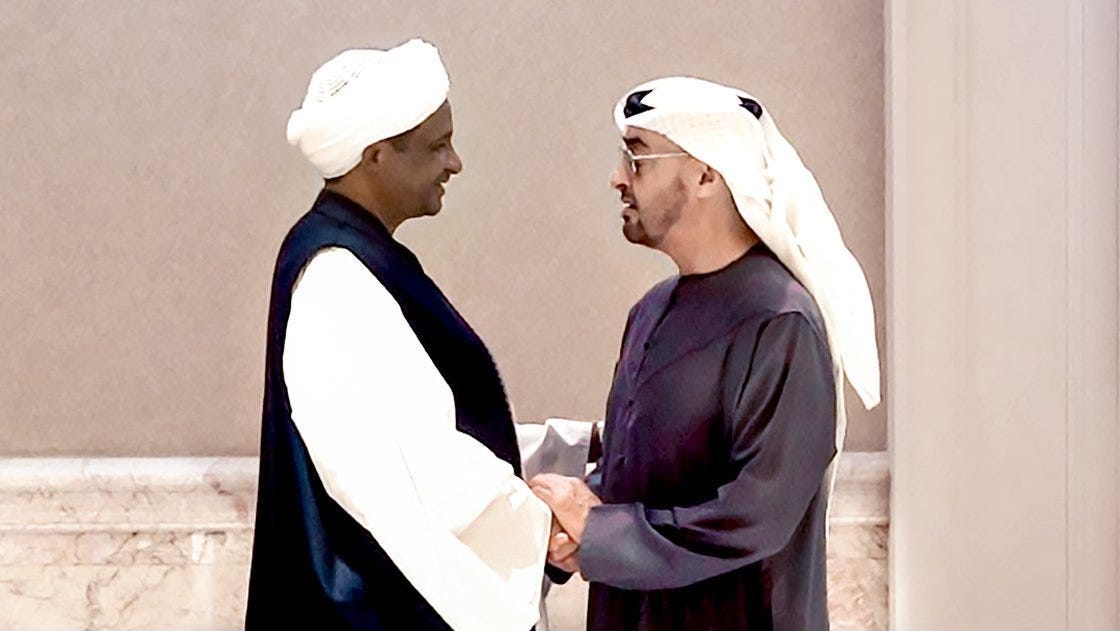
External support: The United Arab Emirates (UAE) is the most important external supporter of the RSF, providing weapons, drones, armored vehicles, money, medical, and logistical support. This assistance not only helps sustain the RSF militarily, it gives them reason to believe that they may ultimately triumph. Moreover, key leaders and aides who are sheltered and subsidized by the UAE have no personal motivation to risk anything for peace, since the status quo benefits them.

RSF Mohamed Dagalo (left) with UAE ruler Mohamed Bin Zayed in Abu Dhabi in 2023, before the outbreak of Sudan’s civil war. War Crimes Prosecutions: Prosecutors affiliated with the SAF-led government in Port Sudan already have charged top RSF leaders with various crimes. RSF leaders also risk prosecution by the International Criminal Court on account of massacres and other crimes committed in Darfur, where the ICC has an active Security Council mandate dating to the previous conflict in the 2000s. If the fighting were to stop now, the RSF leadership could become more vulnerable to arrest. On the other hand, if they take power, they will be able to ignore these courts.