
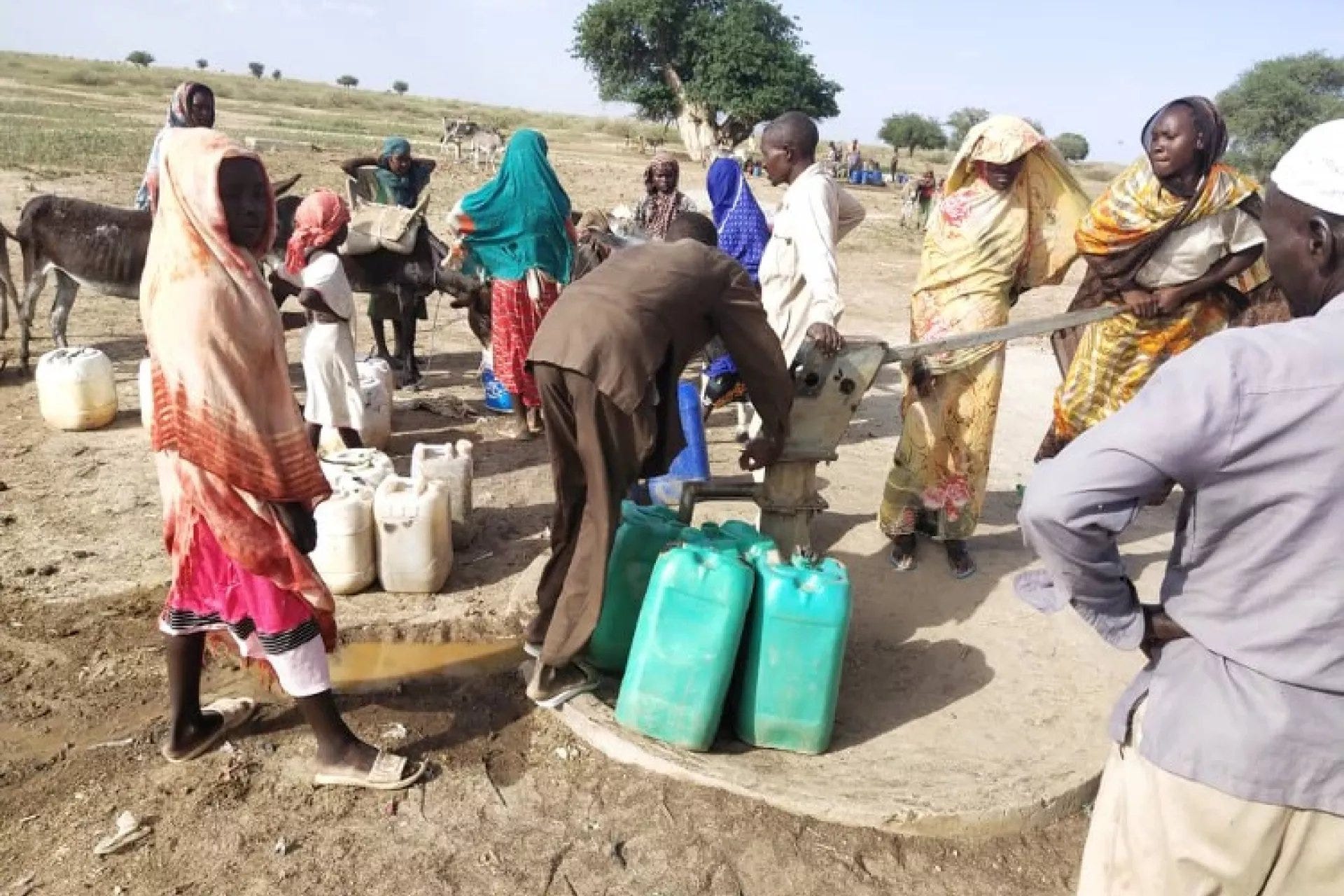
At least 18 civilians, including children, were killed on Wednesday when a Sudanese military drone strike hit a water collection point in Umm Rusum village, located in Al-Sunut locality of West Kordofan State, according to witness accounts, video footage, and local monitoring groups.
The strike hit a civilian gathering area where residents had assembled to collect drinking water, resulting in multiple fatalities at the scene, and coincided with the first day of the holy month of Ramadan, when civilian routines had shifted around fasting and preparations for the evening meal.
The victims included young children who were present with family members at the time of the attack. The area lies north of the Al-Sunut locality headquarters, a rural area that has remained under control of the Rapid Support Forces (RSF) since mid-2023.
Witnesses said the strike occurred at approximately 1 pm local time on the first day of Ramadan. Residents had gathered at the water point, which serves as a primary source of drinking water for the village and surrounding settlements. Video recorded shortly after the strike shows multiple bodies and dead donkeys lying on sandy ground near the well.
According to one video review and geolocated by Sudan War Monitor to the point here (12°10’58.73”N 28°55’25.43”E), civilian belongings, water containers, and livestock carcasses were visible across the site, indicating the strike hit a civilian gathering point rather than a military location.
In the footage, the individual recording described the victims as civilians with no involvement in the conflict. He stated that children as young as two and three years old were among those killed. Women could be heard crying near the well as bodies lay exposed in the open area. The physical environment shown in the video included a water tank, and household items consistent with a rural civilian settlement.
“I do not know what the exact date today is, but a drone has bombed the area of Umm Rusum and killed innocent children who have no connection with anything called the RSF. As you can see, women are crying here at the water well because of what has happened.”
“These bodies lying here are all martyrs, and among them are very young children, including those who were only three years old and two years old, who were killed today in this strike.”
“This drone, today on the first day of Ramadan, came and bombed them and killed them. As you can also see, even the donkey and the other donkeys that were here have all been killed in this attack,” the individual filming said.
Graphic content warning: Video showing aftermath of the drone strike.
Local monitoring organizations attributed the strike to a drone operated by the Sudanese Armed Forces. The Darfur Victims Support (DVS) said the attack directly hit the water source, causing mass casualties among civilians who had gathered there to collect drinking water.
“The attack resulted in the killing of civilians present at the water point, including children, according to the eyewitness account. The organization holds the Sudanese Armed Forces fully responsible for the killing of civilians in this incident and considers the targeting and destruction of a civilian drinking water source to constitute a war crime under international humanitarian law.”
“The organization called on the United Nations Security Council to convene an emergency session to address the protection of civilians and to take urgent measures to prevent further attacks on civilian populations and infrastructure.”
“It also expressed its deepest condolences and sincere sympathy to the families and relatives of the victims. The organization stated that it will issue a detailed investigative report documenting the incident and its findings,” the DVS said in the statement seen by Sudan War Monitor.
The Emergency Lawyers said a drone operated by the Sudanese Armed Forces struck a civilian water source in Umm Rusum village in West Kordofan State, describing the incident as a serious escalation in attacks on civilian infrastructure.
The group said the strike targeted an area with no known military presence and caused widespread civilian casualties and destruction of essential water infrastructure serving multiple rural communities.
“The SAF drone struck a water source in Umm Rusum, West Kordofan, an area devoid of any military presence. The attack resulted in a massacre that killed dozens of innocent women and children and disrupted the main water source that supplies drinking water to at least 17 surrounding villages.”
“This attack constitutes a grave violation of international humanitarian law and reflects a continued pattern of targeting civilian infrastructure essential for survival,” they said in a statement.
While the Sudanese military did not issue any statement on the strike and could not be reached for comment at the time of publication, Umm Rusum village lies within an area under the control of the RSF, making it unlikely that RSF units carried out the attack given their territorial presence.
Expanding Drone Campaign in Kordofan and Darfur
The strike on Umm Rusum village occurred amid a widening pattern of drone attacks across Kordofan and Darfur that have resulted in significant civilian casualties in recent days. The Umm Rusum attack followed a February 16 drone strike on a displacement shelter facility in Al-Sunut locality in West Kordofan. That strike killed at least 26 civilians, an entire famoly comprising of a woman and children, according to field documentation, victim lists compiled by local monitoring groups, and an eyewitness.
The eyewitness who filmed the aftermath of the strike identified himself as the owner of the house and adjacent shop that were destroyed in the drone attack. Speaking while standing beside the damaged structures, he said the unfinished shop had been used as shelter by internally displaced families who had fled earlier violence in surrounding areas.
He explained that women and children had gathered inside the building believing it would provide safety, but the missile struck the structure directly, killing those inside and destroying the property.
In the footage, the man walked through the ruins of the building and surrounding area, pointing to bodies and debris as he described the extent of the destruction. He said members of the displaced families had arrived only recently and had no protection when the strike occurred.
The video shows the collapsed remains of the shop, damaged residential structures nearby, and bodies lying on the ground. His testimony provides a firsthand account of how civilian structures were being used as emergency shelter at the time they were struck.
“On the morning of Monday, February 16, the Air Force of the remnants of the former regime targeted internally displaced people in Al-Sunut locality and killed 26 people. All of them were women and children. After they fled from their homes seeking safety, the Sudanese Armed Forces Air Force followed them and struck the area where they had taken shelter.”
“These are five women and five children. This house belongs to me, and this is a shop. The shop was not even completed. The displaced people were living inside it when it was struck. It was destroyed by a missile, completely destroyed, by the killer, Abdelfattah Al-Burhan. Allahu Akbar, and may God judge you. You destroyed families and homes.”
“Even the underground shelter did not protect them. If this is what you mean by a [Ramadan] truce, we say it is not a ceasefire. If you call this a war, it is cowardice. All of them are children. All of them are children. This is the best evidence [of crimes].”
“This is a child, he could not escape, he could not survive the war planes. They didn’t survive from Al-Burhan’s planes. This is a mother with her children. And this is their eldest daughter. They ran in the middle of the night in order to survive, but they were chased by the fate and the planes of Al-Burhan. They were chased by drones. Allahu Akbar on you. You destroyed them.”
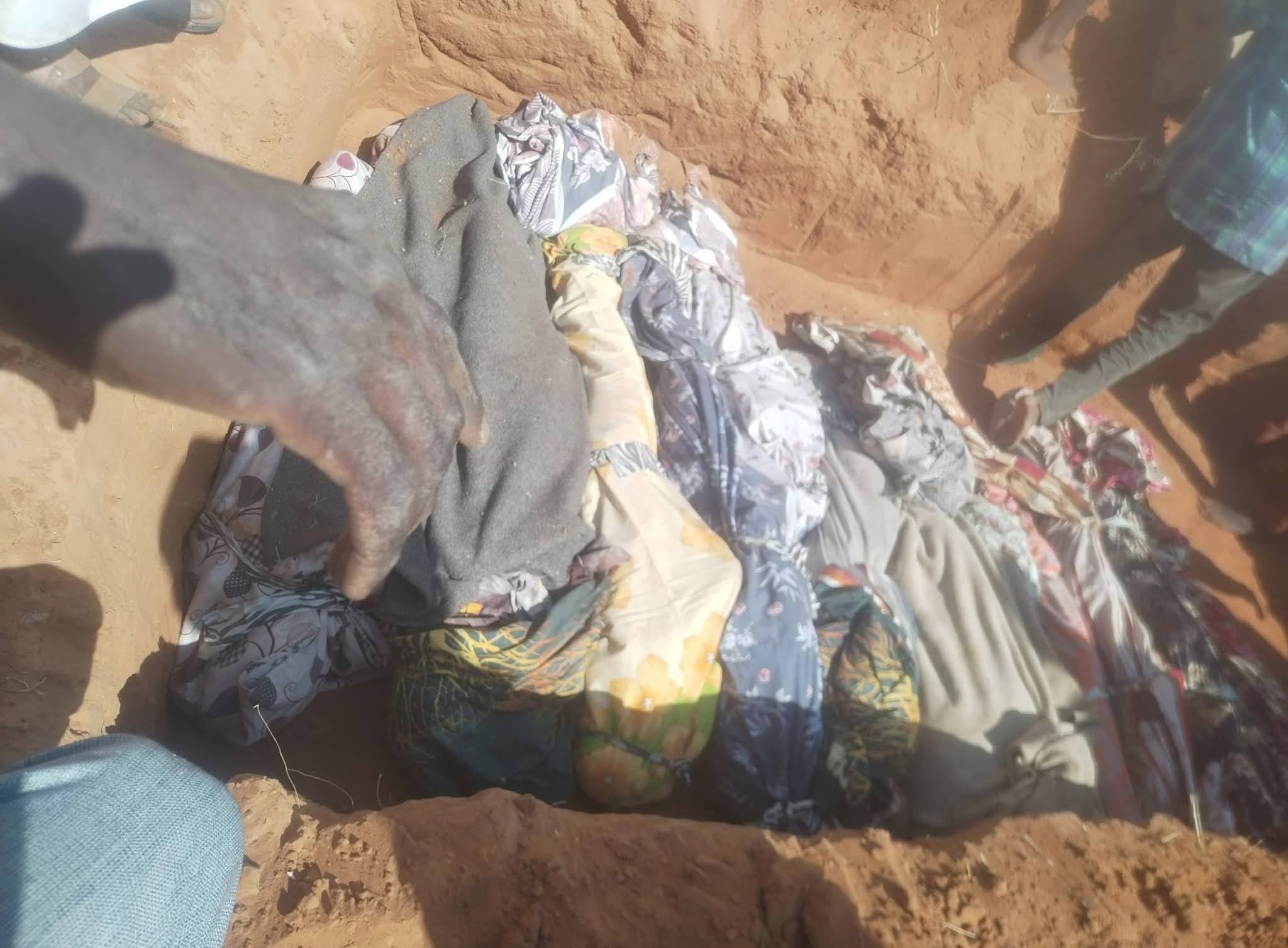
The United Nations Children’s Fund confirmed that children were among those killed in the Al-Sunut strike. UNICEF reported that at least 15 children were killed and 10 others injured in the attack. The agency warned that children across Kordofan were increasingly exposed to violence and deprived of basic protection. It called on all parties to the conflict to protect civilians and ensure the safety of civilian infrastructure.
Another drone strike on February 17 hit Al-Safiya market in North Kordofan, killing at least 28 civilians in a crowded commercial area. Witnesses said the strike occurred during daytime hours when the market was active with traders, transport workers, and residents. The attack caused widespread fear among civilians and disrupted daily life in surrounding communities. Residents said the market had no visible military presence at the time of the strike.
Similar drone strikes have also been reported in Darfur, including a February 15 strike on Adikong market west of El Geneina in West Darfur State, near the Adri border crossing with Chad. Geolocation analysis based on satellite imagery places the strike site southeast of Adikong, within a rural settlement cluster connected by dirt roads to the main Adri–El Geneina corridor.
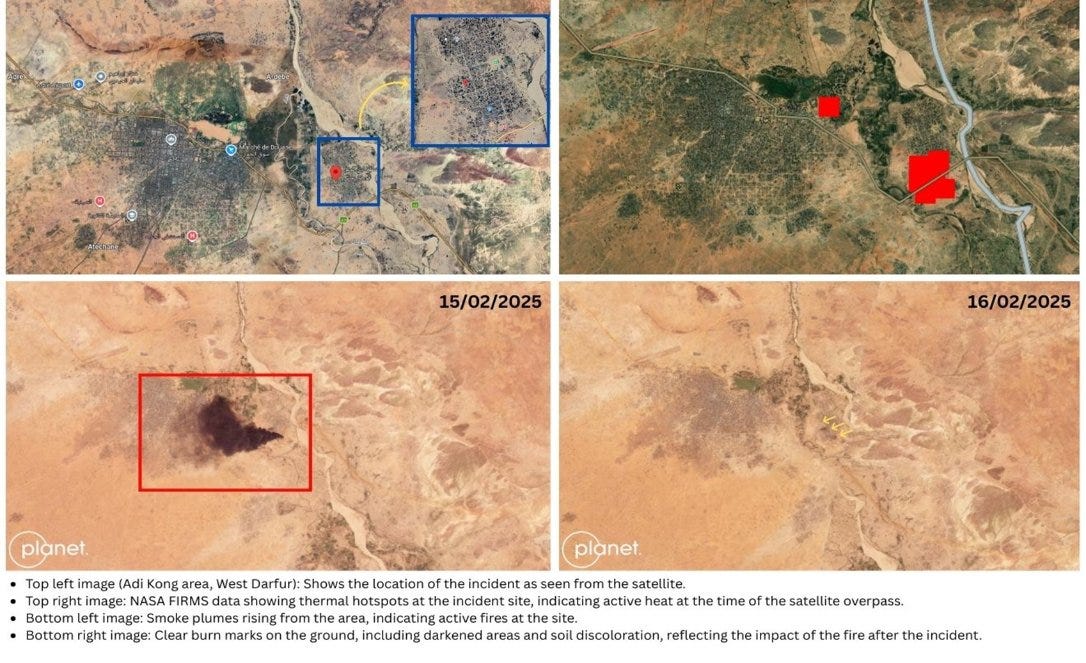
Satellite data from Planet Labs shows a large burn scar at the identified coordinates on February 15, with visible smoke plumes rising at the time of the satellite overpass. Follow-up imagery from February 16 shows darkened ground and soil discoloration consistent with fire damage caused by an aerial strike.
The Sudanese military has frequently accused the Rapid Support Forces of using the Adri border corridor to smuggle combat fuel and other military supplies into RSF-controlled territory. Thermal anomaly data from NASA FIRMS detected active heat signatures at the exact location of the Adikong strike, supporting witness accounts that an explosion and fire occurred at the market site.
The strike location lies along a known civilian trade route used by fuel traders and transporters operating between Chad and West Darfur, reinforcing concerns that the attack occurred in a commercial civilian zone rather than a confirmed military installation.
The strike killed one civilian and injured others, including a child, according to local reports. The area is a known cross-border commercial hub used by traders transporting fuel, food, and other essential goods between Sudan and Chad. The crossing was shut down following the outbreak of war, and despite past SAF authorization allowing its use for humanitarian purposes, convoys that crossed through Adri have subsequently been targeted after entering the interior of Darfur.
Following the strike, several Sudanese army–aligned propaganda accounts on social media claimed the target was an RSF fuel shipments or a fuel convoy allegedly supplying RSF forces. One such account published post asserting that the strike was aimed at disrupting RSF fuel logistics in the border area.
However, local witnesses and monitoring groups said the strike hit a civilian commercial market area, and no independent verification has emerged confirming the presence of RSF military fuel infrastructure at the exact strike location. The incident formed part of a broader pattern of drone strikes affecting civilian areas across western Sudan.
West Kordofan is part of a wider region historically inhabited by Arab pastoralist communities, including the Misseriya and Hawazma tribes, alongside farming communities and displaced populations. Many fighters within the RSF originate from western Sudan, including Darfur and Kordofan.
This social overlap has contributed to SAF viewing areas under RSF control as hostile territory. As a result, civilian areas in these regions have increasingly been exposed to aerial strikes.
Since the outbreak of war in April 2023, the RSF has consolidated control over large parts of Kordofan, including rural areas far from active front lines. These areas serve as civilian population centers as well as logistical corridors linking Darfur to central Sudan. Residents depend heavily on wells, markets, and livestock for survival. Drone strikes on such infrastructure have had severe humanitarian consequences.
The Sudanese army has increasingly relied on drone warfare to strike targets deep inside RSF-held territory, and some of these strikes appear intended to degrade RSF manpower and disrupt areas the army believes could serve as staging grounds for attacks toward SAF-controlled positions in the east.
Support our journalism

Sudan War Monitor is an independent publication covering Sudan’s civil war through OSINT, reporting, Arabic-language sources, and political-military analysis. It publishes maps, verified videos, news, and investigative reporting.