

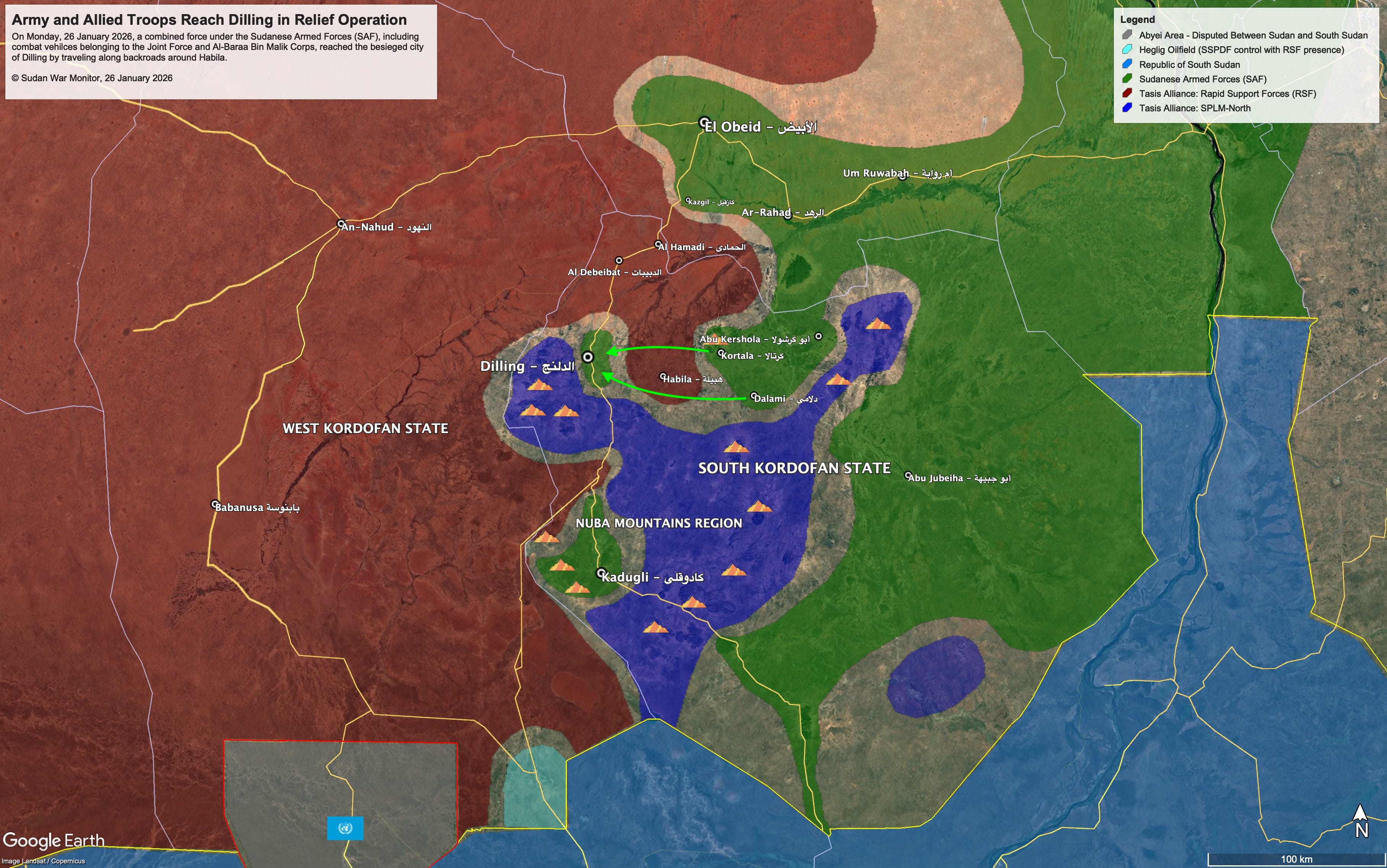
The Sudanese Armed Forces (SAF) on Monday morning succeeded in reinforcing and resupplying its garrison in the besieged city of Dilling, bringing food and ammunition for the army troops in the city, but not for the residents suffering from famine-like conditions.
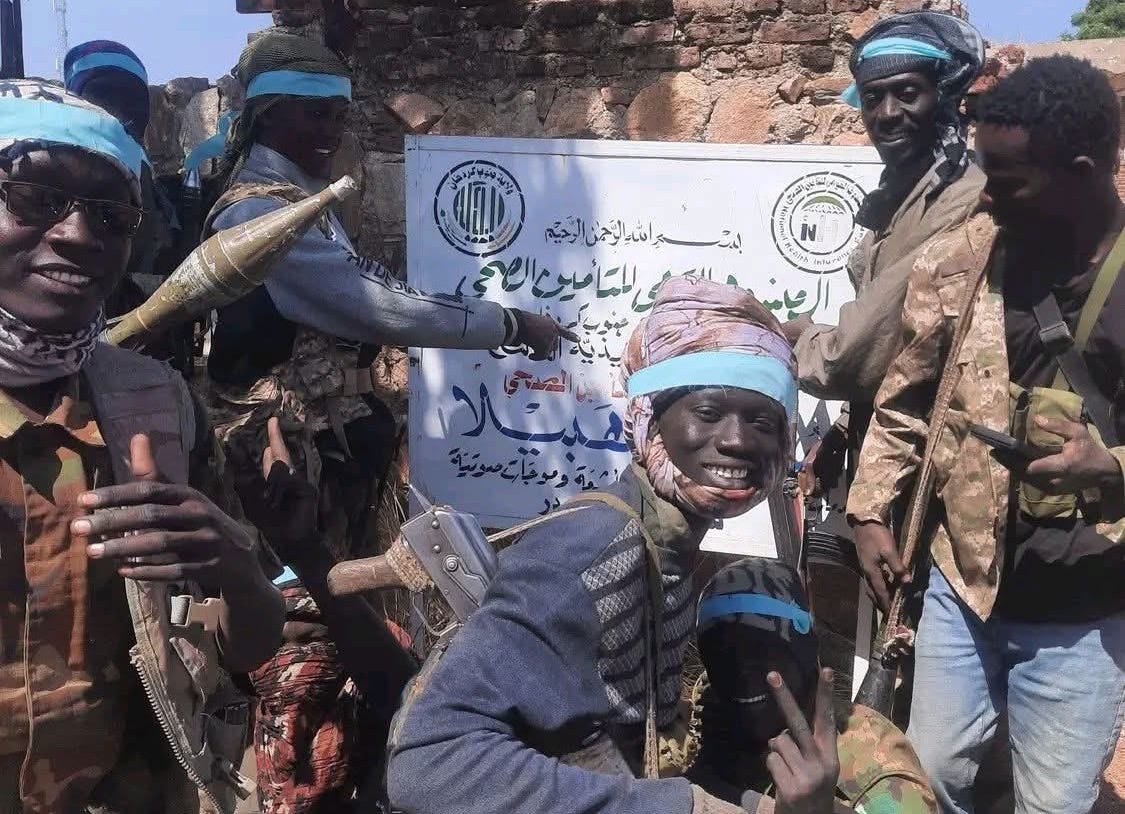
The SAF relief force arrived in pickup trucks and motorcycles without supply trucks, traveling across open countryside and rural backroads. SAF-affiliated reconnaissance elements appeared in or near Habila, but it is unclear if the SAF now fully control Habila or merely passed through the area.
Light clashes occurred en route, but there is no evidence yet of a major battle or heavy casualties. SAF-affiliated accounts on social media circulated videos claiming to show RSF vehicles destroyed in the fighting, but Sudan War Monitor verified that several of these were disinformation, showing long-abandoned vehicle in one instance, and Joint Force vehicles in another case.
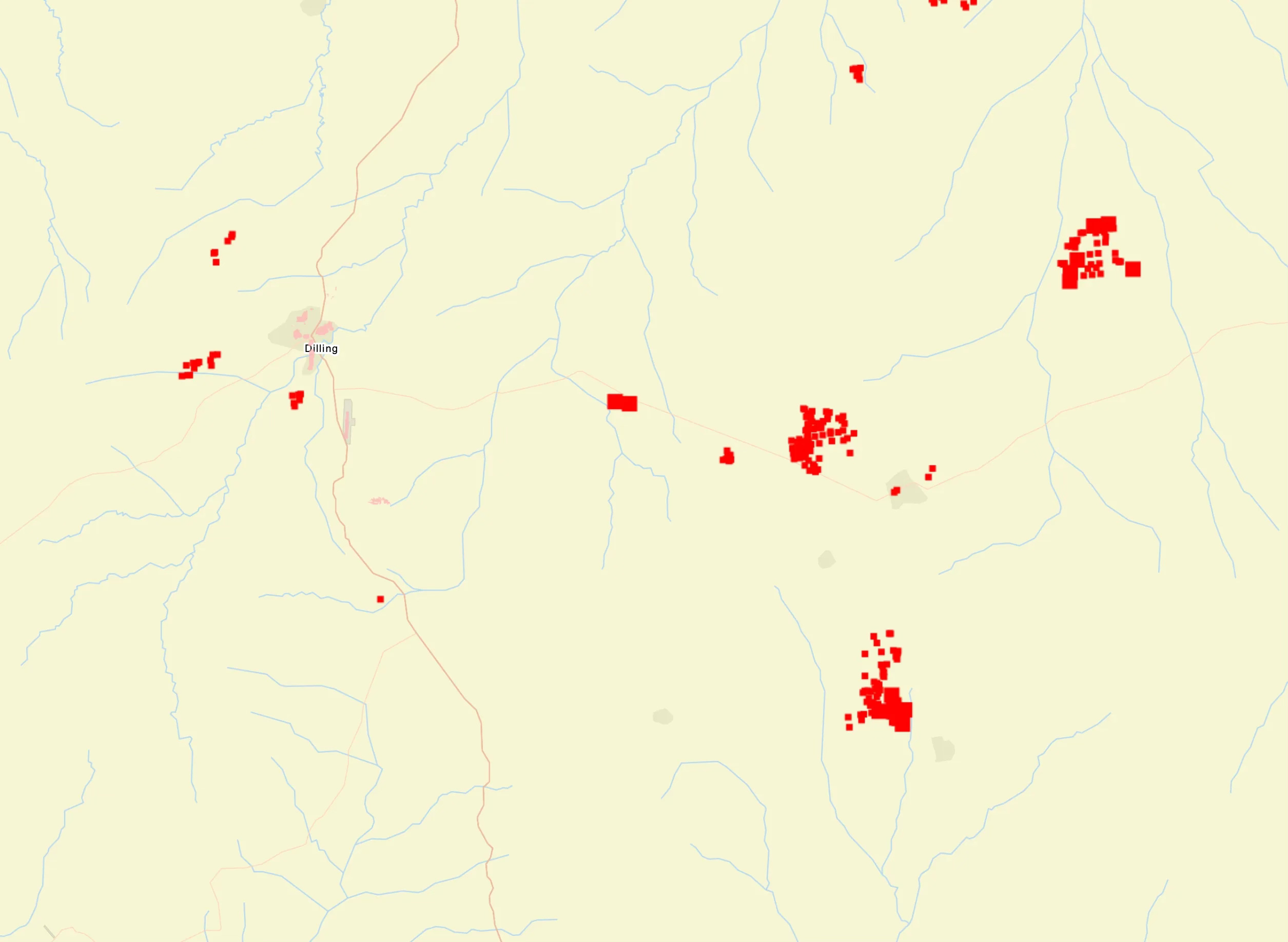
Satellite data from NASA indicates clusters of fire signals, corresponding with likely combat activity, west of Kortala, northwest and south of Habila — along SAF’s route of advance — and on the western outskirts of Dilling.
According to videos verified by Sudan War Monitor, the SAF relief operation did not use the main highway from El Obeid, which remains blocked by an RSF stronghold at Al-Dibeibat (as well as scattered RSF units throughout the countryside). Instead, SAF dispatched fast mobile units from the towns of Dalami and Kortala, where we previously verified SAF presence.
The Rapid Support Forces (RSF) had clashed with SAF troops along this axis several weeks ago, repelling the advance, but this time they failed to do so, either because they felt overpowered or because SAF succeeded in maneuvering around the RSF units using aerial reconnaissance drones.
The lead elements to reach Dilling belonged to Al-Baraa Bin Malik, a well-funded and politically influential paramilitary specializing in drone warfare. Alongside them were Joint Force troops, which are fighters specializing in mobile warfare, many of them coming from the Darfur region.
Dilling has been under joint blockade by the RSF and the SPLM-North, the two main groups within Sudan’s armed opposition coalition, Tasis Alliance. The city is one of the largest in South Kordofan and lies along the the main road between the two capitals of North and South Kordofan.
The prolonged blockade isolated the town, constraining civilian movement and degrading SAF logistics while transforming surrounding villages into contested buffer zones. Fearing attacks and faced with exorbitant market prices, thousands of people have left Dilling, crossing frontlines to reach areas farther from the front where food prices are lower, such as White Nile State. Meanwhile, Dilling has suffered from occasional shelling and drone attacks, and the city’s healthcare services have collapsed, with the three city hospitals now operating largely without supplies, fuel, or staff.
The climate in Dilling is tense and suspected collaborators of the RSF have been publicly lynched in the city’s main square, while others are detained. Agriculture and trade have largely stopped, and the whole of South Kordofan is becoming heavily militarized as the native SPLM-North is heavily recruiting and the army and RSF both have dispatched thousands of fighters to the state.
The arrival of fresh SAF troops in Dilling yesterday raised hopes among the remaining residents that the siege would soon be over. Circulating videos show residents cheering the arriving army and allied forces.
The breakthrough follows weeks of clashes both north and south of Dilling, including around Kazgil (100 km north of Dilling) and in villages near Kadugli (80-90 km south of Dilling), where several army outposts were overrun.
In a statement, the Sudanese military described the Dilling relief operation as a decisive military development, claiming to have inflicted heavy casualties on the RSF and its allies: “The Armed Forces renew their pledge to our patient people that they will continue steadfastly to cleanse the country of the filth of the terrorist militia until security and stability are achieved throughout the land. Our prayers are for paradise and eternal reward for the martyrs, and for a swift recovery for the wounded and injured,” the army statement said.
There was no immediate comment from the RSF.
The main highway to Dilling remains contested and unusable for either military logistics, humanitarian relief, or general trade. But the siege’s outer ring has been punctured, altering the tactical balance around Dilling and complicating RSF efforts to maintain total isolation of the city.
Sudan War Monitor is an independent publication covering Sudan’s civil war through OSINT, reporting, Arabic-language sources, and political-military analysis. We publish maps, verified videos, news, and investigative reporting.
Military-Political Context
Dilling is inhabited predominantly by Nuba communities, alongside smaller Arab populations and long-settled mixed groups. The town holds significant political and symbolic weight for the Nuba population as a historical administrative and commercial center in western South Kordofan.
Repeated SAF attempts to resupply the town along the El-Obeid–Debeibat axis over the past year failed due to ambushes and mine warfare. By late 2025, the RSF had consolidated control along key choke points west and south of the highway, tightening its siege around Dilling and, in coordination with forces aligned to the SPLM-North, cutting the city off from Kadugli, the state capital. This effectively isolated Dilling from SAF-held areas in the Nuba Mountains, compelling SAF planners to seek alternative axes of advance.
Until February last year, forces loyal to Abdelaziz al-Hilu largely maintained a position of armed neutrality in the wider SAF–RSF war, despite fighting both sides intermittently in South Kordofan.
Hilu’s forces clashed at different times with SAF units and RSF formations alike, seeking to defend territorial control and capture weapons rather than formally align with either belligerent. This posture shifted as battlefield dynamics changed, culminating in the SPLM-N’s entry into a political-military alignment with the RSF under the banner of the Sudan Founding Alliance, also known as Tasis, in February 2025.
The alliance formalized coordination between previously hostile actors and placed South Kordofan within a broader RSF-led strategic framework, though combat operations have largely remained separate, with limited but growing military coordination between the RSF and SPLM-North.
Control over Dilling therefore carries implications that extend beyond the immediate military contest, extending to matters of local legitimacy, communal relations, and fears of reprisals and ethnic conflict in a town that has already endured prolonged siege, displacement, and deprivation.
Videos
In this video, SAF soldies are seen entering Dilling from then east of the tow, coming from Habila. this video was shot here: 12° 0'45.52"N 29°40'17.44"E.
In this video, SAF soldiers driving in two combat vehicles goes north. It ws filmed here: 12° 2’20.88”N 29°39’16.89”E.
In the below video, SAF soldiers are arriving in Dilling, also from the east, here: 12° 2’54.52”N 29°39’3.88”E.
In the below video, SAF soldiers are see south of Habila, around this location here: 12° 7’51.49”N 30° 5’49.62”E.