
Dozens of civilians were killed on Tuesday after a suspected Sudanese Armed Forces (SAF) drone strike hit the local market in Gbeish town, West Kordofan State, according to local sources, rights monitors, and statements reviewed by Sudan War Monitor.
The exact casualty toll remained unclear by Tuesday evening, with some local and rights sources placing the death toll at around 20, while others said at least 28 civilians were killed. Sudan War Monitor has learned that additional victims later succumbed to injuries after being transferred to Gbeish Hospital, raising fears the final toll could rise further.
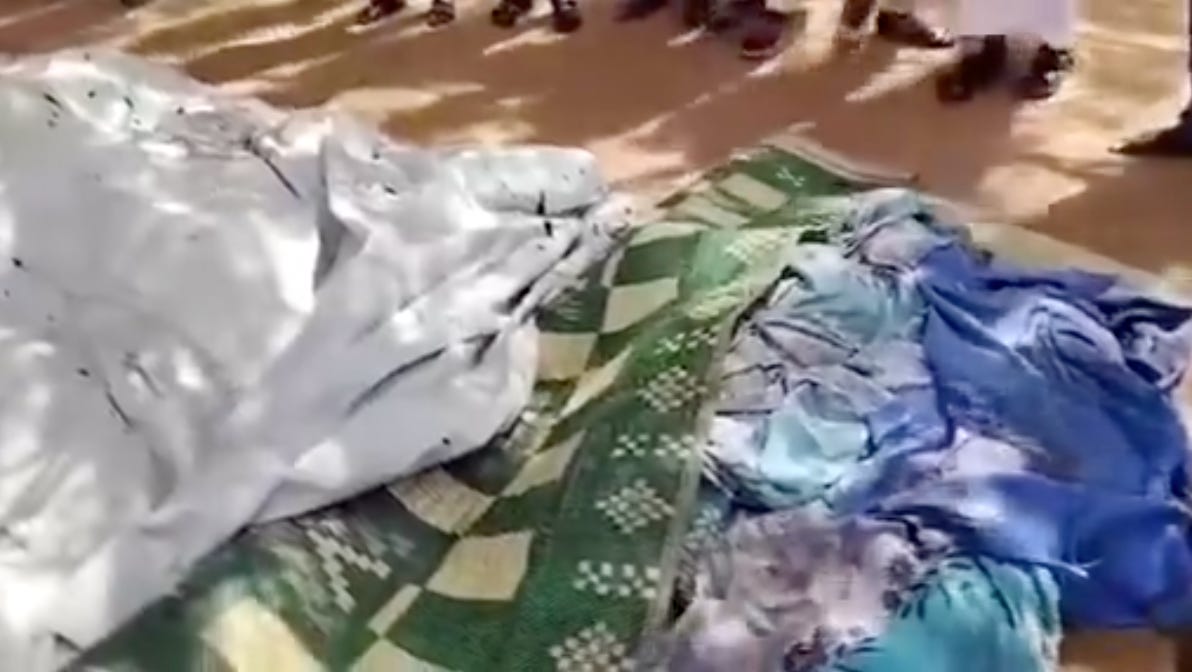
The strike occurred around 11:00 a.m. local time inside Gbeish’s main commercial market, a densely crowded civilian area under Rapid Support Forces (RSF) control. Footage geolocated by Sudan War Monitor to the central market, here 12° 9’11.07”N, 27°19’55.22”E showed bodies scattered across the marketplace.
⚠️ Warning: Graphic Content ⚠️
In this video, bodies are seen on the ground in the aftermath of the attack. Sudan War Monitor geolocated the footage to: 12° 9’11.07”N, 27°19’55.22”E.
Witness accounts indicate the strike initially targeted an RSF vehicle moving near the market before a second munition struck a crowded restaurant identified by local sources as Wad al-Faki restaurant, where civilians had gathered for breakfast during peak market activity.
Local medical personnel said the wounded were evacuated to Gbeish Hospital, which has struggled with shortages of medicine, surgical supplies, and staff after three years of war-related disruption across the country.


The Sudanese military did not issue any statement regarding the incident.
The RSF itself also did not release an official statement. However, the Sudan Founding Alliance, commonly known as Tasis, a coalition of armed and political groups led by the RSF, accused the SAF of carrying out the strike and described it as part of a broader campaign targeting civilian infrastructure in areas outside army control.
In a statement, Tasis spokesperson Ahmed Taqaddus Al-Sann said the strike killed 28 civilians and wounded 41 others, including women and children, while damaging large sections of the market and surrounding civilian property.
The coalition said Gbeish lies far from active frontline operations and argued the strike reflected what it described as systematic SAF attacks on markets, civilian gatherings, and infrastructure using drones and warplanes.
“This morning, a drone aircraft belonging to the authority of the terrorist Muslim Brotherhood group in Port Sudan targeted the market of Gbeish city in West Kordofan State, resulting in the killing of 28 civilians and the injury of 41 others, including women and children, in addition to the destruction of a large part of the market and damage to numerous civilian facilities and citizens’ properties.”
“The Sudan Founding Alliance (Tasis) condemns the conduct of the authority of the terrorist Muslim Brotherhood group in Port Sudan, which has adopted a policy of targeting civilians, markets, human gatherings, civilian facilities, and infrastructure using drone aircraft. This has led to the killing and displacement of civilians, worsened their humanitarian conditions, and increased their suffering, noting that Gbeish city is located far from combat zones and frontlines.”
“This conduct, and the systematic targeting of civilians and the use of civilians as a tool of war by the authority of the terrorist Muslim Brotherhood group in Port Sudan, constitutes a flagrant violation of the rules of international humanitarian law and the rules of engagement, particularly the principle of distinction between military targets and civilian objects,” the statement reads.
Two Darfur-based rights organizations separately condemned the strike, describing it as a direct attack on civilians inside a crowded marketplace. Both groups said women, elderly civilians, and children were among the casualties.
The incident adds to a growing pattern of SAF aerial bombardments targeting towns and markets in RSF-controlled regions of Darfur and Kordofan since the war began in April 2023.
Over the past three years, Sudan War Monitor has documented repeated SAF airstrikes on marketplaces in Al-Koma, Melit, Hamrat al-Sheikh, Nyala, Koma, and other localities located far from active combat zones. In many cases, the attacks occurred during peak commercial hours and resulted in high civilian casualties.
The SAF’s expanding reliance on drones and airpower comes as the military continues to face operational difficulties on the ground across western Sudan. While the army retains air superiority, RSF forces continue to dominate large sections of Darfur and parts of Kordofan, including strategic rural corridors and transport routes.
Gbeish itself sits inside a broader RSF-controlled belt stretching across large areas of West Kordofan and neighboring Darfur regions. The area has increasingly come within range of SAF drone operations launched from military positions further east and north.
The SAF air campaign increasingly serves both tactical and political objectives. Beyond targeting RSF logistical movement, repeated strikes on commercial centers appear aimed at disrupting civilian life and undermining economic activity in territories administered or influenced by the RSF.
The attacks also carry a strong ethnic dimension.
Much of Darfur and western Kordofan is inhabited by Arab tribal communities historically linked — politically, socially, or militarily — to the RSF network that emerged from the Janjaweed militias of the Darfur conflict. Critics of the SAF and allied Islamist factions accuse the military of increasingly treating these regions as hostile social environments supporting the RSF insurgency.
The SAF has consistently denied deliberately targeting civilians and maintains that its operations focus on legitimate military objectives associated with RSF deployments.
However, recurring strikes on markets, restaurants, residential areas, and transport hubs far from active battlefronts have intensified accusations that the military’s aerial campaign is increasingly blurring the distinction between civilian and military targets.
News In Brief:
The RSF on Monday denied reports that Brig. Gen. Al-Fateh Abdullah Idris, widely known as “Abu Lulu,” had been released from detention and redeployed to frontline combat operations in Kordofan, after Reuters reported this week the controversial commander had allegedly returned to the battlefield months after his arrest over atrocities committed during the fall of El Fasher. The report which was widely circulated by international media outlets and rights organizations, cited multiple RSF insiders who claimed Abu Lulu had been quietly freed and sent back to active operations to help boost morale among RSF units engaged in heavy fighting in the Kordofan theater. Abu Lulu, who became internationally notorious after videos emerged showing him executing unarmed civilians during the RSF offensive on El Fasher in 2025, has since been sanctioned by the United Nations, the United States, the European Union, and Britain over alleged war crimes and grave human rights abuses. Rights groups and international investigators have linked him to some of the worst atrocities committed during the RSF capture of the North Darfur capital, where civilians, including displaced persons and non-Arab communities, were systematically targeted amid mass killings, executions, looting, and ethnically charged violence in October.
RSF commander Mohamed Hamdan Dagalo, known as Hemedti, has reportedly issued a death sentence against RSF commander Ali Rizqallah, also known as “Al-Savanna,” following his defection earlier this month to the Sudanese military. The move mirrors a previous death sentence issued by the RSF leadership against commander Nur Al-Guba after he defected to the SAF last month. Such measures reflect growing concerns within the RSF leadership over internal fragmentation and battlefield defections as the war enters its third year. Within the paramilitary movement, defections are increasingly framed not simply as military desertions but as acts of betrayal during wartime, with punitive decrees intended both as retaliation against perceived traitors and as a warning to other commanders and tribal networks inside the organization.
A court specializing in cybercrime and “informatics offenses” in Port Sudan sentenced Sudanese journalist Rishan Oshi to one year in prison and imposed a fine of 10 million Sudanese pounds (roughly $3200) over a Facebook post in which she accused a Sudanese diplomat abroad of financial corruption. The ruling triggered condemnation from Sudanese journalists and press freedom advocates, who argued that publication-related cases should be treated as civil matters rather than criminal offenses carrying prison terms. Oshi, a well-known Sudanese journalist and television commentator, has in recent years emerged as a vocal critic of the Darfur Joint Force allied with the SAF. Last year, she sparked widespread controversy after publicly claiming that some former Darfur rebel leaders aligned with the SAF were primarily seeking financial benefits and political positions in exchange for continuing to fight alongside the army, remarks that drew sharp backlash from armed movement supporters and pro-war political circles.
Both sides continue to commit war crimes and crimes against humanity. The civilian population of Sudan, as in all theatres of war, pay a huge price. The countries that continue supplying money and arms to either side must desist, immediately and for both sides in this long running terrible war, be brought together ro work out a permanent peace. Do it Now for the sake of the Sudanese People.