
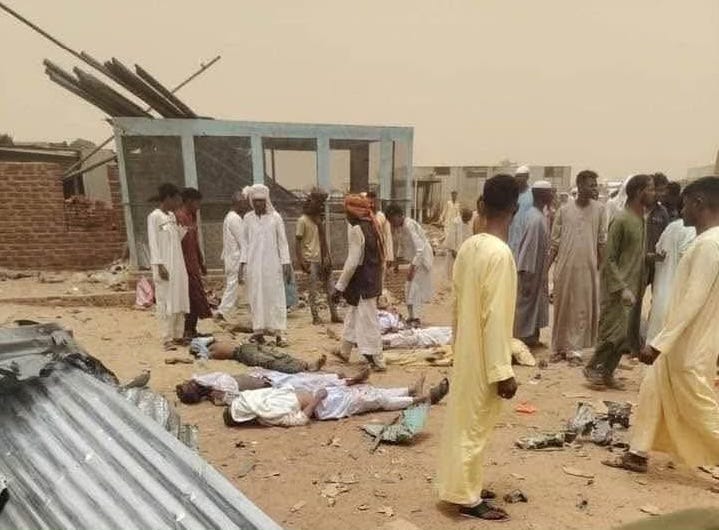
A drone strike on a crowded market in the Abu Zaima area of North Kordofan state killed 11 civilians and wounded dozens on Saturday, June 6, 2026, the Emergency Lawyers group said. No party has claimed responsibility for the attack, which hit an area under Rapid Support Forces (RSF) control that has come under repeated army airstrikes.
Hours later, an RSF drone strike on a fuel station in the army-held state capital El Obeid killed nine people, according to civilian sources.
Emergency Lawyers said the 11 dead and dozens wounded at the Abu Zaima market — in the Hamrat al-Sheikh administrative unit of Jabrat al-Sheikh locality — represented a preliminary toll that was expected to rise.
In a statement on Saturday, the group said the attack came less than a day after similar strikes targeted villages and civilian vehicles in the same area, in what it described as a continuing escalation of attacks on civilians and civilian infrastructure. On Friday, drone strikes hit the villages of Al-Khashkhasha and Al-Baqriyat near Abu Zaima, killing two people and wounding five, and a separate strike on a civilian vehicle killed two more, the group said.
Emergency Lawyers did not identify the party behind the strikes, and neither the army nor the RSF has claimed responsibility. However, the Hamrat al-Sheikh area is held by the RSF and has come under repeated army airstrikes during the war, including a strike in October 2024 that killed some 30 people.
The 11 people killed in the strike on the Abu Zaima market were identified as:
Abdallah Ahmed Masoud
Mustafa Ahmed Masoud
Mohamed Ali Mohamed Gadallah
Kheirallah Gaddal
Bella Koko
Musa Abdallah Bilal
Radwan Mohamed Khalifa
Bar’i Mohamed al-Uheimar
Abdel Wahab Gorn
Abdallah al-Sheikh
Hassan Zakaria
Attack on El Obeid fuel station
In El Obeid, RSF drones launched from the outskirts of the city struck the Al-Mithaq fuel station, located east of the dry port, on Saturday evening.
Civilian sources in the city said the strike killed nine civilians and wounded 15 others. Among the dead was Dr. Nur al-Huda Abdel Jalil Mohamed, a commander in the Special Operations Forces in North Kordofan, who was also the youth secretary of the General Union of the Gawam'a tribe.
The strike caused extensive damage to the station, which caught fire, sending up flames and thick columns of smoke and spreading panic among residents living nearby. Accounts of the station’s ownership differed. Some civilian sources said it belonged to a resident of El Obeid, while RSF sources claimed it belonged to what they called “the Muslim Brotherhood army,” saying the RSF had been closely tracking fuel stockpiles in the city ahead of the rainy season, when supply routes are often cut.
Meanwhile, in a press statement, the command of the army’s 5th Infantry Division (al-Hajjana) said its ground-based air defenses had repelled a drone attack on the division on Saturday morning, June 6, shooting down two drones before they reached their targets.
Two residents killed in Al Khowai, W. Kordofan
In neighboring West Kordofan state, a group of gunmen riding motorcycles and wearing RSF uniforms shot dead a man in the village of Karnaka, in the rural Al Khowai area of Al Khowai locality, on Saturday afternoon, June 6.
Sources in the town of Al Khowai told Sudan War Monitor that men affiliated with the RSF militia carry out daily roadblocks, stopping residents and robbing them of money and belongings at gunpoint, and open fire on anyone who refuses to hand over their possessions. They identified the victim as Mohamed al-Habib Adam.
On Thursday, June 4, 2026, the Dar Hamar Emergency Room said the RSF militia had killed Daw al-Beit Abdallah Bashir in the village of Shalouta, also in rural Al Khowai. The group said men on motorcycles intercepted the victim and attempted to rob him at gunpoint. When he refused to hand over his belongings, they shot him on the spot before fleeing to an unknown location.
Sudan War Monitor is a reader-funded, independent news outlet. Please consider becoming a paid subscriber to fund reporting & analysis of a conflict that is widely ignored, underreported, and misunderstood.