
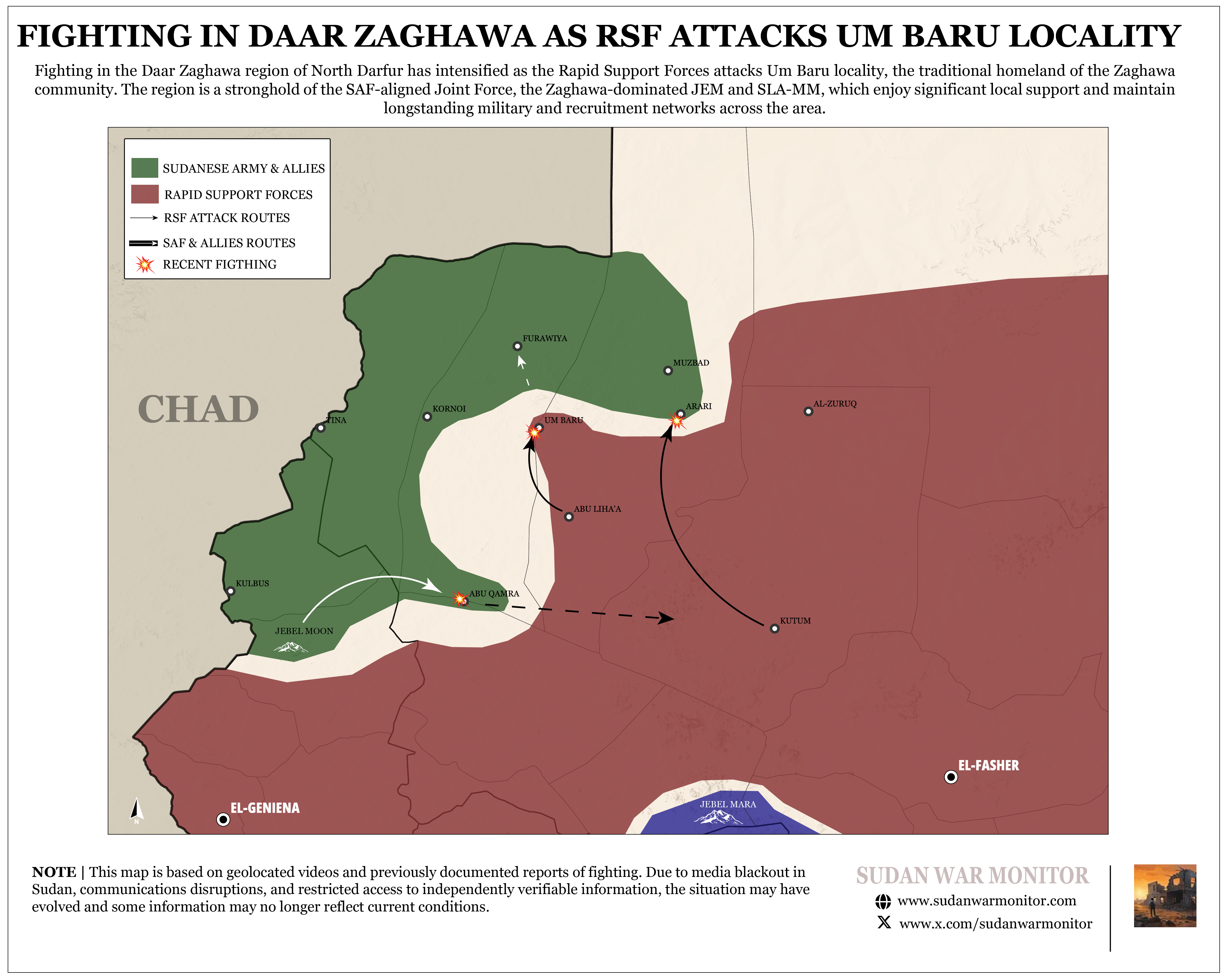
Fighting has intensified in the Daar Zaghawa region of North Darfur after the Rapid Support Forces (RSF) launched coordinated attacks on Um Baru locality, opening a new front in one of the last remaining areas of Darfur still outside the paramilitary group’s control.
Videos reviewed and geolocated by Sudan War Monitor show that RSF fighters entered Um Baru town on Wednesday afternoon following an advance from Abu Liha’a, a town located south of Um Baru. The footage indicates that the paramilitary succeeded in capturing the town, dealing another setback to the Sudanese Armed Forces (SAF)-aligned Joint Force coalition months after the fall of El Fasher.
The fighting also spread eastward toward Arari village in eastern Um Baru locality, where another RSF column advanced from the direction of Kutum. According to local sources and video evidence reviewed by Sudan War Monitor, the assault on Arari was repelled by Joint Force fighters.
However, communications disruptions and a near-total network outage in the area have made it impossible to independently establish the full extent of the fighting or determine whether the frontlines have since shifted.
No official statements regarding the latest clashes had been issued by either the RSF or the Sudanese Armed Forces at the time of publication.
The RSF has attacked Tina, Kornoi and Um Baru localities on several occasions since the fall of El Fasher, seeking to break the last remaining Joint Force enclave in Darfur. Despite these repeated offensives, the paramilitary group has failed to establish lasting control over the Daar Zaghawa region, where strong local support networks and difficult terrain have enabled the Joint Force to retain its foothold.
One RSF fighter appearing in a video circulated on social media claimed that the force had reached Furawiya, a town located roughly 40 kilometers north of Um Baru, but is located in Kornoi locality.
Sudan War Monitor, however, geolocated the footage to the southern outskirts of Um Baru town (here: 15° 0’10.68”N 23°43’48.30”E), just to the southeast of a former UNAMID compound indicating no evidence of the claim that the RSF might have gone as far as Furawiya.
Both sides have increasingly used such tactics during the war in an effort to shape perceptions of battlefield developments. Owing to the communications blackout in northern Darfur, many claims made by combatants cannot be independently verified in real time.
Sudan War Monitor has therefore relied extensively on open-source investigations, including the geolocation of videos, satellite imagery and other digital evidence, to verify battlefield developments and assess competing claims.
The latest assault on Um Baru nevertheless underscores that the RSF still regards the region as an unfinished front in its campaign to consolidate control over Darfur.
The area encompassing Um Baru, Kornoi and Tina localities in North Darfur, together with neighboring Kulbus locality in West Darfur, constitutes the last significant territory in Darfur still held by the Joint Force and other SAF-aligned forces.
Joint Force Counterattack
While the RSF was pushing northward into Um Baru locality, the Joint Force launched an operation of its own, attacking and capturing Abu Qumra, a town in Kornoi locality near the border with Al Serief locality.
Videos reviewed and geolocated by Sudan War Monitor show Joint Force fighters inside Abu Qumra, apparently having entered the area from the direction of Jebel Moon—also known as Jebel Misseriya—in neighboring West Darfur State. The operation appeared intended to outflank the RSF by striking its rear positions rather than confronting the advancing force around Um Baru directly.
In one video filmed inside Abu Qumra market (here: 14°19'19.05"N 23°24'20.95"E), a fighter stated that the footage was recorded on June 27, 2026, and declared that “there is no Janjaweed in the area,” using a term commonly employed by Darfur’s non-Arab communities to describe the RSF and the Arab militias from which it emerged.
The footage suggests that the Joint Force succeeded in taking control of Abu Qumra, although it remains unclear how long it retained its hold over the area. The operation recalls earlier Joint Force tactics in North Darfur, where its fighters relied heavily on mobility, surprise attacks and deep raids into RSF-held territory.
Unlike the Sudanese military, whose operations generally depend on fixed defensive positions and conventional formations, the Joint Force inherited many of its military doctrines from two decades of insurgency against the government of Omar al-Bashir. Its fighters are accustomed to maneuver warfare across the deserts of Darfur and often seek to compensate for numerical disadvantages through ambushes, rapid offensives and attacks on enemy supply lines.
The latest clashes, however, also underscore the growing pressures facing the coalition as it attempts to defend its remaining strongholds in Darfur while simultaneously participating in military operations on other fronts.
Background
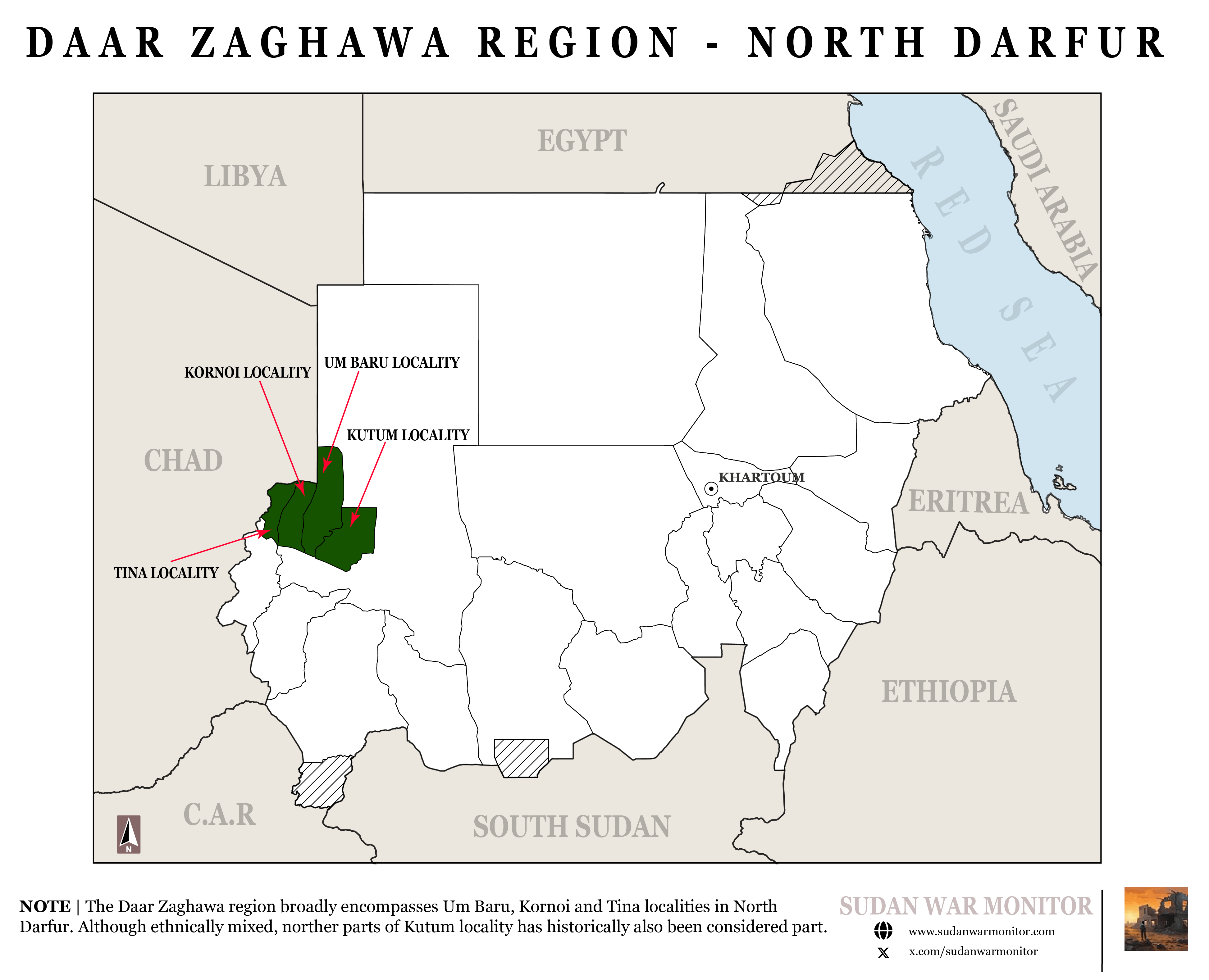
Daar Zaghawa occupies a strategic position along Sudan’s borders with Chad and Libya and has long served as a recruitment base, logistical hub and sanctuary for Darfur’s armed movements.
The region is populated overwhelmingly by members of the Zaghawa community, many of whom have historical ties to the Justice and Equality Movement (JEM) and the Sudan Liberation Army faction led by Darfur Governor Minni Arko Minnawi.
The area’s geography has also made it difficult to conquer. Sparse settlements, vast desert plains and cross-border ethnic networks have historically allowed Zaghawa armed groups to regroup and sustain military campaigns even after suffering setbacks elsewhere.
The RSF’s push into Um Baru therefore carries both military and symbolic significance. Since capturing El Fasher in October last year, the paramilitary group has consolidated its control over much of Darfur, including all five state capitals.
However, the persistence of Joint Force control in the west northern localities has remained a challenge to the RSF’s claims of complete dominance over the region. The latest fighting suggests the RSF is once again attempting to eliminate the remaining pockets of organized resistance in Darfur.
Videos
RSF soldiers in this videos appears in Um Baru, east of the former UNAMID base, here: 15° 0’19.98”N 23°43’11.48”E.
RSF soldiers seen driving through Um Baru market, here: 15° 1’24.90”N 23°42’16.34”E.
Elements of trhe Joint Force at Abu Qumra near network tower, here: 14°19’17.04”N 23°24’27.39”E.