

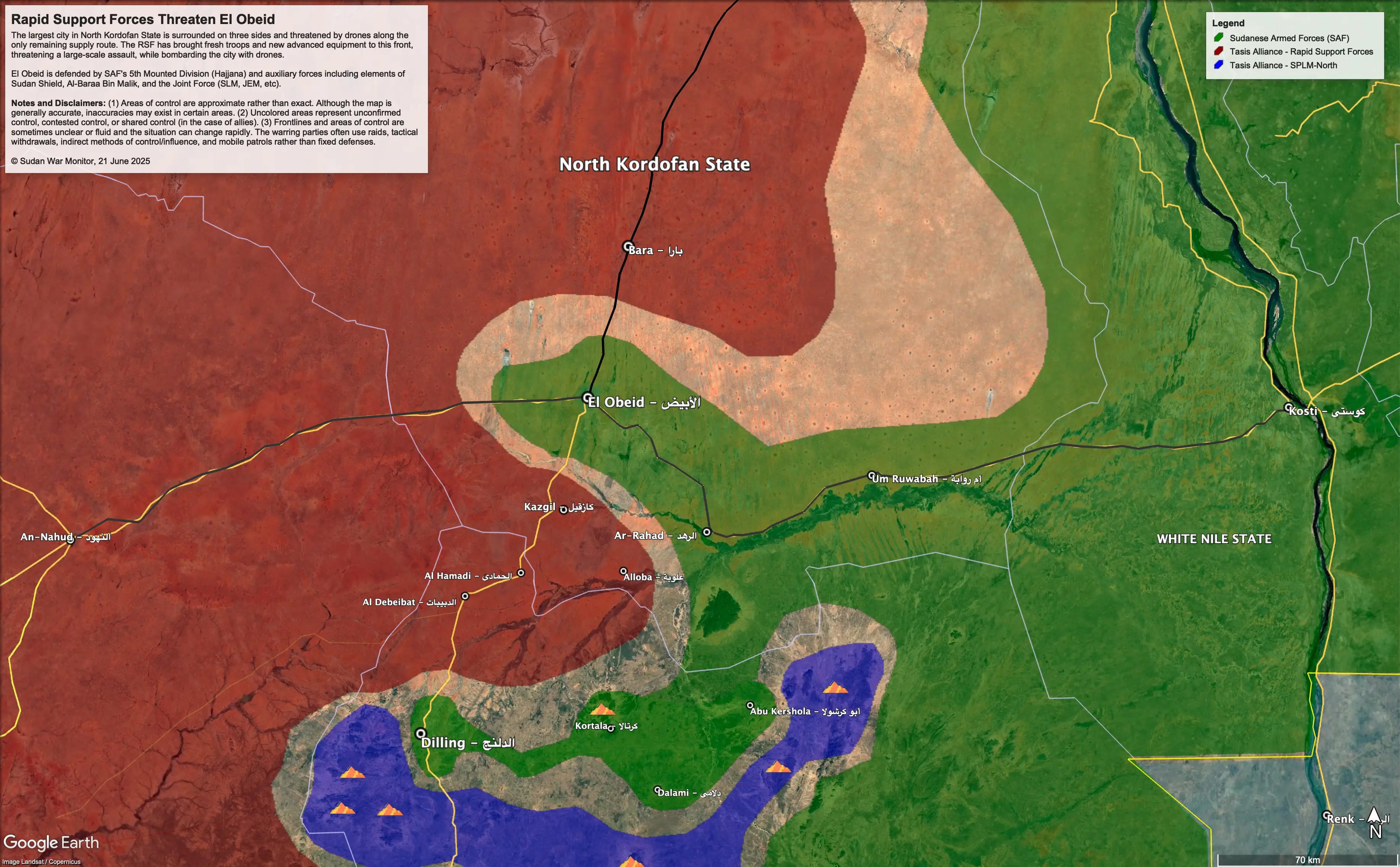
Fears are growing that the Rapid Support Forces (RSF) are preparing a major assault on El Obeid after weeks of drone attacks on the city and military reinforcements moving into surrounding areas.
The city has remained under Sudanese Armed Forces (SAF) control since the outbreak of war in April 2023, but suffered RSF incursions in 2023 and 2024. It is one of the army’s most important strongholds in western Sudan and serves as a gateway to Darfur, Kordofan, and central Sudan.
The latest attacks have targeted fuel infrastructure, commercial areas, and neighborhoods, raising concerns that the RSF may be seeking to weaken the city before launching a broader ground operation. Additionally, new combat groups have arrived in rural areas around the city, including some with newly imported armored vehicles.
The city itself has been heavily fortified. Extensive trench systems, which are visible from satellite imagery, have been dug around much of El Obeid’s perimeter, while SAF-allied Joint Force auxiliaries have conducted mobile patrols out of the city, attempting to keep the RSF from encroaching too close.
Sudan War Monitor geolocated two recent videos showing the aftermath of separate drone attacks inside the city. One shows the aftermath of a strike on a fuel station located outside El Obeid at coordinates 13°10’39.39”N, 30°9’42.01”E. Civilian sources said nine people were killed. The footage shows a burning fuel depot and extensive damage to the station.
A second video shows destruction at a crowded market elsewhere in the city.
The United Nations, several Western governments, and humanitarian organizations have expressed concern over the military escalation around El Obeid. In a statement through spokesman Stéphane Dujarric, UN Secretary-General António Guterres said he was “particularly alarmed by reports of the deployment, by the Rapid Support Forces, of substantial military reinforcements around El Obeid which may indicate an imminent ground offensive on the city, potentially placing yet another major population centre in Sudan at grave risk of large-scale violence.”
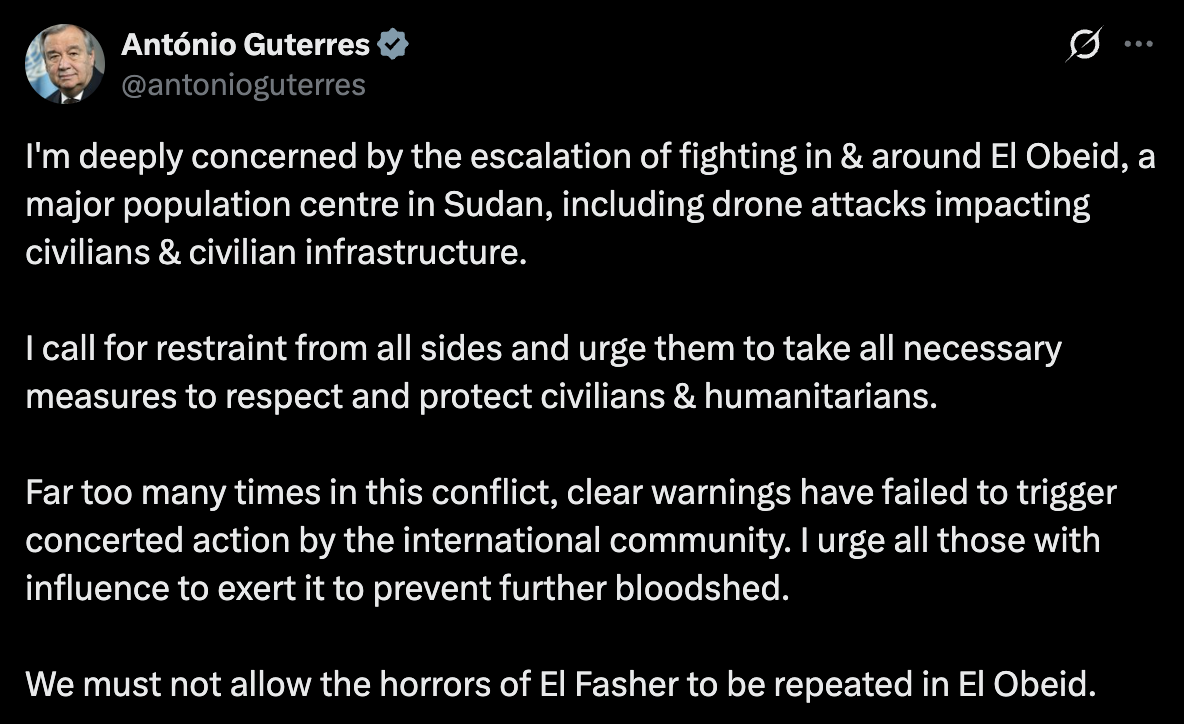
The Secretary-General called for restraint from all parties, adding:
“Far too many times in this conflict, clear warnings have failed to trigger concerted action by the international community. The Secretary-General urges all those with influence over the parties to exert it to prevent further bloodshed. We must not allow the horrors of El Fasher to be repeated in El Obeid,” the statement said.
In a related development, the Secretary-General’s Envoy for Sudan, Pekka Haavisto, spoke by phone to RSF Commander-in-Chief Mohamed Dagalo, reportedly urging him to ensure civilian protection, humanitarian access, and the safe movement of civilians.
According to a statement issued by Dagalo’s press team, the RSF leader affirmed his administration’s commitment to protecting civilians, claiming that his forces will abide by the provisions of international humanitarian law and the Geneva Conventions regarding codes of conduct and rules of engagement during military operations.
He also committed to opening safe corridors for civilians to leave combat zones freely and securely (see also: “No Exit from El Fasher”). At the same time, Dagalo warned against the dangers of using civilians as human shields or attempting to recruit and drag them into the conflict, accusing groups he described as “Muslim Brotherhood militias and mercenaries” of launching attacks on villages and residential areas surrounding El Obeid.
Separately, the UN Human Rights Office in Geneva and the UN High Commissioner for Human Rights Volker Türk warned of the potential for further atrocities if the city is attacked.
Türk warned that an assault on El Obeid could have consequences reminiscent of the atrocities committed in El Fasher and Zamzam IDP camp in North Darfur last year, where civilians bore the brunt of the fighting. He urged immediate action to prevent a repeat of those events as military tensions continue to rise around the city.
“Given the patterns of serious violations of international law documented by the UN Human Rights Office during RSF offensives on El Fasher and Zamzam IDP camp last year, the risk of summary executions, abduction, arbitrary detention and other violence against civilians is high.”
“The ever-increasing use of drones to conduct airstrikes is having a further devastating impact on civilians and civilian infrastructure in Kordofan. Over the past two weeks, there have been dozens of drone strikes on El Obeid, particularly targeting fuel stations and trucks, and leading to loss of civilian lives. This has had a serious impact on civilian access to basic services.”
Türk called for deescalation, saying, “The people of Sudan need peace – urgent measures must be taken to protect civilians and prevent further atrocities, including sexual violence, as well as further displacement and civilian suffering.”
Background of the Siege
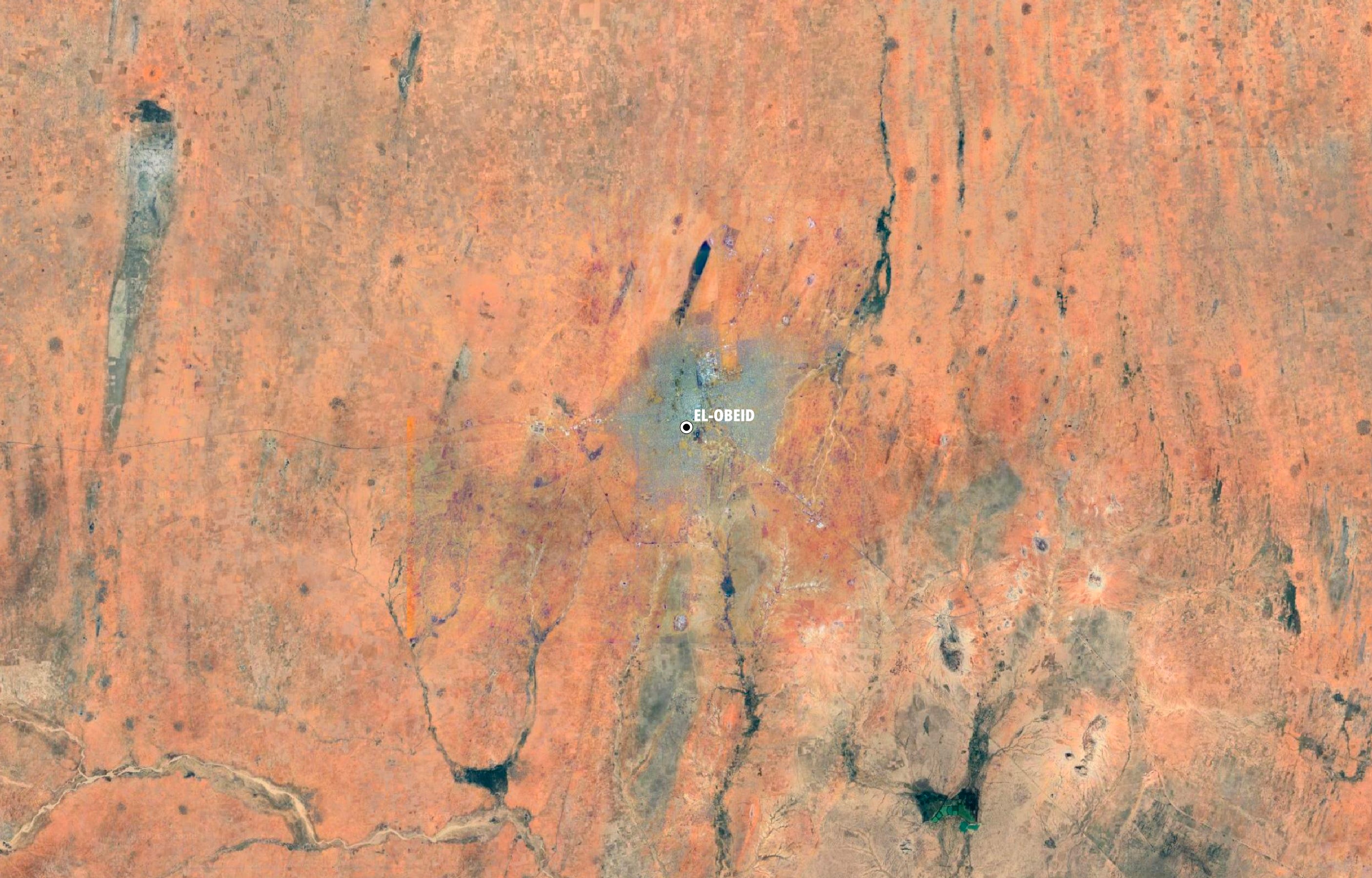
El Obeid has a population of about 500,000 and is a major commercial hub and crossroads connecting Kordofan, Darfur, White Nile, and the capital region. It hosts the Sudanese army’s 5th Infantry Division, known locally as “Al-Hajjana,” which historically meant the “Camel Corps” — though the division now fights in combat vehicles and from fixed defensive positions.
Early in the war (2023-2024), the RSF succeeded in isolating El Obeid from other parts of Sudan, seizing roads and neighboring towns and cities. At the same time, the RSF bypassed the city rather than making a serious effort to capture it, since Khartoum was their priority; they established key desert supply routes between Khartoum and Darfur, along which fighters, supplies, weapons, and looted goods traveled.
Initial efforts by the SAF to relieve the siege of El Obeid failed in 2024, until after the fall of Khartoum in early 2025. At that point, RSF morale and logistics broke down, causing a rout across large parts of Kordofan. This allowed SAF to reopen the road to El Obeid and send supplies and reinforcements. In late 2025, the SAF even pushed west toward Al-Khowai in West Kordofan, north toward Bara, and south toward Al-Debeibat.

But the RSF in the meantime consolidated their control over several besieged towns and cities in West Kordofan and North Darfur (An-Nahud in May 2025, El Fasher in October 2025, Babanusa in December 2025, etc.), freeing up thousands of troops for deployment in South and North Kordofan.
In recent months, SAF lost most of the ground it had gained in 2025, retreating back into El Obeid. Apart from occasional incursions toward outlying towns, it focused its efforts on securing El Obeid and the key east-west road linking Kordofan to the Nile Valley.
Earlier this year, Sudan War Monitor documented how RSF forces expanded around Bara, approximately 50 kilometers north of El Obeid. The town sits along the Inqaz al-Gharbi highway, Sudan’s most important road connecting North Kordofan with Khartoum State.
RSF commanders have, on several occasions, openly described efforts to restrict commercial traffic moving toward El Obeid and disrupt supply routes linking it with northern Sudan. The strategy was aimed not only at isolating military forces inside the city but also at weakening the local economy.
Sudan War Monitor is a reader-supported publication. If you found this investigation valuable, consider becoming a paid subscriber to support our continued reporting on Sudan's war.
Military Importance of El Obeid
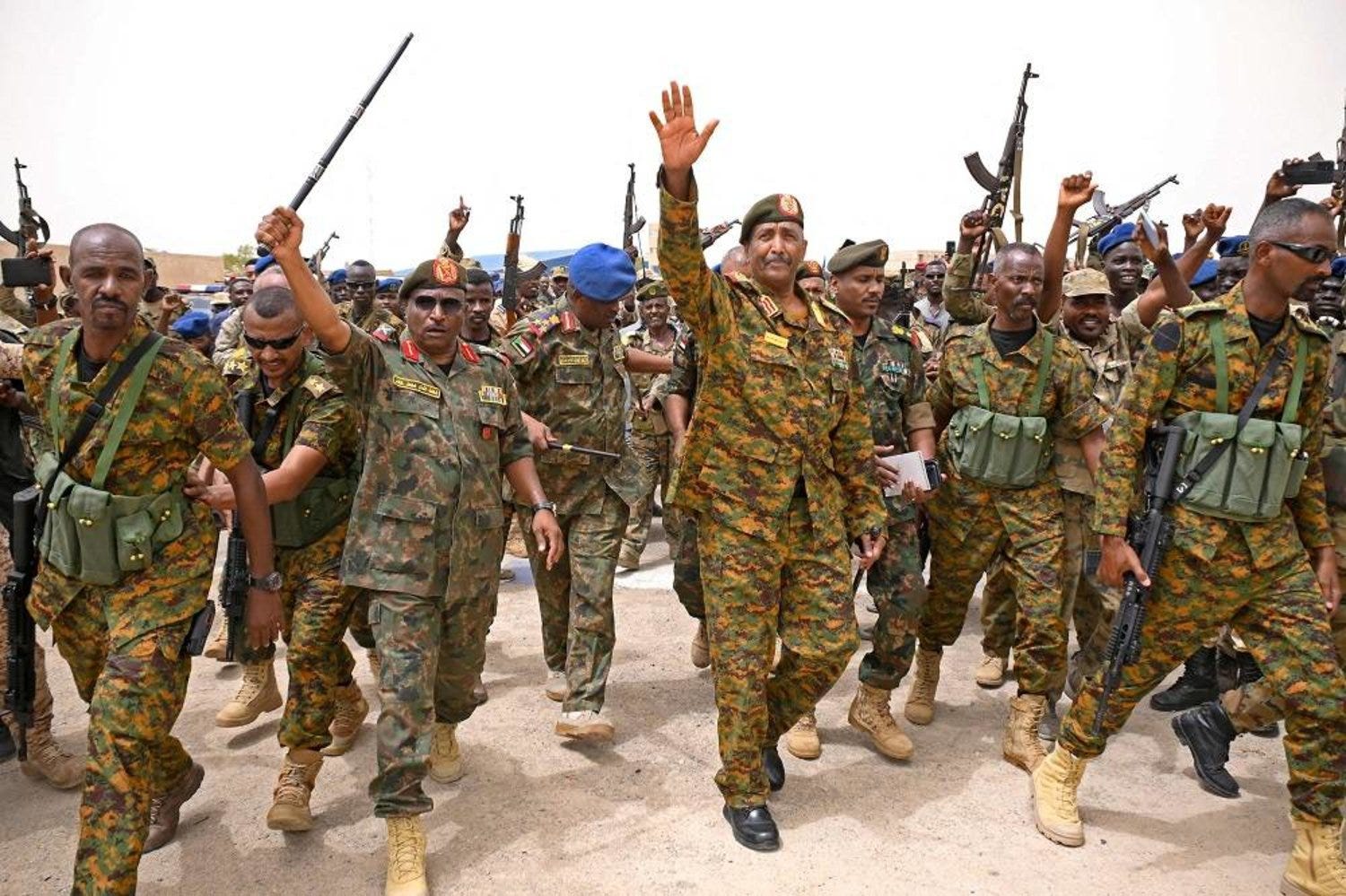
If the city of El Obeid were to fall to the RSF, it would reshape the military balance across Kordofan. SAF-controlled garrisons in Dilling, Kadugli, Kortala, and elsewhere would be at greater risk. Additionally, the RSF would again be within striking distance of White Nile State and the capital region.
The humanitarian consequences would also be dire, since El Obeid’s population is large and it also hosts thousands of people already dispalced by fighting elsewhere in Sudan’s western regions.
Politically, an RSF attack on El Obeid — even if it failed or succeeded only in part — would undermine the Sudanese Armed Forces’ public portrayal of a triumphal progress in its ongoing war. It would be the first major city attacked by the RSF outside the paramilitary’s western homelands since 2024.
The fall of Khartoum in 2025, along with the temporary RSF retreat from much of North Kordofan that year, was seen by many Sudanese as the decisive turning point that heralded the total defeat of the rebel group. A major attack on El Obeid would challenge that narrative, signalling the RSF’s resurgence and potentially its ability to threaten central Sudan again.
The military has consistenly rejected international mediation and negotiations with the RSF, claiming that victory is near. Army leaders, who took power in a coup in 2021, characterize the RSF as a barbaric renegade paramilitary that canot be dealt with diplomatically, only by force. The RSF now controls all of West Kordofan and much of North and South Kordofan states, as well as parts of Blue Nile State, together with their ally, the Sudan People’s Liberation Movement (North).
In the video above, RSF fighters are seen on elevated ground northwest of Kazgil, overlooking Jebel Hashab and the approaches to El Obeid along the road linking North and South Kordofan. The footage provides further evidence of RSF activity south of El Obeid as concerns grow over a possible escalation. The RSF, like several armed groups involved in Sudan’s conflict, has faced repeated allegations of recruiting and using child soldiers during the war.
In another video shown below, RSF fighters can be seen moving with dozens of pickup trucks and armored vehicles across the semi-arid terrain of North Kordofan. Several of the vehicles appear to be equipped with heavy weapons. The footage provides further indication of an RSF military presence around El Obeid as fighting and drone attacks continue across the region.
Diplomatic Alarms and Global Relief Mobilization
International concern regarding El Obeid has increased sharply as diplomats draw comparisons with the events that preceded the fall of El Fasher in October 2025.
The European Union warned that “El Obeid must not become another El Fasher” and called on the Rapid Support Forces to immediately halt their assault on El Obeid. Similar concerns have been raised by Western governments, which fear that a major battle for the city could produce another humanitarian catastrophe.
The comparison reflects the experience of El Fasher, where an 18-month siege ended with the collapse of the city’s defenses and widespread atrocities following the RSF takeover.
Sudan War Monitor previously documented how thousands of people were killed during and after the fall of El Fasher. Survivors described executions, attacks on hospitals, killings of detainees, and assaults on civilians attempting to flee. Videos reviewed by Sudan War Monitor at the time showed RSF fighters executing detainees, attacking hospitals, and targeting groups of men fleeing the city.
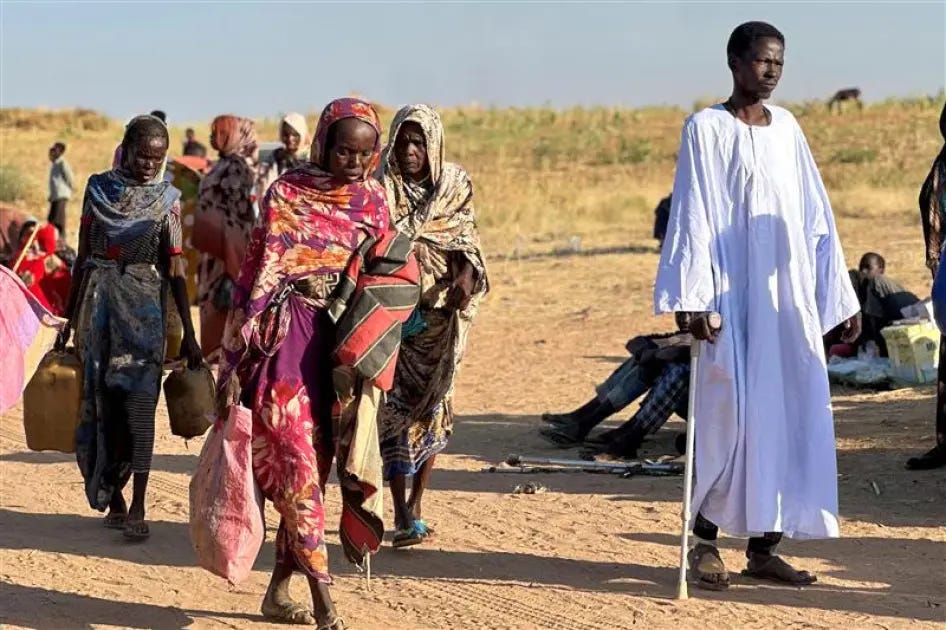
The fall of El Fasher also triggered a mass displacement crisis. Tens of thousands of civilians fled toward Tawila, an area in North Darfur control by neutral factions of former Darfur rebel groups, and other locations across Darfur, arriving wounded, hungry, and traumatized after days of travel.
Those events continue to shape international assessments of risks facing El Obeid. Speaking before the UN Human Rights Council in Geneva on Friday, Norwegian Ambassador Tormod Endresen warned that approximately 500,000 civilians, including more than 100,000 internally displaced persons, could be at risk if fighting reaches the city.
Humanitarian conditions across Greater Kordofan continue to worsen. Aid organizations report difficulties delivering assistance because of insecurity, road restrictions, attacks on fuel infrastructure, and ongoing fighting.
Food prices have risen across much of the region as supply routes become increasingly unreliable. Humanitarian agencies warn that disrupted trade routes and restricted access are worsening food insecurity and increasing the risk of famine in some areas. Many families are reducing meals and selling assets as economic conditions deteriorate.
Shine a Light on Sudan’s Crisis
Sudan War Monitor is dedicated to tracking the world’s largest humanitarian crisis and the conflict that has caused it. We’ve been able to sustain and grow this initiative thanks to a global network of supporters. You can help by upgrading to a paid subscription, which gives you access to subscriber-only extras, as well as our full archive of reporting and analysis.