Heglig Oilfield placed under neutral South Sudan protection
Tripartite agreement with RSF and SAF sees SSPDF deployed to secure strategic oil infrastructure after SAF redeployment
South Sudan army has deployed forces to the Heglig Oilfield under a tripartite security arrangement with the Sudanese Armed Forces (SAF) and the paramilitary Rapid Support Forces (RSF), placing one of the most critical energy nodes in the (north) Sudan–South Sudan borderlands under neutral protection as the war in Sudan continues to reshape regional security dynamics.
The deployment follows the withdrawal of units from SAF’s 90th Brigade of the 22nd Infatry Division from Heglig to Pan Akuach in South Sudan’s Unity State. RSF forces subsequently moved into Heglig without resistance on Monday, prompting Juba to activate the tripartite mechanism to prevent clashes around oil facilities, according to security sources familiar with the arrangement.
Heglig sits within the Muglad Basin, a rift basin containing much of both Sudans’ proven oil reserves and forming the backbone of oil connectivity between the two countries. First developed in 1996 by Arakis Energy and now operated by the Greater Nile Petroleum Operating Company, the field is linked to Khartoum and Port Sudan via the Greater Nile Oil Pipeline.
For South Sudan, Heglig is the gateway through which oil from Unity State’s fields – in Rubkona County (Unity Oilfield) and Koch County (Tharjiath Oilfield) – is transported north for export. Any damage to the facilities or pipeline would be economically catastrophic for Juba, which depends almost entirely on oil revenues, while Sudan would also lose crucial transit and processing fees that have become increasingly important since the outbreak of war.
Speaking to reporters in Juba on Thursday, Information Minister Ateny Wek Ateny said the South Sudan government had reached a tripartite agreement with SAF and the RSF to place Heglig under the control of the South Sudan People’s Defense Forces (SSPDF), South Sudan’s national army, as a neutral force mandated to protect oil infrastructure and workers. He said RSF units would withdraw north of the oil field, without specifying the distance.
“Following recent clashes between the Sudanese Armed Forces (SAF), and the Rapid Support Forces (RSF), these clashes resulted into tactical withdrawal of the SAF forces led by Brigadier-General Tariq Mokhtar of Brigade 90, Division 22, that is based in Babanusa. They withdrew towards the territory of the Republic of South Sudan, the area of Pan Akuach area in Unity State.”
“So the SAF units that entered into the Republic of South Sudan, as required by international law, have surrendered their weapons to the SSPDF, the South Sudan People’s Defense Forces, that were in the area, to protect the oil fields and also protect our international borders.”
“There was no hostility, so the forces that entered into South Sudan are safe and they are now being arranged to be taken back to their country. They have surrendered their weapons as required by international law.”
“So following the development, a tripartite agreement has been reached among the SSPDF, the SAF, and RSF, the three armies in the area…. have agreed, and that agreement has granted the SSPDF primary security responsibility over the Heglig oil fields.”
“His Excellency President Salva Kiir Mayadit, on his side, which the government of South Sudan commend under his leadership, have intervened and have been talking to two sides of the war in Sudan led by General Abdelfattah al-Burhan of the sovereign council of the Sudan, and the other forces, which are the RSF forces, led by General Mohamed Hamdan Daglo.”
“The President talked to them on phone so that they escalate the situation. The RSF forces withdrew northern part of Gilead, so that the Gilead oil area remains under the South Sudan People’s Defense Forces.”
A Unity State–based source familiar with the deployment told Sudan War Monitor that RSF forces are expected to pull back to Suq al-Qaria, about 40 kilometers northwest of Heglig, and to Kharasana, about 50 kilometers north of the oil facilities. The source said the arrangement is intended to create a buffer zone to keep active combat away from production and transit infrastructure and to ensure protection of oil workers.
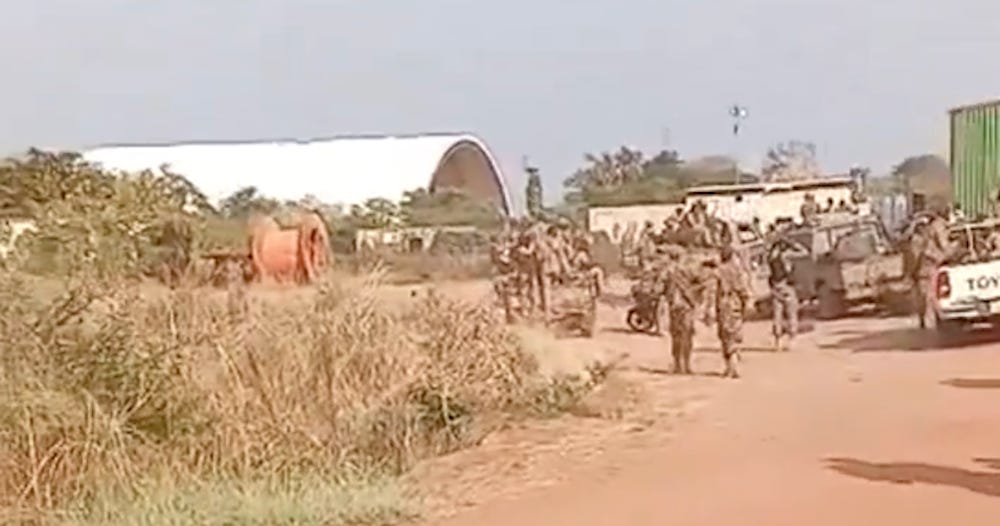
A video filmed by an RSF fighter and reviewed and geolocated by Sudan War Monitor to this location (9°59’50.46”N 29°23’58.62”E) shows a South Sudan army convoy entering the Heglig oil field, marking the start of the SSPDF deployment under the tripartite security arrangement. The footage captures armored vehicles and troop carriers turning right from the main road entering the headquarterts of the 90th infantry brigade.
A separate video, recorded by a South Sudanese army officer, shows the deployed commander, Maj. Gen. Michael Makal Kuol Majak, touring the teh area just south of Heglig shortly after the deployment. In the footage, Makal is seen inspecting positions as part of efforts to assert control and secure the area.
The videos, circulating on social media, provide rare visual confirmation of the SSPDF’s presence at Heglig following the RSF’s entry into the area and the SAF’s Monday withdrawal. Both clips underscore the rapid implementation of the tripartite agreement aimed at preventing clashes around strategic oil infrastructure.
Sudan War Monitor was unable to independently verify the exact dates the videos were filmed, but their emergence aligns with official statements from Juba confirming the deployment of South Sudanese forces to protect the oil fields.
The terms of the agreement, however, remain unclear. It is not known whether the RSF will receive any share of oil revenues or transit fees, which have traditionally been paid by South Sudan to Sudan for use of pipelines and export infrastructure. The absence of publicly defined financial arrangements has raised questions about the durability of the deal and the incentives for all parties to uphold it.
The SSPDF deployment also carries internal political and security implications for South Sudan. Armed groups aligned with the Sudan People’s Liberation Army in Opposition (SPLA-IO) and other militias operate along the border, and South Sudanese fighters have previously been documented fighting alongside RSF units inside Sudan. The neutral role at Heglig risks entangling Juba in Sudan’s conflict while sharpening internal fault lines among armed actors.
Command of the Heglig deployment has been assigned to Maj. Gen. Michael Makal Kuol Majak, a Bul Nuer from Mayom County in Unity State and a former SPLA-IO operations commander during South Sudan’s 2013–2018 civil war. His appointment is sensitive, given his long-standing and uneasy relationship with Gen. Mathew Puljang Top, the commander of SSPDF’s 4th Infantry Division in Bentiu, reflecting broader power rivalries within Unity State’s military establishment.
South Sudan’s involvement comes against the backdrop of unresolved border disputes and fragile bilateral agreements since its secession from Sudan in 2011. Tensions have repeatedly flared over Abyei, Heglig, Kafia Kingi, and sections of the Kiir Adem/Bahr el-Arab corridor, despite cooperation agreements signed in 2012 covering oil transit, security arrangements, and border management. Implementation has often faltered during periods of internal conflict in either country.
While the deployment is not directly linked to South Sudan’s own civil war, the spillover risks are significant. Sudan’s conflict has severely damaged South Sudan’s economy, deepening a fiscal crisis that has left civil servants and soldiers unpaid for more than a year. The resulting strain has heightened the risk of unrest, defections, and localized mutinies—factors that could complicate Juba’s ability to sustain a neutral security role at one of the region’s most sensitive oil chokepoints.


