
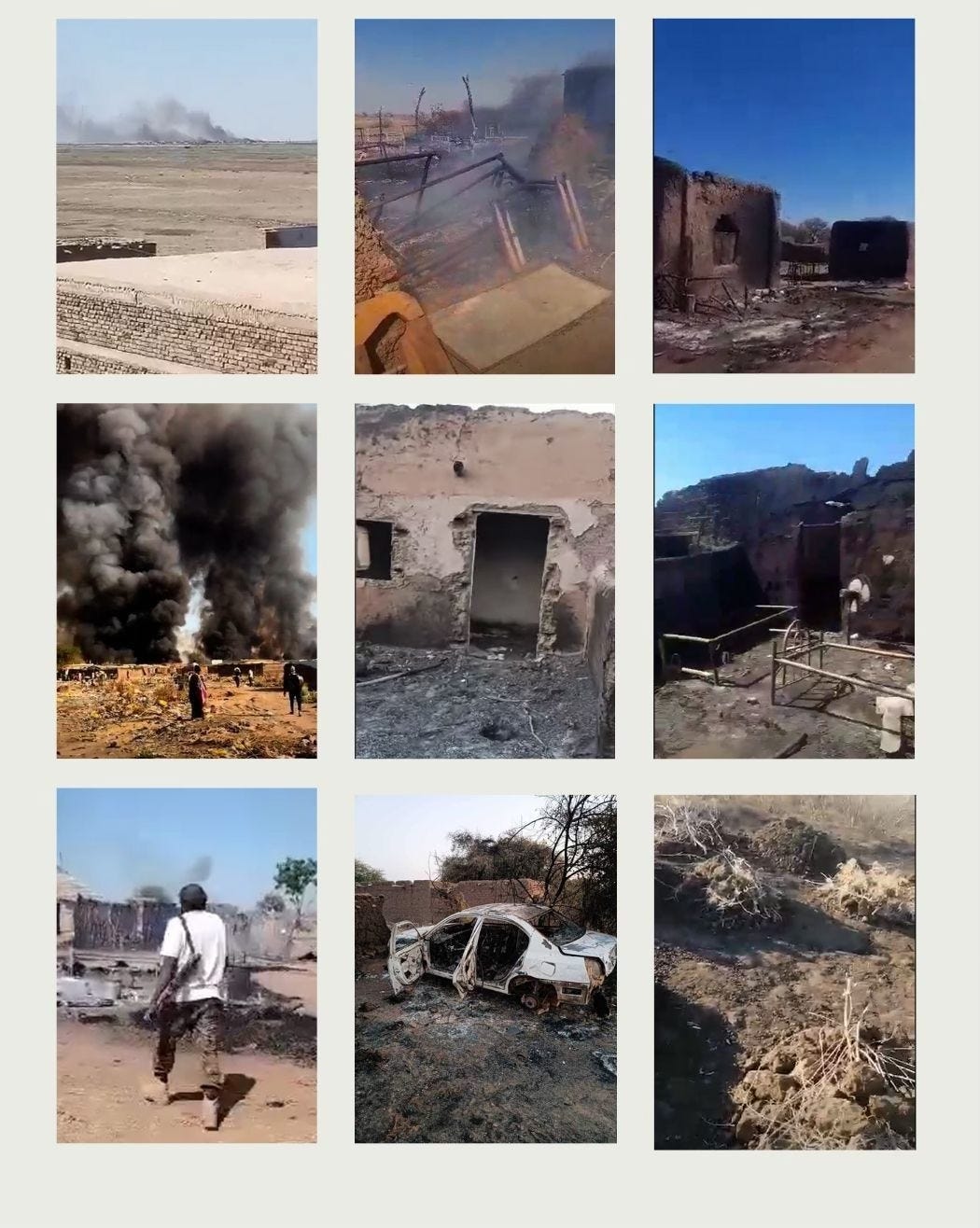
A months-long investigation by Lighthouse Reports, working with Sudan War Monitor, CNN, and Yale’s Humanitarian Research Lab, finds evidence that the Sudanese Armed Forces (SAF) and allied militias systematically targeted Kanabi farming communities in Al-Jazira and Sennar states on ethnic grounds. Based on verified videos, survivor testimonies, whistleblowers, and satellite imagery, the investigation documents mass arrests, mass killings, mass graves, and burned villages during a military offensive in central Sudan.
While Sudan War Monitor previously reported on a wave of attacks against Kanabi and other ethnic minorities around Wad Madani—including Nuba, Darfuris, and South Sudanese—this investigation goes further. It confirms specific incidents and establishes a broader pattern of racially motivated atrocities during SAF’s 2024–2025 military offensive in the Nile Valley.
Sudanese farmers in Jazira state are known as the Kanabi, a farming community largely of non-Arab, Black Sudanese descent. Much of this community is from Darfur and Kordofan and moved to the state in the mid-1900s, drawn by opportunities to work the rich soils of the state, where successive governments invested in massive irrigation projects.
The Kanabi have long been marginalized by the Arab-led state due to their ethnicity and live in villages called kambos. The same ethnic divisions that have plagued Sudan since the state-led Darfur genocide in the early 2000’s have driven the marginalization of the Kanabi for decades.
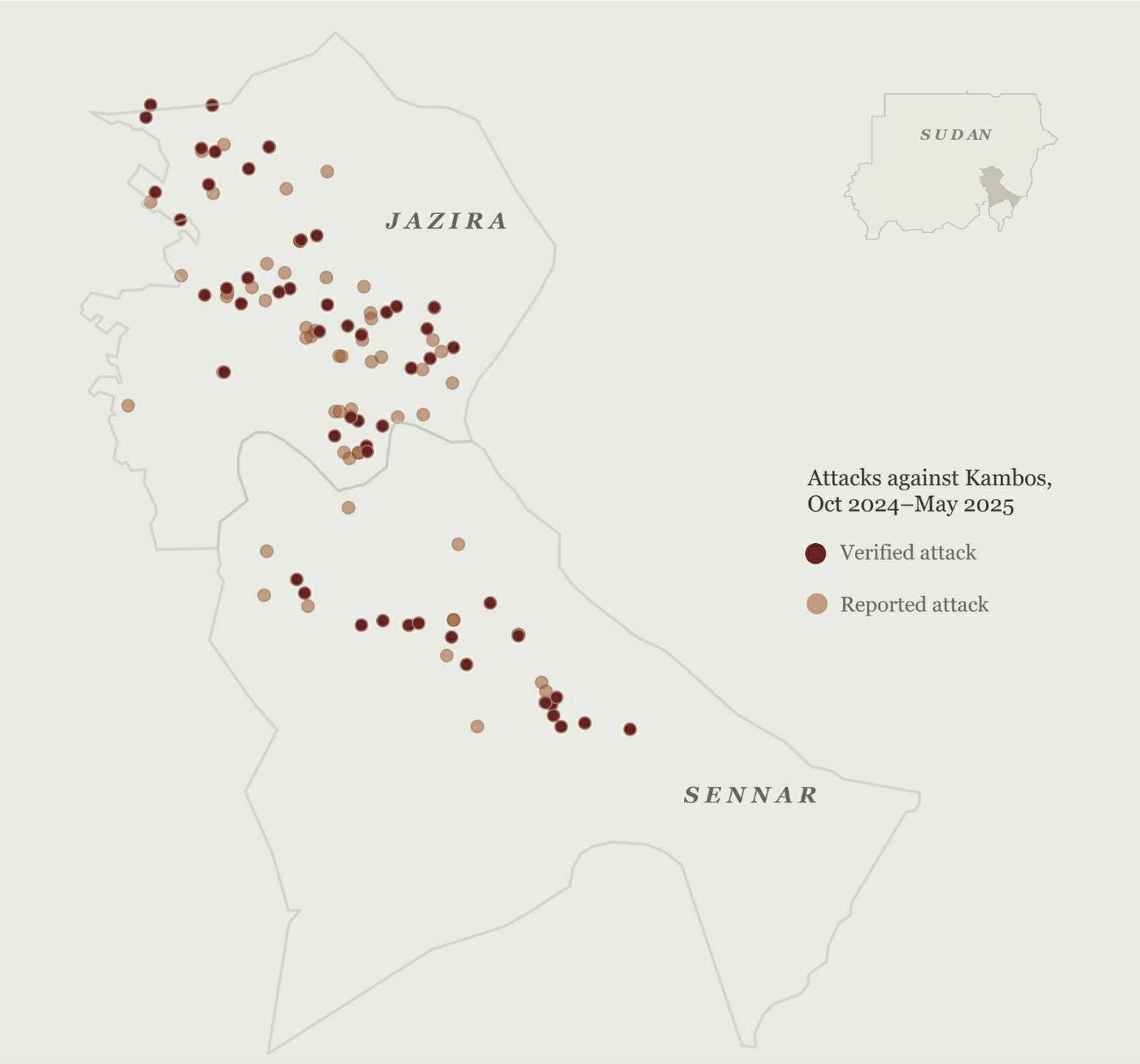
The Kanabi suffered particularly between October 2024 and January 2025, a period coinciding with the arrival of the Sudanese military and allied forces in the area and the withdrawal of the Rapid Support Forces (RSF), which had controlled the region for approximately a year. This timing suggests a retributive motivation, as SAF and its proxies killed ethnic minorities to exact revenge for the RSF’s previous conquest and occupation of the area.
In public discourse at the time on social media, pro-SAF militants cheered these killings and accused Kanabi and other ethnic minorities of collaborating with the RSF. This kind of hate speech persists in Sudan today, albeit now focused mostly on western communities in Darfur and Kordofan. Our investigation therefore raises questions not only about past atrocities but about the significant risks of further ethnic killings as Sudan appears to be continuing down a path of more war, ethnic hatred, and a cycle of revenge.
“Have we not learned our lessons from the past? We cannot stand idly by and allow more Sudanese to become victims of horrific human rights violations. We must act, and this war must stop now.” — UN Human Rights Chief Volker Türk
Recently, UN Human Rights Chief Volker Türk and humanitarian agencies have sounded the alarm over a potential new wave of atrocities, famine, and mass displacement in the Kordofan region. UN officials expressed concerns over the use of hateful and divisive speech that risk fueling the violence. UN officials also reported mass arrests of civilians in Kordofan for allegedly “collaborating” with opposing parties, repeating the pattern of mass arrests documented by our investigation in central Sudan.
Bodies Dumped in Canals and Mass Graves
Video summary of the joint investigation:
Joy Ngozi Ezeilo, a member of the United Nations’ Independent Expert Team on Sudan, told CNN that the attacks against the Kanabi were widespread and indicate “targeted extermination of people” and “ethnic cleansing.”
Massacre sites verified during this investigation included the Wad Madani Bridge (Police Bridge), Al-Muaileeg Bridge, Wad Al-Na’eem area, and Bika Checkpoint. These killings took place in the days after the Sudanese Armed Forces and allied forces entered the city of Wad Madani on 12 January 2025.
A military source who was among the arriving SAF forces — a whistleblower — admitted that SAF and allied forces arrested large numbers of Kanabi residents, killed them, and threw their bodies into the main irrigation canal in the Wad Al-Na’eem area west of Madani, where the investigation team confirmed the existence of a mass grave. A large number of bodies were also removed and buried using excavation machinery (a dredger) in the area of Bika Bridge, known as Bika Checkpoint.
One source stated that more than 500 people from nearby Kanabi settlements—including Kambo Hilla Qasab, Kambo Al-Kamar Al-Ja‘aliyyin, Kambo Abdelaziz, Kambo Wad Maqbul, and Kambo Saad Al-Shafi‘—were arrested on accusations of cooperating with the Rapid Support Forces. Large numbers of them were killed and their bodies thrown into the canal (al-kanar), some of them alive and wounded. The source said: “Their number is large, but I personally saw about 500 people.” The same source added: “Anyone proven to have carried weapons with the Rapid Support Forces was killed immediately, and those who were providing support were taken by the security cell.”
Video: SAF troops detain and beat civilians in Kariba, Al-Jazira State, calling the dogs and accusing them of supporting the ousted RSF. Such severe abuse and torture often proceeded verified mass executions in the region.
In the Bika area, one military commander stated that those who were present in the area were “dealt with” through the security cell, without giving specifics. The same source reported that a large number of civilians who had come out of the city of Wad Madani chanting in support of and welcoming the Sudanese Armed Forces at the moment of their arrival in the city were nonetheless fired upon by soldiers, resulting in many deaths. They were buried in a mass grave near the western-side entrance of the Police Bridge.
The speaker did not disclose the source of the orders to open fire, limiting himself to saying: “Their number was large—hundreds—we did not count them.” He continued: “We buried them in a mass grave together with Rapid Support Forces fighters whom we killed at the same location.”
Video: SAF officers celebrate over the bodies of supposed RSF fighters or ‘collaborators’ near the Police Bridge in Wad Madani. The victims are all wearing civilian clothes and unarmed. Graphic/disturbing content.
Attacks against civilians continued as SAF and allied forces advanced northward to the Hassahissa area, where they launched wide-scale assaults that affected more than 16 Kanabi settlements. Numerous civilians were killed and arrested, their property looted, and what remained was destroyed and burned, including Kombo Al-‘Alaqam, Kombo Nabq, Kombo 17, Kombo Umm ‘Adara, and others. The surviving residents were forced to flee toward the areas of Tabat and Al-Musallamiya, while some local residents continue to demand their permanent removal from the area.
One survivor from Hassahissa stated that mobilized civilians (mustanfirīn) loyal to the army, wearing military uniforms, attacked the Kanabi village where he lived, opened fire indiscriminately on civilians, and arrested at least five people on accusations of cooperating with the RSF. They also looted and burned the village and its property. He said: “They burned six vehicles and nine motorcycles, and cut down trees that were more than 35 years old.”
SAF-allied mustanfirīn from neighboring villages also attacked another Kanabi settlement near Hassahissa on the grounds that it was considered a support base for the Rapid Support Forces—an accusation commonly directed at these population groups. The attacking group opened fire on the village after surrounding it from all sides. One survivor stated that the attackers were chanting against Kanabi residents: “No more Kanabi from today.” He added that the attackers looted civilians’ property without justification, taking valuable items such as televisions and refrigerators.
The same witness explained that the attacking group repeatedly declared that they would no longer allow the Kanabi or citizens originating from western Sudan to remain in Al-Jazira:
“You are gharaba [outsiders/westerners], and the gharaba must be eradicated from Al-Jazira. We don’t want gharaba in Al-Jazira. All gharaba are support bases for the Rapid Support Forces.”
Another witness reported that a civilian named Youssef, who worked at a bakery in the Wad Al-Sayyid area, was arrested by mustanfirīn from the area on the accusation that he had been selling bread to the RSF. He was taken out of the area, and his body was later found floating in the canal.
Video from Al Tabib Abu Khreis, 14 January 2025: SAF-affiliated forces detain and insult a group of civilians. The speaker filming this says the men will be killed while the women spared: “We don’t kill women.”
Another speaker stated that they had repeatedly seen bodies floating in the waters of the canal that passes nearby, which led them to stop using canal water altogether: “We saw two bodies at the nearby culvert, and more than once we saw bodies in the canal, so we stopped drinking the water.”
In eastern Al-Jazira, a senior army officer from the Eastern Axis Operations Room (Al-Fau Axis) reported that a group of civilians from Kombo Taiba and Dar al-Salam had arrived at the operations command headquarters to report killings and ongoing attacks against Kanabi residents in the area by members of the Sudan Shield Forces (a SAF paramilitary). However, officers refused to intervene to protect civilians in those areas.
Visual materials circulated on social media and verified by the investigation team showed a number of fatalities in Kombo Taiba, along with numerous photographs and videos documented from the areas of Dar al-Salam Al-Hadeiba and Al-Sharif Ya‘qub.
The military source in the Al-Fau command room said that killings along the Khartoum–Madani road were so extensive that people became indifferent to what happened to bodies lying on the ground:
“Bodies were spread everywhere along the Madani–Khartoum road. It became an ordinary sight for people. You could see a body being eaten by dogs, and no one had the capacity—or even the moral will—to bury anyone.”
Similarly, eyewitnesses in the Abu ‘Ashar area, near the Chinese Hospital, reported seeing multiple bodies floating in the irrigation canal in the area immediately after the arrival of army forces in the areas. Bodies continued to arrive on a daily basis for nearly a week. Many of them were pulled from the canal and buried in graves near the canal and the railway line.
A report by the United Nations Independent Investigation Committee, published on 5 September 2025, stated that after the Sudanese Armed Forces and their allies regained control of Al-Jazira State in January 2025, acts of retaliation specifically targeted the Kanabi community, accusing them of siding with the Rapid Support Forces. The report documented more than 40 killings during attacks carried out by the Sudan Shield Forces between 9 and 12 January 2025, during which those forces attacked several Kanabi villages, including Taiba and Dar al-Salam Al-Hadeiba. The report described the attackers as using armed vehicles, opening fire and killing unarmed civilians, burning homes, and looting property and livestock. It stated:
“In Taiba alone, at least 26 people were killed, including a child. The perpetrators used racist language against the victims, such as ‘slaves’ and ‘gharaba’ [outsiders]. In Dar al-Salam Al-Hadeiba, at least 16 people were killed, many homes were looted and burned, and some individuals remain missing. Most residents were forced to flee and were prevented from returning to their village.”
Organized and Planned Campaign
The attacks against the Kanabi settlements in Al-Jazeera State and Sennar State occurred with prior planning and coordination, according to sources connected to the security services and the army.
Military sources stated that SAF and the Islamic Movement, which backs the military, worked together to recruit certain ethnic groups by inciting them against the Kanabi, thereby forming local SAF-allied armed groups. These included the Sudan Shield Forces, Asham Sudan Forces, the Liberation of Al-Jazira Forces, and other local groups that were assembled and armed by the Sudanese Armed Forces in preparation for the campaign, in addition to the well-known Al-Baraa bin Malik Battalion, the largest SAF-allied Islamist force.
Weapons were distributed among these militant groups with the purpose of arresting and killing residents of the Kanabi. Sources reported operations centers where killings, torture, and unlawful burials were carried out, including at the Hassahissa Textile Factory, Al-Managil University, and at several government buildings in these areas.
Video: Burned Kanabi settlement of Alqum, Al Jazeera State, January 2025
A military source from Hassahissa said that the instructions to attack the Kanabi settlements came from higher authorities, saying: “This issue of attacking the Kanabi comes from above—from the kizan [a slang term for Islamist politicians].” This contrasts with claims that these killings were merely local events, carried out by rogue local forces.
General Abdel Fattah Al-Burhan, Commander-in-Chief of the Sudanese Armed Forces, visited Wad Madani just days after SAF forces entered the area, while bodies were still floating in canals throughout the region.
One of the leaders of the SAF-affilited mustanfirīn (mobilized civilians) from the Managil area stated that their sons serving in the army coordinated the local operations, noting that most residents of the neighboring Kanabi village were arrested and tortured. He said: “We arrest them and torture them here. Those who die, we bury. Those who are badly injured, we hand over to their families. Those who remain, the army takes them to Al-Managil.”
Certain community leaders assisted SAF in recruiting and organizing the campaign against the Kanabi. For example, Al-Tayyib Al-Imam Joda, emir (leader) of the Nafeidiya clan of the Kawahla tribe from the Sarhan area west of Al-Jazira, spoke on multiple occasions inciting residents against certain tribes. The traditional leader appeared alongside a number of army commanders on several occasions and participated in events held by the Sudan Shield Forces, the SAF paramilitary implicated in attacks in Al-Jazira.
The Sudanese Armed Forces and the General Intelligence Service did not respond to questions regarding the killings. The Sudan Shield Forces stated that their forces did not attack civilians on an ethnic basis and that they adhere to their rules of engagement and to international humanitarian law.
The SAF-allied Joint Force likewise denied responsibility for the killings. In response to a question from Lighthouse Reports during an interview in Port Sudan, Joint Force leader Minni Arko Minawi confirmed that killings had occurred against Kanabi residents adding, however, “When I heard about the events, I immediately ordered my forces to stop the killing.”
Justice and Reconciliation
Residents of Kanabi villages in central Sudan are seeking permission to return to their home areas and resume their lives as before. Others are demanding accountability for the victims who were killed, tortured, and abused at the hands of the aforementioned groups.
General Abdel Fattah Al-Burhan has formed an investigation committee into the events in Kombo Taiba in eastern Al-Jazira. The committee visited the area and spoke with residents who recounted horrific stories and detailed descriptions of the harm they suffered. However, the committee has not announced the results of its work to date.
Local residents reported a lack of confidence in the government investigation committee. Some believe that achieving justice will require alternative mechanisms. One displaced person said: “Justice needs popular mobilization, but it is not easy. These criminals do not want us to return to the area, and nothing has happened for justice until today.” Another interviewee said,
“They tortured my children and killed them. I hope justice will be achieved and that they will be punished.”
A third survivor said that justice is about more than just honesty about the crimes that took place; it also means provision of the necessities of life for the survivors—food, water, and security.
At the community level, a local reconciliation committee had previously been active under the leadership of the lawyer Ali Adam Jibril and others. The committee attempted to mediate between residents and return some displaced people in eastern Al-Jazira to their areas, despite opposition. On 18 August 2025, returnees to the Dar al-Salam Al-Hadeiba area were attacked by gunfire from armed individuals. The committee did not continue its work due to the death of Ali Adam, who had been leading the initiative.
Contraction of Cultivated Areas Due to Violence
Victims and their families seeking to return to their homes in Al-Jazira State face significant economic difficulties, as the war has severely impacted the agricultural sector, the availability of labor, irrigation systems, and markets.
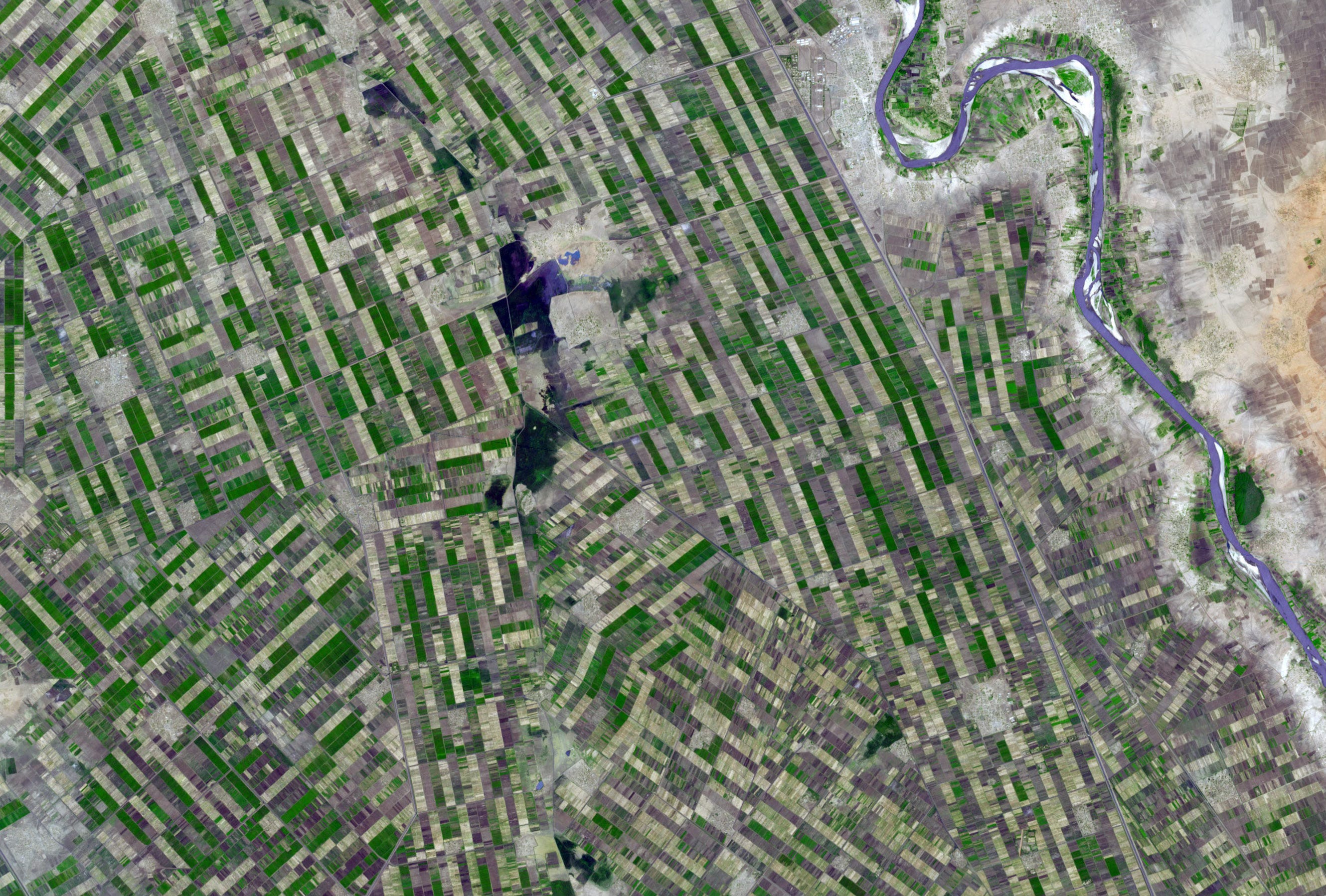
Satellite images captured by Dr. Peter Aldous from the Lighthouse Reports investigation team, using remote-sensing systems via satellite imagery, revealed a noticeable decline in cultivated areas over the past few years. These findings include instances of drought and irregularities in irrigation water flow across wide parts of the project.
A number of farmers interviewed by the Lighthouse Reports and Sudan War Monitor investigation team confirmed that the displacement of Kanabi residents and the prevention of others from accessing farmland, leading to the abandonment of large agricultural areas. Some farmers estimated that more than 30 percent of the cultivated area in southern Al-Jazira has become fallow due to the displacement of those they referred to as seasonal laborers.
Several farmers suggested that there has been a significant contraction of the current winter cropping cycle in the Abu Daqan, Wadi Sha‘ir, Al-Fawwar, and Abdelhakim offices in southern Al-Jazira, as well as in the Al-Kamar Al-Ja‘aliyyin areas. In addition, the offices of Al-Nuweila, Al-Rayan, and Hamadna Allah have experienced a marked decline, alongside widespread neglect and deterioration of internal irrigation canals.
Some farmers attributed the decline in cultivated land to the displacement of Kanabi residents, who had long played a central role in financing and operating farms. These residents often leased land or worked under informal share-cropping and advance-payment arrangements that allowed cultivation to continue. With their forced removal, many landowners say they no longer have the means to farm their land, leading to the abandonment of fields.
Sudan War Monitor Is Reader-Supported
This work is possible thanks to the generous support of subscribers and donors. Sudan War Monitor is independent and does not support any party in the ongoing conflict. We report on conflict events, human rights abuses by all warring parties, peace efforts, and the humanitarian consequences of the war.