
Opposition forces are on the move in South Sudan, striking army outposts across four states and stirring growing unease in the national capital, Juba, where the president sacked top security officials, the deputy governor of a conflict state, and the interior minister in a series of decrees Monday.
Leaders within the armed opposition group SPLM-IO now widely consider the 2018 peace agreement to have collapsed and have declared their intention to march on Juba. Although this objective does not appear to be immediately achievable, SPLM-IO attacks in several regions have displaced thousands of people, emptying towns and villages and scattering frontline army units.
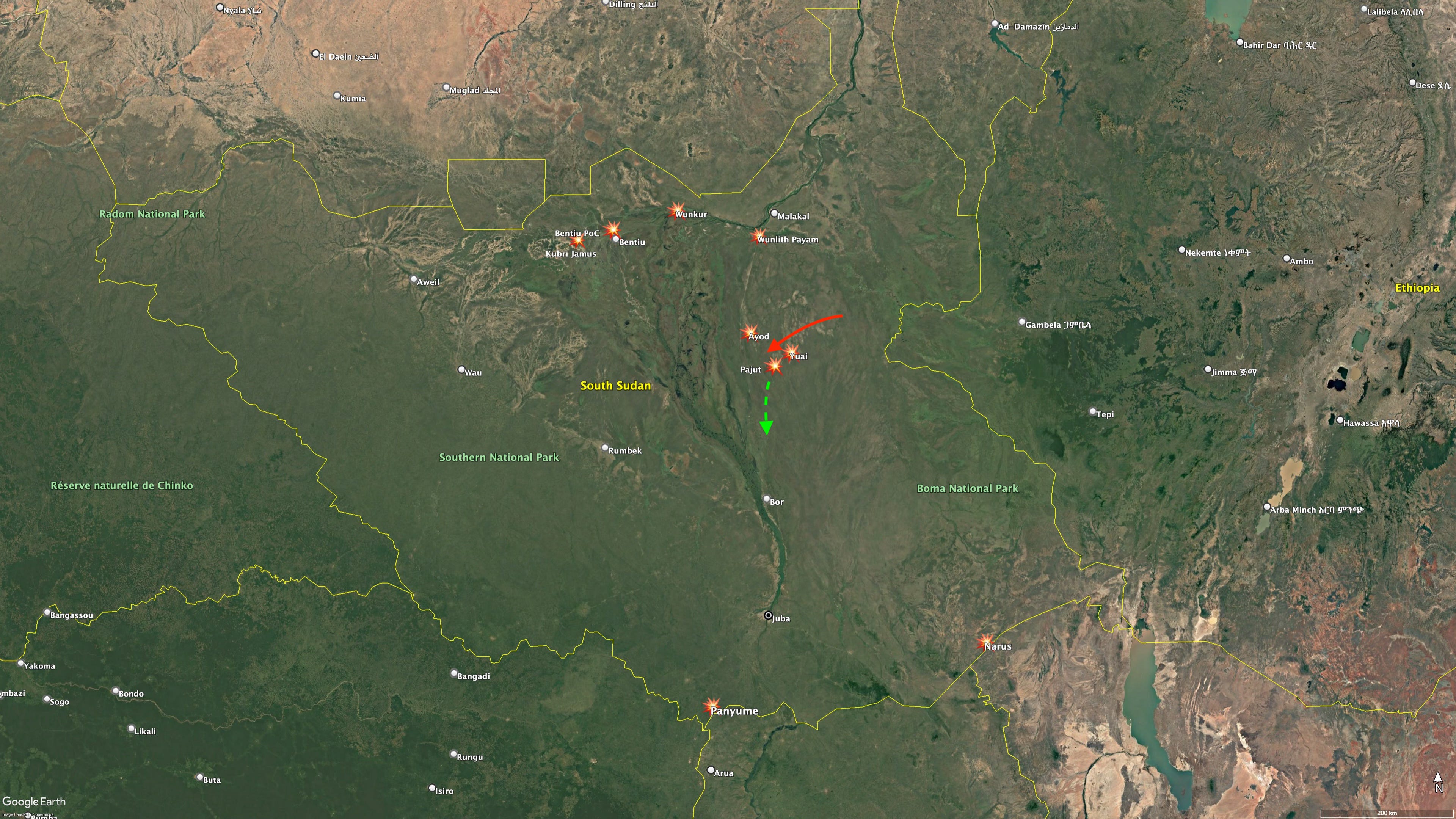
The SPLM-IO overran an army garrison in Yuai, Jonglei State, on 2 January 2026, following fighting in other parts of Jonglei and Upper Nile last year.
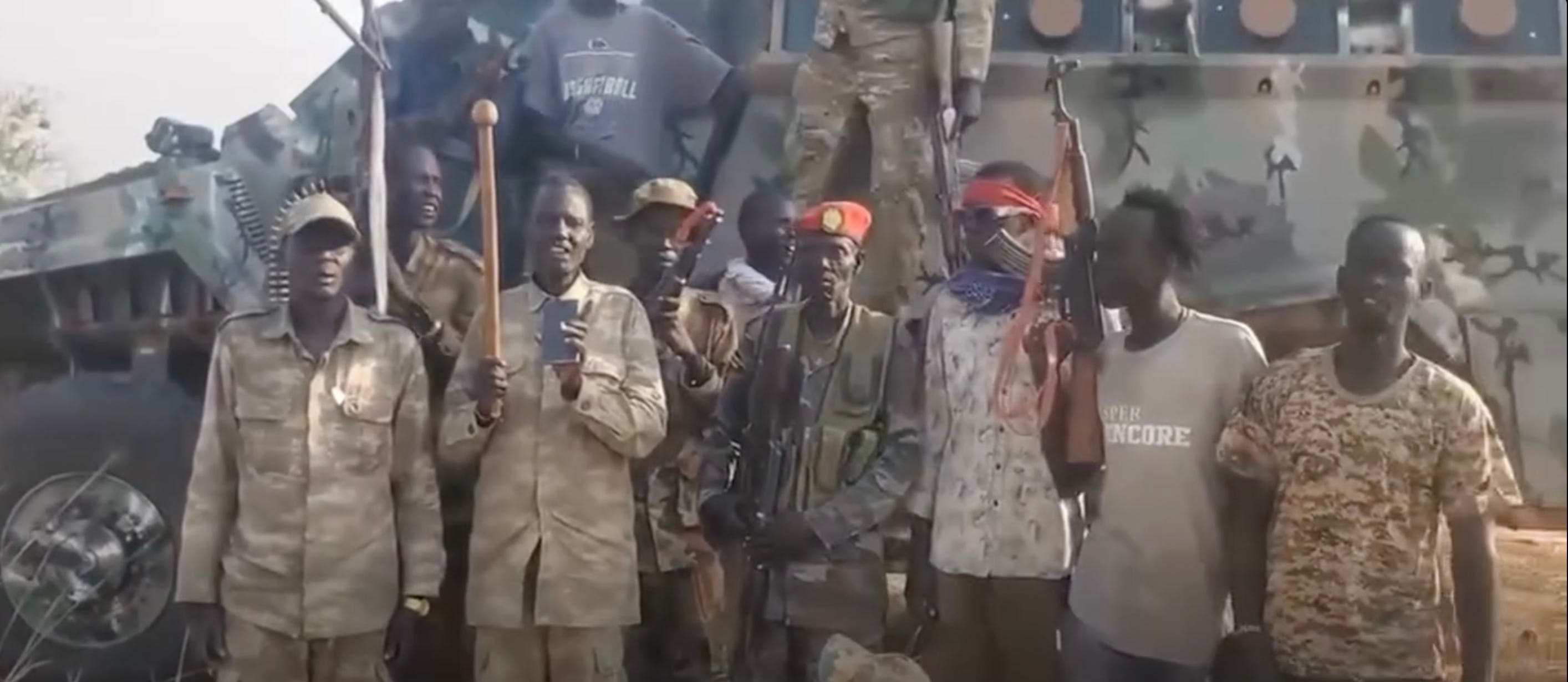
In response, the South Sudan People’s Defense Forces (SSPDF) assembled a large force at Pajut in preparation for a counteroffensive. But the opposition forces preempted this, attacking Pajut and driving the SSDPF out of Uror County. They killed and captured at least 100 soldiers in these clashes.
European embassies, Japan, Canada, and the U.S. issued a joint statement Tuesday, 20 January 2026, expressing grave concern about the recent violence. They said, “We call on all parties to agree to an immediate cessation of hostilities and to resolve issues through peaceful dialogue.” These governments collectively fund most of the humanitarian aid operations and development assistance in South Sudan, plus a UN peacekeeping mission.
Meanwhile in the Equatoria region, fighting erupted in two areas, first at the border town of Narus near the Kenyan border, then at Panyume near the tri-border area between South Sudan, Uganda, and the Congo.
John Lokwar, the paramount chief of Kapoeta East County, told Radio Tamazuj that the fighting lasted four days:
“Narus is engulfed in turmoil. The gunfire has intensified, and many residents are wounded. Initially, there were casualties, and now the fighting has erupted once again. The streets are deserted; townspeople have all sought shelter in the bushes, suffering from severe thirst and lack of food. All shops remain shuttered, and the atmosphere is filled with fear and desperation.”
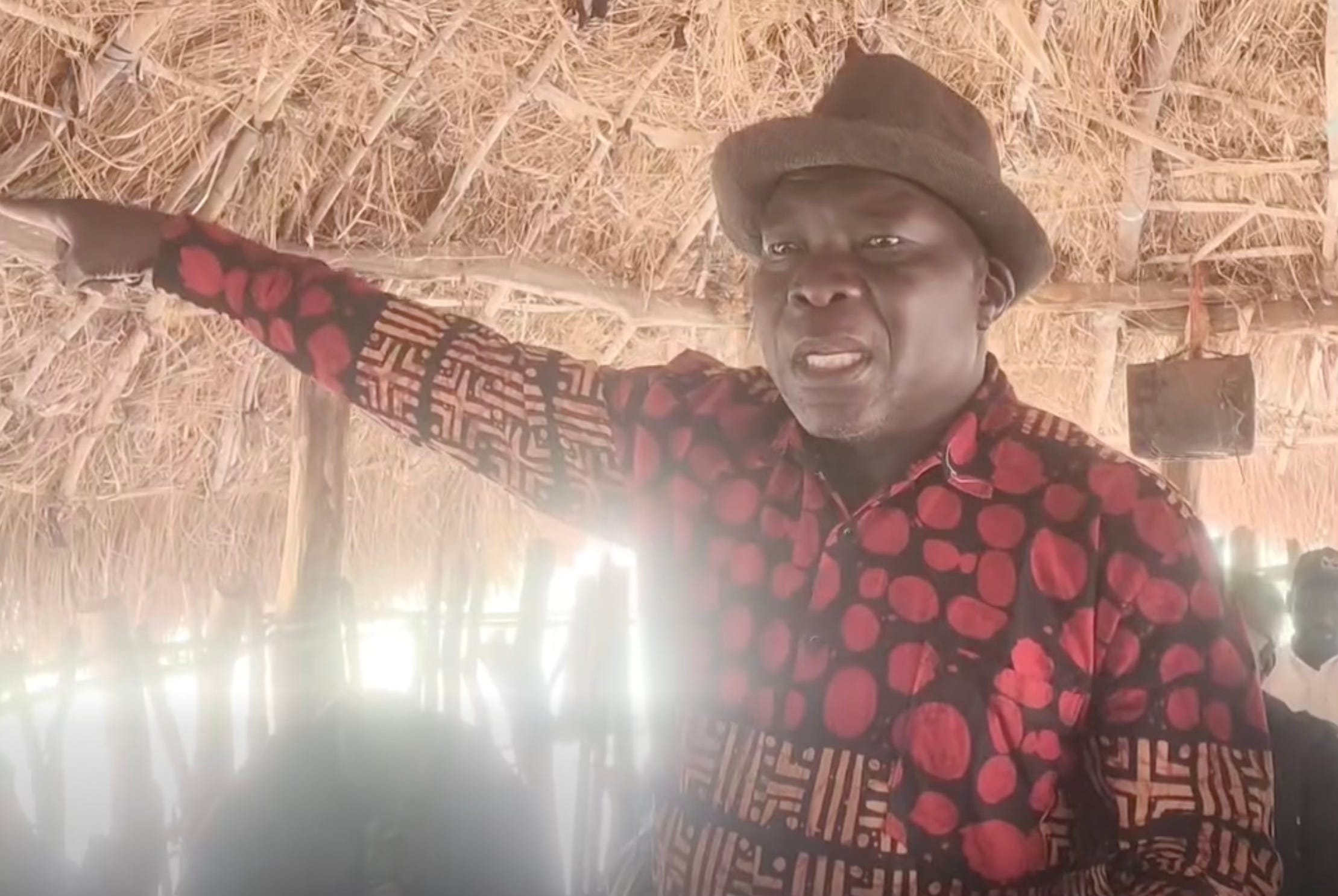
The attack on Panyume followed a meeting of opposition commanders in Central Equatoria, led by Lt. Gen. Wesley Welebe, SPLM-IO Operations Commander, who ordered a general offensive, according to video of his speech and a press release circulated by the movement’s spokesman.
In his recorded remarks, Welebe demanded the release of SPLM-IO leader Dr. Riek Machar, who became vice president under the 2018 peace deal but now is detained in Juba. “If Kiir does not release Dr. Machar this month, we will come get him and release him in Juba. If by force, no problem, we will do it. And nothing [bad] will happen to the doctor.”
Welebe claimed that SSPDF troops were “tired” and on the run in the Yei region (where he was speaking), in Jonglei, and in Upper Nile. “There is nothing called ‘peace’ any more. Only regime change. That is what I say.”
Want to keep up with the latest security and political developments in Sudan and South Sudan? Sign up to get 2-4 weekly emails containing maps, videos, fact-based reporting, and incisive insights from an independent perspective.
Unrest in Government Ranks
South Sudan’s government is headed by President Salva Kiir, an ailing strongman who came to power in 2005 after the death of his predecessor in the Sudan People’s Liberation Movement (SPLM), John Garang. He was elected once in 2010 with 93 percent of the vote but has since repeatedly postponed elections and materially breached two major peace agreements.
South Sudan ranks as the world’s poorest country by standard economic and development indicators, including GDP per capita and the share of the population living below the international extreme poverty line.
This reflects governance failures compounded by many years of conflict, which have dampened investment and business activity and disrupted agricultural livelihoods. In Transparency International’s Corruption Perceptions Index, South Sudan has consistently ranked among the worst-performing countries worldwide, placing last globally in 2021 and 2024.
Oil wealth has sustained South Sudan since independence in 2011, but investigations have revealed that billions of dollars in petroleum revenue are missing or misused, while a substantial share must also be paid to Sudan for the use of its pipelines and port infrastructure.
Subdued global oil prices, heavy borrowing during the 2013–2018 civil war, and fighting in neighboring Sudan that temporarily cut off exports have further strained South Sudan’s finances. As a result, civil servants and soldiers frequently go unpaid, deepening the corruption crisis and fueling internal rivalry, factional feuding, and criminality linked to unpaid armed forces.
Last week in the Gudele suburb of Juba, a church leader died during an armed robbery of his home. The same week, a feud within the National Security Service (NSS) erupted into the open after politically connected traders sought to recover $5 million of scrap copper that NSS personnel had confiscated and sold for profit. Kiir’s reshuffle of NSS leadership on Monday night may be related to this incident.
On Monday morning, a Petroleum Ministry director was found dead in his vehicle near the Custom–Rock City roundabout, his vehicle riddled with bullets. The circumstances surrounding this shooting are unclear.
South Sudan hosts a 17,000-strong peacekeeping mission, UNMISS, which is currently scaling back due to budget cuts. One of its staff members, interpreter Bol Rhoch Mayol Kuot, was killed near Wau last month after being detained by “security actors,” UNMISS disclosed in a statement.


Faced with growing unrest among his loyalists and economic difficulties, South Sudan’s president has tried to assert control and manage factionalism by frequently reshuffling his cabinet and top ranks of the security services. Officials sometimes are appointed and removed within weeks or even days.
On Monday night, Kiir issued a slew of new appointments and dismissals. Among the most significant was the elevation of Aleu Ayieny Aleu to the interior ministry. A veteran loyalist from Kiir’s home state, Warrap, Aleu held the same post during the height of the last civil war (2013-2015). He replaces Angelina Teny, wife of detained First Vice President Riek Machar. This post had been given to the SPLM-IO under the 2018 peace agreement, so Angelina’s dismissal is another sign that the peace agreement is broken.
According to the UN Office for the Coordination of Humanitarian Affairs, more than 180,000 people were displaced in four counties of Jonglei State — Nyirol, Uror, Akobo, and Duk — between late December and 19 January, due to “renewed fighting and airstrikes.” At least four health facilities have been looted, leaving more than 100,000 people without access to essential services.
For now, the fighting remains contained to rural parts of the country distant from the capital. Most of South Sudan is still generally peaceful, with the army controlling the majority of South Sudanese territory and enjoying numerical superiority over the rebels.
However, the military situation by itself does not tell the full story. Political analysts have warned that Kiir’s growing isolation, erraticism, and health issues make his regime more vulnerable to being toppled than ever before, either by the SPLM-IO or from within. Widespread discontent has emerged even in regions that Kiir counted on for support during the last civil war, such as Northern Bahr al Ghazal and parts of Warrap.
In November, Kiir sacked and arrested his other vice president, Bol Mel, a Northern Bahr al Ghazal native, who had widely been viewed as Kiir’s heir apparent. This has stoked resentment in the state, which played a significant military role in the last war, supplying tens of thousands of soldiers for Kiir’s army. Another historically powerful politician from Northern Bahr al Ghazal, Governor Paul Malong Awan, remains in exile in Kenya and leads the South Sudan United Front/Army, an opposition group unaffiliated with SPLM-IO.
Shedding Light on Active and Emerging Conflicts
Sudan War Monitor is an independent publication covering Sudan’s civil war through OSINT, reporting, Arabic-language sources, and political-military analysis. We publish maps, verified videos, news, and investigative reporting. If you have the means, please consider subscribing to support this effort.