Kamikaze Drones Hunt for Targets in Kordofan
Deadly attacks in North Kordofan, West Kordofan, Abyei, and North Darfur
The Sudanese Armed Forces (SAF) has begun employing a new type of kamikaze attack drone in the Kordofan region, targeting fuel depots, markets, and convoys in rear areas controlled by the Rapid Support Forces (RSF).
The strategy aims to deprive RSF units of fuel supplies and make it more difficult to rotate frontline units and rush reinforcements to vulnerable areas. Additionally, by targeting markets throughout Darfur and Kordofan, SAF seeks to shut down commercial activity, thereby weakening the RSF and encouraging mass displacement from RSF-held areas.
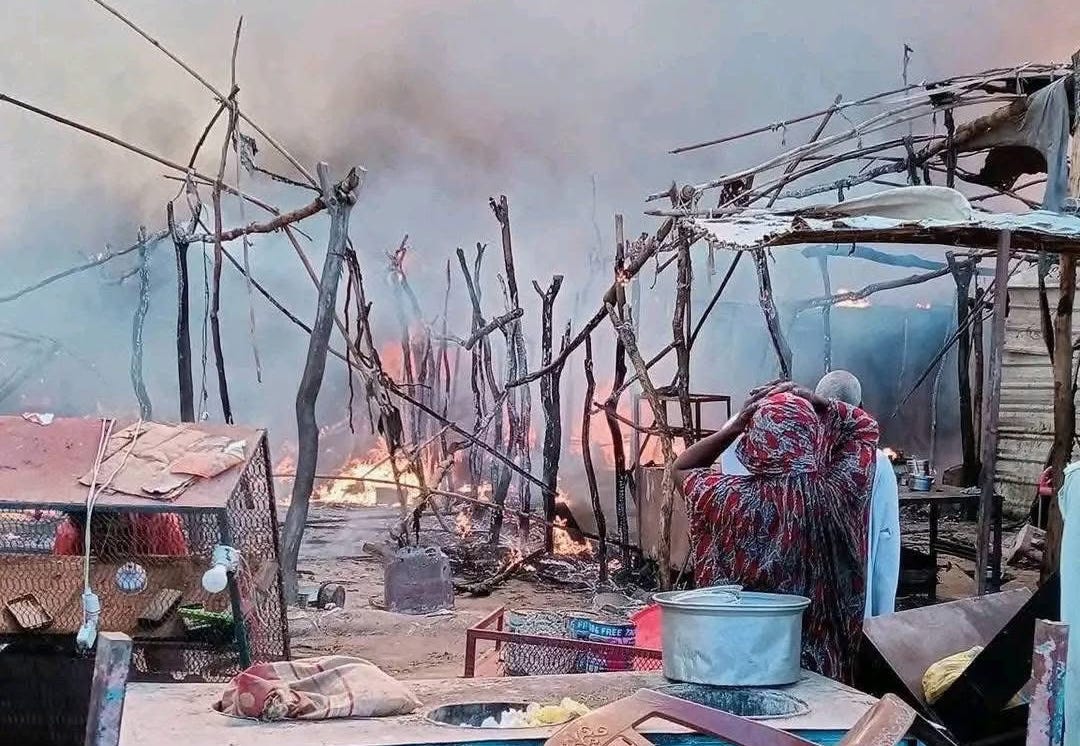
The latest attack occurred yesterday at Amiet Market (also called Souq Al-Na’am, or Ostrich Market) in the Abyei Special Administrative Area, a key trading zone between West Kordofan and the Republic of South Sudan.
Bystanders who filmed the scene said the fire began at the fuel market in Amiet — a target that may have had a dual military-civilian use — before spreading to other parts of the market, burning homes and traders’ stalls and goods. A similar attack took place at the Chad-Sudan border in December, targeting fuel trucks that had just passed into RSF-controlled territory.
The success of this strategy so far is likely partly the reason for the RSF’s recent military setbacks in South Kordofan State and a lull in RSF ground attacks in the region over the past month.
Footage from Souq al-Na’am, filmed by bystanders, 5 Feb. 2026:
SAF has been attacking markets since the beginning of the war (and also in previous wars), but its method of doing so has changed. After losing most of its manned warplanes in 2023-2024, the Sudanese Air Force acquired TB-2 and Akinci guided-missile drones from Turkey. It deployed these with mixed success in late 2024-2025, but lost many of them to anti-aircraft fire.
SAF’s new strategy relies on cheaper, one-way drones, also called ‘loitering munitions.’ RSF troops in Abu Zabad, West Kordofan, shot down one of the new kamikaze drones Wednesday, February 4, 2026, allowing for identification. Based on the debris, weapons researcher ‘War Noir’ identified the drone as a Baykar YIHA-III loitering munition, which is produced by the same company that makes SAF’s more advanced drones.
This type of drone began appearing in several conflicts in 2024-2025, including the recent India-Pakistan clashes, Russia-Ukraine, and Congo. The Yiha-III was co-developed by Turkey’s Baykar consortium and Pakistan’s NASTP. It relies heavily on Turkish technology but is produced in Pakistan.
The Yiha-III drone can loiter for several hours and has an operational range of approximately 200 km, making it suitable for short- and medium-range tactical missions, but not for strategic attacks deep into enemy territory.
Footage of RSF fighters with Yiha-III debris in Abu Zabad, West Kordofan
The unit cost of the Yiha-III kamikaze drones is much lower than than the high-end strategic drones. Although the price is not publicly advertised, contemporary loitering munitions typically have a unit cost of roughly $50,000 to $250,000, depending on the type and the terms of the arms deal.
Sudan’s drone war continues to evolve. Earlier this week, The New York Times revealed in an investigation that SAF operates its long-range Akinci drones from a desert airbase in Egypt at the border with Darfur. The Times reported,
“The Turkish drones are being hidden in Egypt to keep them safe, according to four American officials and one from the Middle East. It is unclear if Egyptian or Sudanese forces operate the drones. Like others who were interviewed for this article, the officials spoke on the condition of anonymity to discuss sensitive intelligence.”
Several recent attacks throughout North and West Darfur are likely to have been carried out by drones operating from this Egyptian airbase. One drone hit the Jebel Issa market in Malha Locality in North Darfur, on January 25. According to Darfur Victims Support, a human rights group, more than a dozen people died in the attack. Below is a video from Issa Market:
To counter SAF’s airstrikes, the RSF has acquired Chinese drone-jamming and surface-to-air missile systems, likely provided by the United Arab Emirates, according to Wim Zwijnenburg, a drone expert at the Dutch organization PAX.
The RSF has also carried out drone attacks of its own, hitting both civilian and military targets. Like SAF, it has long-range drones, but it has used these against electrical infrastructure, airports, and leadership targets, rather than markets. In recent weeks, the RSF’s drone force appears to be mostly focused on the immediate frontline in North and South Kordofan.
Kordofan remains the main combat theatre of Sudan’s war, with secondary fronts in North Darfur and Blue Nile State.
The first two years of the war witnessed heavy fighting in Khartoum and other cities of the Nile Valley, but that region is now quiet, albeit scarred by the conflict and now heavily militarized. Approximately three million Sudanese have returned to their homes since fighting ended in central Sudan, but millions more remain abroad or in IDP camps.
Many schools remain closed, and there are more young men in military training camps than in universities.
Sudan War Monitor — Shedding Light on Sudan’s Crisis
Sudan War Monitor is an independent publication covering Sudan’s civil war through OSINT, reporting, Arabic-language sources, and political-military analysis. We publish maps, verified videos, news, and investigative reporting. If you have the means, please consider subscribing to support this effort.


