
The Sudanese Armed Forces (SAF) and allied groups have launched a major offensive across North Kordofan State, attacking villages held by the paramilitary Rapid Support Forces (RSF) west of El Obeid in Al-Sheikan Locality while also pushing west from Bara and Jabrat al-Sheikh toward parts of Sodari Locality that remain under RSF control.
The fighting began on Thursday and marks the army’s largest ground operation in the state since the SAF captured Bara, Jabrat al-Sheikh and several other towns in late July.
The latest operation is aimed at removing RSF units that remained in villages and smaller towns after the army regained most of North Kordofan’s main urban areas and reopened the direct road between El Obeid and the capital Khartoum region.
The army controls El Obeid, Bara, Jabrat al-Sheikh and most of the state’s other major towns, but the RSF still holds several important positions. West of El Obeid, the paramilitary controls areas beginning from Abu Qa’ud and Umm Sumaima, while to the south it remains in control of Kazgil.
In Sodari Locality, the RSF controls Sodari town, Umm Badr, Hamrat al-Sheikh and a number of smaller settlements spread across the locality. These remaining positions have allowed the RSF to maintain a military presence in North Kordofan even after losing many of the state’s larger population centers.
The latest offensive began from several directions at nearly the same time. Army units and fighters from former Darfur rebel groups moved west from El Obeid against RSF positions on the road toward Abu Qa’ud and Umm Sumaima, while separate forces moved west from Bara and Jabrat al-Sheikh toward Sharshar and other settlements in Sodari Locality.
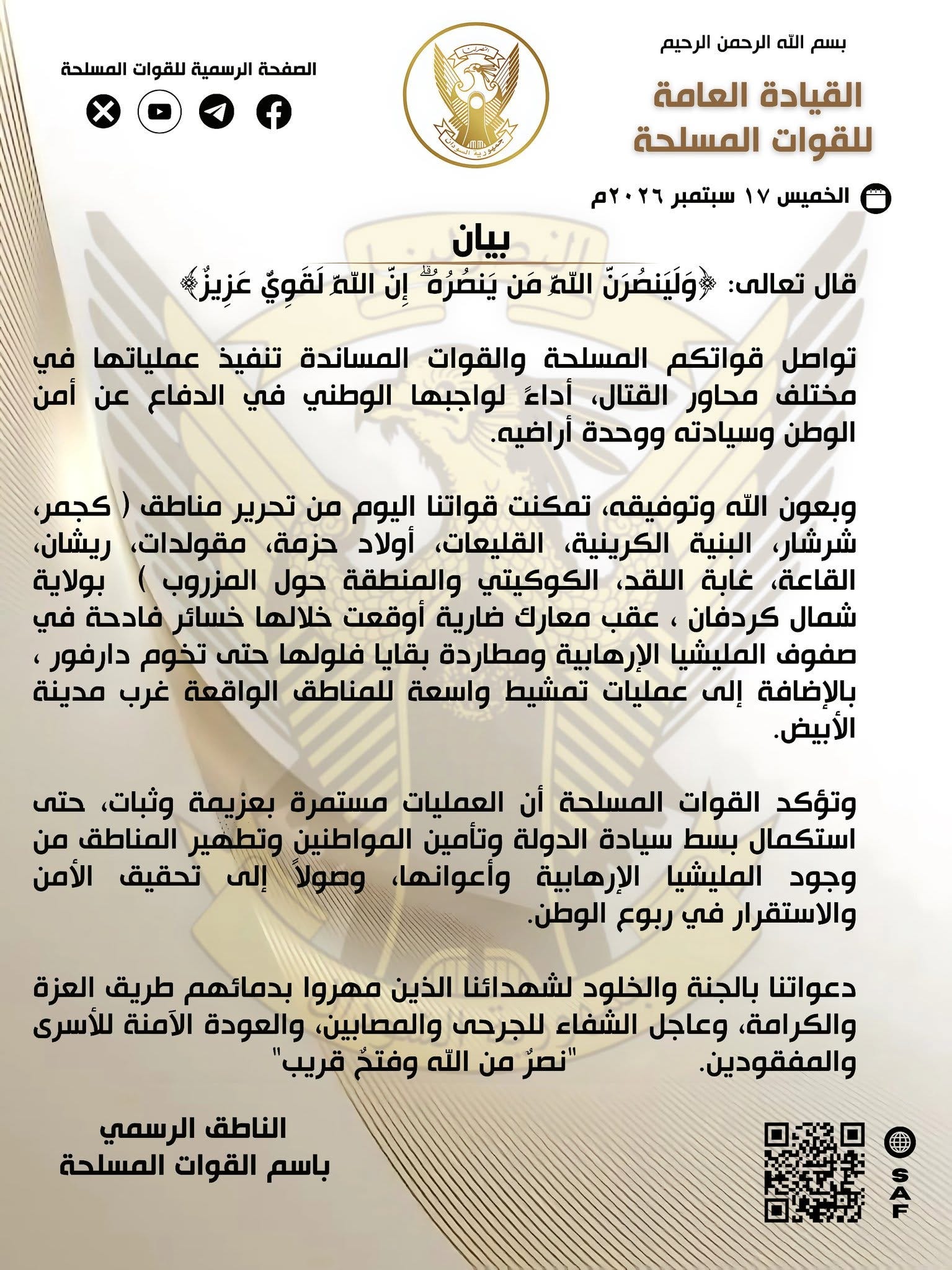
In a statement, the Sudanese military said its forces captured Kajmar, Sharshar, Al-Baniya Al-Kurayniya, Al-Qulai’at, Awlad Hazma, Maquldat, Rishan, Al-Qa’a, Ghabat Al-Laqad, Al-Kukaiti and areas near Al-Mazroub during Thursday’s fighting.
The military also said clearing operations were continuing west of El Obeid and claimed its forces were pursuing retreating RSF fighters.
“With God’s help and guidance, our forces today liberated the areas of Kajmar, Sharshar, Al-Baniya Al-Kurayniya, Al-Qulai’at, Awlad Hizma, Maquldat, Rishan, Al-Qa’a, Al-Laqad Forest, Al-Kukaiti, and the area surrounding Al-Mazroub in North Kordofan State, following fierce battles in which heavy losses were inflicted on what the statement described as the ‘terrorist militia.’”
“The remaining forces were pursued toward the borders of Darfur, while extensive clearing operations were also conducted in areas west of El Obeid.”
“The Armed Forces affirm that operations will continue with determination and steadfastness until state sovereignty is fully restored, civilians are secured, and areas are cleared of the presence of what the statement called the ‘terrorist militia’ and its supporters, with the aim of restoring security and stability throughout the country,” the army statement reads.
Sudan War Monitor has not independently verified all of the areas listed in the statement or the army’s claims concerning RSF casualties, but videos reviewed and geolocated by Sudan War Monitor confirm the presence of army-aligned forces in several of the places named by the military.
For example, the video below, reviewed by Sudan War Monitor, shows men, including an armed SAF fighter, beside a sign for Kordofan University’s College of Community Development in Tna.
Sudan War Monitor geolocated the footage to 14°9’9.95”N, 29°26’54.72”E, confirming the presence of army-aligned forces in the village, which lies about 47 kilometers southeast of Sodari town, roughly 150 kilometers west of Jabrat al-Sheikh and about 120 kilometers west of Bara.
Fighters from the Islamist-aligned Al-Baraa bin Malik Brigade are seen inside Tna town on September 18, 2026. Sudan War Monitor geolocated the video to 14°9’9.95”N, 29°26’54.72”E.
Sudan War Monitor also geolocated another video to at Kajmar at 14°24’27.31”N, 30°23’59.23”E, while anothers confirms their presence at Al-Qa’a at 14°14’46.39”N, 29°59’30.43”E. Other videos which we also geolocated confirmed SAF presence in Rishan, Sharshar and Kokweti.
The verified locations show that the army advance reached well into rural areas that had remained under RSF control after the July fighting. They do not, however, establish continuous army control of all the land between those settlements, where the situation remained difficult to assess.
Army supporters claimed during the first hours of the offensive that SAF and allied forces had already reached or captured Sodari town, but the available visual evidence did not support those claims.
The below video, which was presented as having been filmed in Sodari, was instead geolocated by Sudan War Monitor to Al-Qa’a, south of the town’s main market, at 14°14’47.71”N, 29°59’30.96”E.
In this video, fighters from the Joint Force of Armed Struggle Movements (JSAMF) are seen inside Al-Qa’a, although the location was presented as Sodari. It is unclear whether this resulted from limited familiarity with the area or was an intentional claim made as part of the information war surrounding the offensive. Sudan War Monitor geolocated the footage to the main market area of Al-Qa’a village.
Al-Qa’a lies about 60 kilometers east of Tna, and the video was filmed on Thursday, a day before army and allied forces entered Tna. The RSF later published footage of its own to challenge claims that the Sudanese military had captured Sodari.
One video posted online on Thursday evening shows RSF fighters standing outside Sodari Hospital. Sudan War Monitor geolocated the footage to the hospital’s main entrance at 14°24’31.94”N, 29°5’33.20”E, confirming the RSF’s presence in Sodari town at the time the video was recorded.
In this video, RSF fighters are seen in front of Sodari Hospital here14°24’31.94”N, 29°5’33.20”E.
Control of individual villages in Sodari Locality should not be confused with control of the entire locality. The area is large and sparsely populated, with settlements separated by stretches of open land and connected by numerous dirt roads and desert tracks.
Both sides can move around the main roads, and a force may enter one village while its opponent continues to operate only a short distance away. This pattern has repeatedly complicated battlefield assessments in North Kordofan, where towns have changed hands while surrounding rural areas remained contested.
West of El Obeid, fighting continued toward Abu Qa’ud, one of the RSF positions that has remained outside army control despite repeated attacks, while separate clashes were reported around Jebel Abu Sinun northwest of the city. In its statement, the Sudanese army referred to the fighting on this front only as “extensive clearing operations in the areas west of the city of El Obeid.”
This came despite claims by pro-army social media channels that SAF and allied groups had captured Abu Qa’ud, Umm Sumaima and Jebel Abu Sinun.
In response to the Sudanese army operations, the RSF said in a statement Friday that it had repelled an army assault on Abu Qa’ud and claimed to have seized weapons and ammunition from the attacking force.
“Earlier this Friday, the valiant and heroic forces of the Rapid Support Forces (RSF) achieved a major victory over the Sudanese Armed Forces (SAF), which operates under the terrorist Islamic Movement and their mercenary allies, after repelling their failed attack on the Abu Qu’oud area, west of the city of El Obeid.”
“Our heroic forces inflicted heavy losses in personnel and equipment on the Islamic Movement’s army and pursued its remnants as they fled in disarray, dragging their tails of defeat and humiliation. Our forces also seized large quantities of weapons and ammunition, which are currently being inventoried.”
“Our forces affirm that ongoing military operations are proceeding at a measured and steady steps until the complete liberation of the entire homeland is achieved, the Sudanese people are freed from the army of the terrorist Muslim Brotherhood, and Sudan is rebuilt on new and just foundations that eradicate injustice and marginalization affecting all the peoples of Sudan,” the RSF said in a statement posted on Telegram without mentioning the army operations in Sodari Locality.
Sudan War Monitor could not independently verify the casualty figures claimed by the RSF. However, we were able to confirm that army operations reached as far as Mamsuka, just east of Abu Qa’ud.
One video geolocated by Sudan War Monitor shows members of the Sudanese military at the entrance to Mamsuka village at 13°9’54.02”N, 29°55’24.77”E, about 15 kilometers east of Abu Qa’ud.
In this video, members of the Sudanese military are seen at the northern entrance to Mamsuka village, along the Al-Nahud–El Obeid Highway. Sudan War Monitor geolocated the footage to 13°9’54.02”N, 29°55’24.77”E.
Abu Qa’ud and Umm Sumaima have been among the most persistent RSF positions west of El Obeid. Both lie along the road leading from the North Kordofan capital toward Al-Khuwei in West Kordofan and have repeatedly been attacked by army and Joint Force units.
In September 2025, SAF and fighters from former Darfur rebel movements advanced through Abu Qa’ud and entered Umm Sumaima before RSF forces counterattacked. Fighting continued for several days and control shifted again, showing the difficulty the army has faced in holding ground west of El Obeid when RSF units remain active in nearby villages and open countryside.
Pro-Sudanese army accounts also claimed that SAF had regained control of Jebel Abu Sinun. Sudan War Monitor confirmed the presence of army forces south of the mountain in the north of nearby village of Abu Sinun, but could not independently establish whether the footage was recent, despite the person filming saying it was recorded on Friday, September 18, 2026.
Sudanese military in this video are seen driving toward Jebel Abu Sinun village northwest of El-Obeid.
Both sides have previously circulated old battlefield footage with newly added voiceovers or descriptions claiming that it showed recent control of areas they no longer held.
Kazgil remains another major RSF position in North Kordofan, located south of El Obeid on the road toward South Kordofan. The RSF has maintained control of the area. Kazgil gives the paramilitary a continued presence south of the state capital and allows it to operate along routes connecting North and South Kordofan.
The latest offensive has focused mainly on the areas west of El Obeid and the fighting toward Sodari, leaving Kazgil as one of the main remaining RSF-held positions that would have to be taken if the army is to claim full control of North Kordofan.
In what appeared to be a propaganda response to the army offensive in northern North Kordofan, pro-RSF accounts circulated footage showing fighters claiming to have launched clearing operations south of Kazgil, which remains under RSF control, in an apparent attempt to shift attention from the army’s advances in other parts of the state.
Sudan War Monitor geolocated one of the videos to Kazgil, confirming the presence of RSF fighters in the area, but could not determine when the footage was recorded, and there was no evidence of a Sudanese army operation around Kazgil at the time.
RSF fighters filming inside Kazgil town. We were able to geolocate this video to this location ( 12°48’13.16”N 30° 6’2.47”E) at the northern entrance of the town.
The present operation follows the army’s offensive in late July, when SAF and allied groups captured Bara, Jabrat al-Sheikh, Umm Sayalla and several other towns along the main road linking El Obeid with Khartoum.
That advance reopened a direct land connection that had been cut for much of the war and removed the RSF from several of its most important positions north of El Obeid. Before that offensive, the paramilitary had used Bara and surrounding areas to pressure the state capital and disrupt traffic moving between North Kordofan and army-controlled areas in central Sudan.
The July fighting did not remove the RSF from the surrounding countryside. RSF units withdrew into villages and rural areas and continued operating away from the main road, where they could move using unpaved routes and return to areas that the army had already passed through.
We warned at the time that reopening the road did not mean the surrounding area was fully secure, since RSF fighters could still attack convoys or re-enter settlements if army units became overstretched. The current offensive appears intended to deal with that remaining military presence by extending SAF control beyond the main towns.
The RSF has often avoided defending every settlement under heavy attack. Its fighters can withdraw, disperse into villages or open terrain and later regroup for a counterattack. The same pattern has been seen repeatedly in Darfur and Kordofan, where the paramilitary relies heavily on mobility rather than fixed defensive lines.
This allows RSF units to preserve part of their fighting strength when faced with larger SAF concentrations, although it can also result in the loss of towns and equipment when withdrawal routes are cut or attacking forces move quickly.
The army has increasingly relied on the Joint Force of Armed Struggle Movements in this kind of fighting. The Joint Force is made up mainly of former Darfur rebel groups that fought the Sudanese government during the Darfur conflict and later signed the Juba Peace Agreement in 2020.
Its largest components include the Sudan Liberation Movement led by Drfur Governor Minni Minnawi and the Justice and Equality Movement led by Finance Minister Jibril Ibrahim. The groups initially stayed out of the SAF-RSF war but joined the army in early 2024 and have since taken a major role in fighting across Darfur and Kordofan.
Joint Force fighters are particularly useful to SAF in open rural areas because many of them have years of experience fighting from pickup trucks across Darfur’s desert and semi-arid terrain. Their tactics rely on rapid movement, ambushes and attacks from several directions, methods that resemble those used by the RSF itself.
Many fighters in the Joint Force are ethnic Zaghawa, while the RSF continues to draw heavily from Arab communities in Darfur and Kordofan. This has given some of the fighting in western Sudan a strong ethnic character, particularly when forces recruited from different communal networks meet in rural areas where tribal identity remains politically and militarily important.
North Kordofan itself is ethnically mixed and cannot be divided neatly between communities supporting one side or the other. The state includes Arab pastoral and semi-pastoral groups, farming communities and large mixed urban populations, especially in El Obeid and other towns.
Neighboring West Kordofan has major Hamar and Misseriya populations and strong social links with Darfur. These connections give the RSF access to recruitment networks, local guides and knowledge of rural routes, but they have not produced uniform Arab support for the paramilitary.
Some Arab communities in Kordofan have backed the army, while others have tried to remain neutral or formed local forces to protect their own areas. Hamar groups in West Kordofan have mobilized against the RSF at different stages of the war, while disputes over looting, taxation and local authority have also brought the paramilitary into conflict with communities that might otherwise share social or tribal ties with some of its fighters.
The war has divided communities as well as regions, and military loyalty often depends on local circumstances rather than ethnicity alone.
Support our journalism

Thank you for reading Sudan War Monitor. We do this work because we believe that journalism is one accountability mechanism that ultimately can contribute toward peace and justice in Sudan—however distant that hope may be. Our work is intended to be a resource for humanitarians, civil society, ordinary Sudanese, diplomats, and news media. Subscribe or share to support our work and #KeepEyesonSudan.