
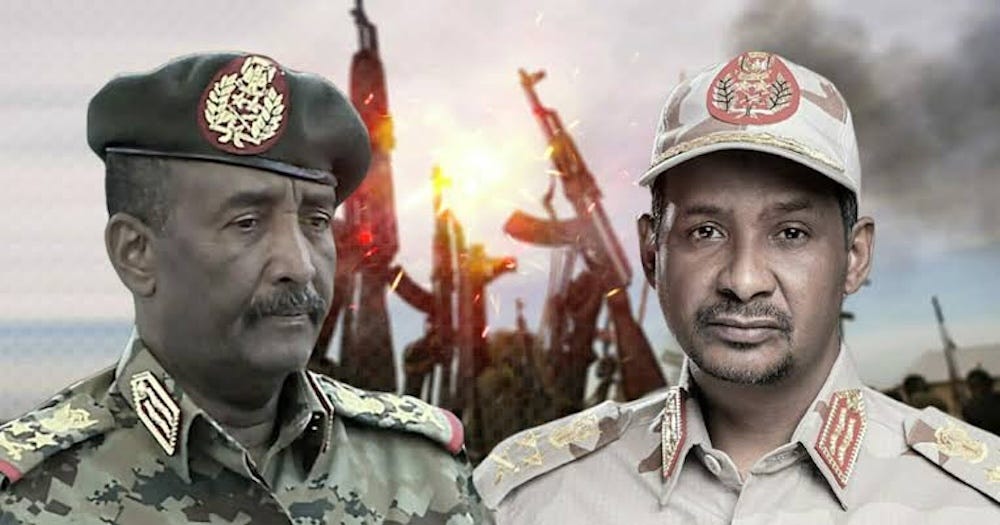
The British government on Monday imposed sanctions on 15 senior commanders from Sudan’s rival military forces, marking the first anniversary of the fall of El Fasher, where Rapid Support Forces (RSF) fighters carried out mass killings, sexual violence, and other atrocities following the capture of the North Darfur State capital in October 2025.
The sanctions target commanders from both the RSF and the Sudanese Armed Forces (SAF), whom the British government suspects of involvement in serious abuses during Sudan’s civil war, including conflict-related sexual violence. The measures include asset freezes and travel bans, accompanied by £15 million in new humanitarian assistance for survivors of sexual violence and communities threatened by famine.
Among those designated are RSF Colonel Hussein Abu Jalak, whom British authorities linked to atrocities committed during the siege of El Fasher, and Al-Nour Ahmed Adam, known as Al-Qubba, who was identified as playing a prominent role in the siege and attacks on the city and who has this year defected to the Sudanese military. The British announcement did not provide detailed allegations against every individual in the group.
The measures were announced exactly one year after RSF forces captured the headquarters of the Sudanese army’s 6th Infantry Division in El Fasher on October 26, 2025, effectively breaking the remaining organized military defenses of the last major Darfur city outside RSF control. The military defeat was followed by large-scale atrocities against civilians, including ethnic killings and sexual violence.
The October 2025 offensive brought an end to an eighteen-month siege during which the RSF progressively isolated El Fasher, severed its supply routes, and subjected residential neighborhoods to repeated artillery and drone attacks. Sudanese army troops, former Darfur rebel movements organized under the Joint Forces, and locally recruited fighters had defended the city despite shortages of food, fuel, ammunition, and medical supplies.
Fall of the Sixth Infantry Division
El Fasher became one of the principal battlegrounds of Sudan’s civil war after the Joint Forces, a coalition of former Darfur rebel movements, joined the Sudanese army against the RSF in ealry 2024. These movements included factions of the Sudan Liberation Movement and the Justice and Equality Movement, which had previously fought against the Sudanese government during the 2003-2020 Darfur conflict.
The RSF subsequently concentrated thousands of fighters around the city, attacking army positions and allied forces from several directions. The defenders maintained control of the central garrison and surrounding neighborhoods through repeated assaults, while Sudanese military aircraft periodically conducted supply drops to replenish dwindling stocks of ammunition, fuel, and other essential supplies.
By early 2025, the RSF had expanded its control over much of North Darfur’s surrounding countryside, leaving El Fasher increasingly isolated. Its capture of Al Maliha and Um Kadada, north and east of the state capital, respectively, weakened the army’s remaining positions outside the city and reduced the ability of its allies to move reinforcements across the region.
In April 2025, RSF forces overran Zamzam displacement camp, approximately 15 kilometers south of El Fasher. The camp had sheltered hundreds of thousands of civilians, many of whom had originally fled earlier rounds of violence in Darfur. Its capture accelerated the displacement crisis and further tightened the RSF’s encirclement of the city.
The paramilitary force subsequently constructed an extensive network of earthworks, trenches, and berms around El Fasher. These positions served not only to restrict the movement of defenders but also to control civilian exit routes and prevent essential supplies from reaching the population. As the siege continued, food prices rose sharply and medical services deteriorated.
On October 26, RSF fighters entered the headquarters of the 6th Infantry Division following a coordinated offensive against the remaining army defenses. Army troops and allied Joint Forces fighters withdrew toward western neighborhoods as the RSF consolidated its control. The collapse of the city’s defense left the surviving defenders scattered and exposed thousands of civilians, many of whom had sought protection in army-held areas, to advancing RSF fighters.
Mass killings and sexual violence
The capture of El Fasher was followed by killings of civilians, executions of prisoners, and widespread sexual violence. Videos circulated by RSF fighters themselves provided evidence of abuses, while survivor testimonies subsequently described killings along escape routes, abductions, robberies, and attacks targeting people suspected of supporting the army or belonging to particular ethnic communities.
A joint investigation published in May 2026 by Al Jazeera’s Fault Lines, Lighthouse Reports, and Sudan War Monitor reconstructed the final stages of the siege using survivor interviews, satellite imagery, and geolocated footage. The investigation documented the systematic restriction of civilian movement and the use of sexual violence against people attempting to escape.
The investigation also corroborated findings by the United Nations Human Rights Office, which documented more than 6,000 killings by RSF fighters during the first three days after their entry into El Fasher. The documented figure does not necessarily represent the full death toll, given the difficulties investigators faced in accessing areas affected by the violence.
Survivors interviewed for the investigation described a dangerous route southwest of the city through Garni, where RSF checkpoints subjected fleeing civilians to searches and interrogations. Fighters confiscated personal belongings and examined identities to identify people suspected of links to the army or Joint Forces. Some civilians were detained or killed, while others reported sexual assaults.
British officials said new research supported by the UK-funded Centre for Information Resilience (CIR) had uncovered further evidence that starvation and sexual violence were deliberately employed during the conflict. The research documented RSF fighters discussing restrictions on water supplies and the movement of traders into El Fasher, alongside accounts of women and girls being abducted and repeatedly raped.
Foreign Secretary Ed Miliband said the investigations demonstrated that rape and starvation continued to be used against Sudanese civilians a year after the atrocities in El Fasher. He called for accountability for the perpetrators and an end to external military support for the warring parties, while warning that obstruction of humanitarian operations was worsening the risk of famine.
“The war in Sudan has created a humanitarian catastrophe. A year on from the atrocities in El Fasher, UK-funded investigations have shown that rape and starvation are still being weaponised against the people of Sudan.”
“These are crimes against our humanity - the perpetrators must be held accountable and support from all external backers to the warring parties must end.”
“El-Nino may worsen an already desperate situation, but whether famine takes hold is in the hands of the RSF and SAF – they must stop attacking aid convoys and let food reach communities,” Ed Miliband said.
The British government’s decision to sanction commanders from both military organizations reflects allegations of abuses extending beyond El Fasher. Although the massacre that followed the city’s capture was attributed to the RSF, investigations throughout Sudan’s war have also documented attacks on civilians and civilian infrastructure involving the army and forces aligned with it.
Humanitarian assistance and famine risks
Alongside the sanctions, Britain announced £5 million in new assistance for survivors of conflict-related sexual violence. The funding is intended to support sexual and reproductive healthcare, maternal health services, psychosocial treatment, and protected facilities for women and girls affected by violence during the conflict.
A further £10 million will support humanitarian operations in parts of Darfur and Kordofan, where fighting, displacement, restrictions on aid access, and deteriorating food security have left large numbers of civilians dependent on emergency assistance. The British government also warned that possible El Niño-related drought could aggravate already severe conditions.
Part of the funding will improve water and sanitation services in displacement sites around Tawila, west of El Fasher. The town became a major destination for civilians fleeing the North Darfur capital and surrounding areas during the siege and subsequent RSF offensive. Displacement has placed additional pressure on limited water, sanitation, and healthcare infrastructure.
Other assistance will support health, protection, and humanitarian services in El Obeid, the capital of North Kordofan, where the conflict has disrupted transport, trade, and access to essential supplies. The city’s strategic position on routes linking central Sudan with Darfur and Kordofan has made the surrounding region an important theater of military operations.
In a separate statement marking the anniversary, members of the Coalition for Atrocity Prevention and Justice for Sudan condemned the killings and other abuses committed during the fall of El Fasher. The statement, published by Global Affairs Canada, cited ethnic killings, summary executions, torture, enforced disappearances, arbitrary detention, forced recruitment, and widespread sexual violence.
The coalition expressed support for the United Nations Independent International Fact-Finding Mission for Sudan and the African Union’s parallel investigative work. It also called for continued international cooperation with accountability mechanisms, including the International Criminal Court, which has an existing mandate to investigate crimes committed in Darfur.
The coalition warned that patterns of violence documented during the siege had not ended with the fall of El Fasher. Drone attacks, strikes affecting civilian infrastructure, obstruction of humanitarian assistance, and continued displacement were creating conditions in which further large-scale atrocities could occur elsewhere in Sudan.
“Justice and accountability are vital to achieving sustainable peace in Sudan. Victims and survivors deserve justice and accountability for the heinous crimes perpetrated during this conflict.”
“Those responsible for serious violations and abuses must be investigated and held to account. The Coalition will continue working with Sudanese and international partners to support credible accountability processes, including the work of the International Criminal Court concerning Darfur, and meaningful transitional justice for the people of Sudan,” the statement said.
It also urged foreign governments and other external actors to stop supplying arms, financing, or other assistance that enables the war to continue. The coalition called for full implementation of international sanctions, including the United Nations arms embargo applicable to Darfur, and demanded safe access for humanitarian organizations operating in conflict-affected areas.
Support our journalism
Sudan War Monitor is a collaborative of journalists and open source researchers tracking the events of Sudan’s war and the search for solutions. We’re building a platform to battle disinformation and warmongering and amplify the voices of victims, humanitarians and peacemakers.