
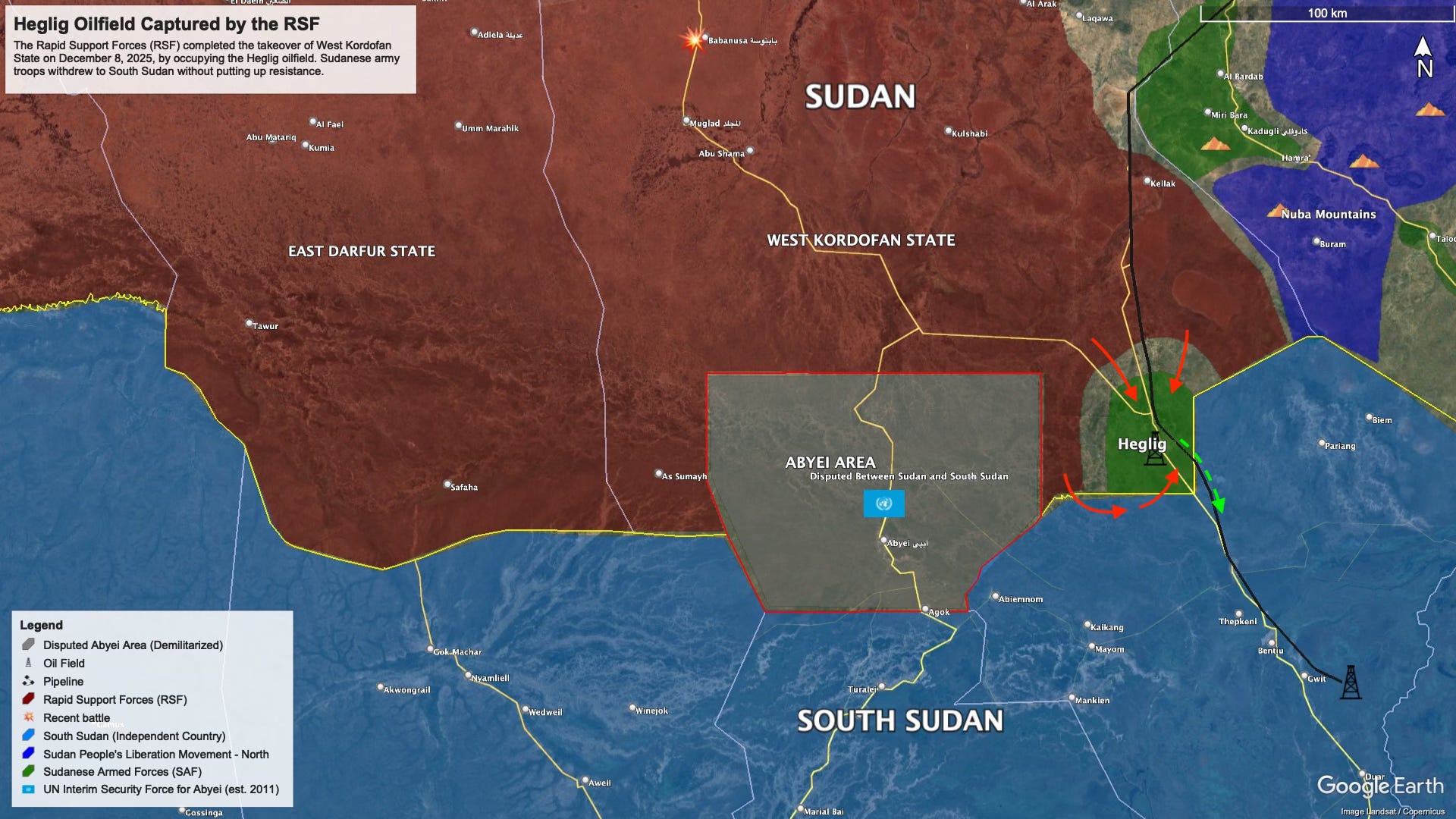
The Rapid Support Forces (RSF) seized control of the Heglig oilfield on Monday, overrunning the Sudanese Armed Forces’ (SAF) last remaining territory West Kordofan and delivering yet another defeat to the army following the recent capture of El Fasher and Babanusa.
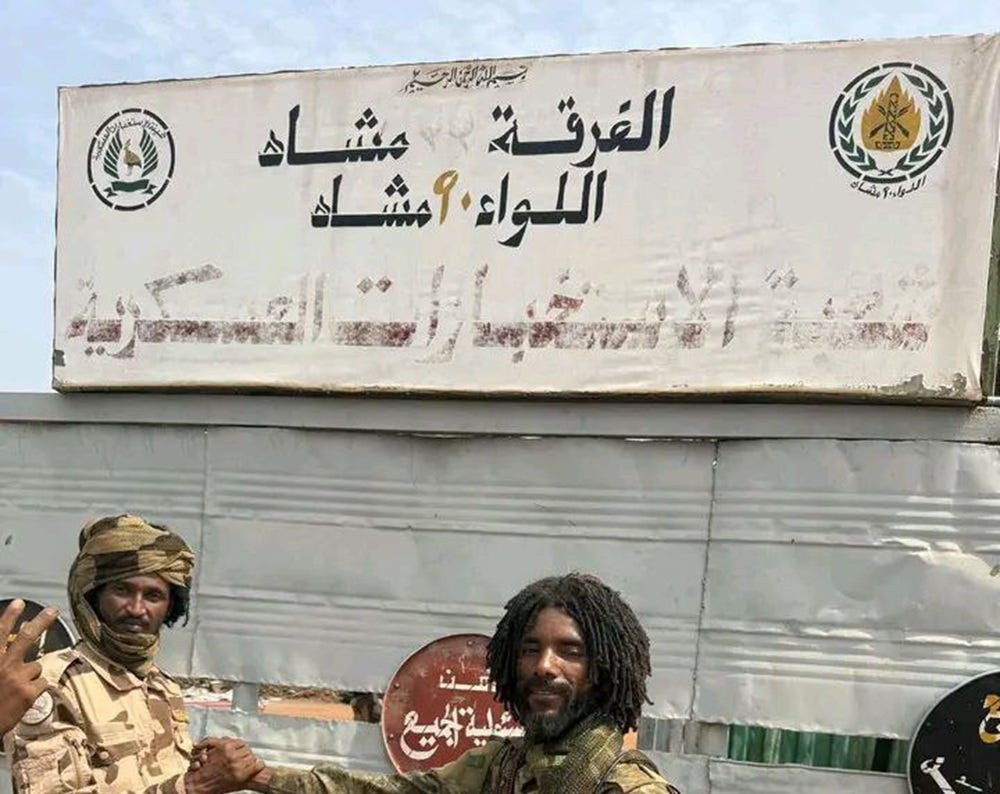
Videos reviewed and geolocated by Sudan War Monitor show RSF fighters inside the headquarters of the SAF 90th Infantry Brigade, confirming the collapse of the final brigade of the 22nd Infantry Division. RSF troops are also seen in a video celebrating beside an abandoned tank and a disabled armored vehicle, highlighting the scale of the army’s disintegration as its defensive perimeter around the oilfield evaporated.
Heglig, situated on the border with South Sudan’s Unity State, is Sudan’s most strategic petroleum facility and the transit point for South Sudan’s crude exports to Port Sudan — making the RSF takeover a development with immediate regional implications.
The RSF released a lengthy statement shortly after its fighters established control over Heglig, seeking to frame the capture of the oilfield as a decisive shift in the broader conflict. The statement also appeared aimed at reassuring regional actors—especially South Sudan—that oil facilities and transit flows would not be targeted.
“The brave Rapid Support Forces (RSF) on Monday morning successfully took control of the strategic area of Heglig in South Kordofan State after the terrorist Muslim Brotherhood army fled the area.
“The liberation of the Heglig oil zone marks a pivotal point in the path toward freeing the entire homeland, given the area’s economic importance as a major resource that the Port Sudan clique [SAF] has long relied upon to finance, expand, and prolong the war.”
“Our forces affirm that they will secure and protect all vital oil facilities in the area to safeguard the interests of the people of the sisterly Republic of South Sudan, who depend heavily on oil that flows through Sudanese territory to global markets.”
“We further reiterate that we will provide full protection to all engineering and technical teams and workers in the oil facilities, ensuring an environment that allows them to carry out their duties safely.
“We reaffirm our full commitment to the humanitarian truce announced by us, while maintaining our inherent right to self-defense as guaranteed by international law.”
Sudan War Monitor Is Reader-Supported
This work is possible thanks to the generous support of subscribers and donors. Sudan War Monitor is independent and does not support any party in the ongoing conflict. We report on conflict events, human rights abuses by all warring parties, peace efforts, and the humanitarian consequences of the war.
Sudan Army Units Flee into South Sudan
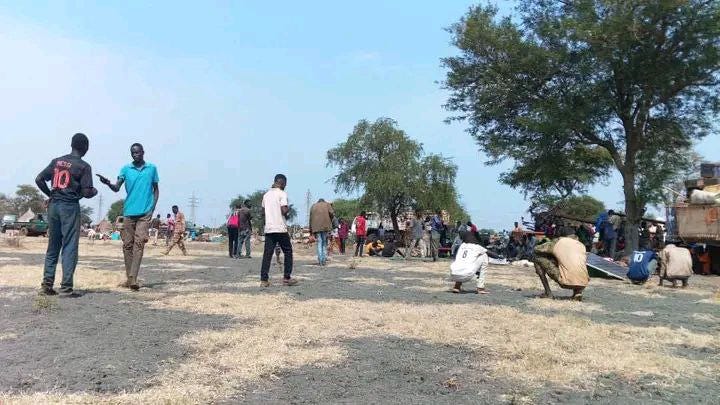
Following the collapse of the SAF garrison at Heglig, hundreds of soldiers fled south across the border into South Sudan. Multiple local and military sources told Sudan War Monitor that the troops arrived in Pan Akuach, a border village in northern Unity State, after abandoning their positions in Heglig.
South Sudanese officials said the soldiers arrived without coordinated withdrawal and are now being held in temporary locations pending further assessment. RSF units briefly entered South Sudanese territory during the pursuit and made limited contact with South Sudan People’s Defence Forces (SSPDF) personnel before withdrawing.
In this video, RSF soldiers appears with a senior South Sudan army officer saying they have “entered South Sudan by mistake.”
The interaction was described as non-hostile, but the brief incursion underscores the heightened sensitivity of the region, where South Sudan’s economy is heavily dependent on an uninterrupted oil corridor running directly through Heglig.
The RSF’s advance into Heglig is the culmination of a rapid southern offensive that accelerated after the fall of El Fasher freed up significant RSF manpower.
The capture of the North Darfur capital allowed the paramilitary to reallocate experienced units to West Kordofan, overwhelming SAF positions that had been weakened by attrition and cut off from reliable supply routes. The downing of an IL-76 transport aircraft near Babanusa in November further crippled SAF’s ability to support its besieged bases.
Last week, RSF fighters seized Babanusa, headquarters of the 22nd Infantry Division, after a two-year siege. With Babanusa gone, Heglig became the division’s last defensible position — reduced to a single functional brigade that quickly collapsed under RSF pressure.
The fall of Heglig means SAF no longer maintains any operational presence in West Kordofan.
The takeover also raises urgent concerns in Juba, where government revenues depend almost entirely on oil transported through Sudan. Any prolonged instability around Heglig or the pipeline corridor could threaten South Sudan’s fragile macroeconomic stability at a time of severe currency shortages, inflation, and declining production capacity in Unity State.
In recent years, South Sudan’s economic relations with the United Arab Emirates (UAE), the leading international sponsor of the RSF, have become increasingly important.
Videos
In this video, RSF soldiers are seen with a military truck full of ammunition boxes. It was likely captured after an attempt to also withdrew the ammunition by the fleeing Sudanese army soldiers.
In this video, an RSF soldier calls his colleagues telling them to return as they have entered South Sudan.
Photos
RSF soldier with captured ammunition in Heglig:


These photos shows remnant of Sudanese army soldiers in Pan Akuach, South Sudan with their vehicles and trucks packed. This photos were shot here: 9°36’19.35”N 29°37’30.77”E.

