

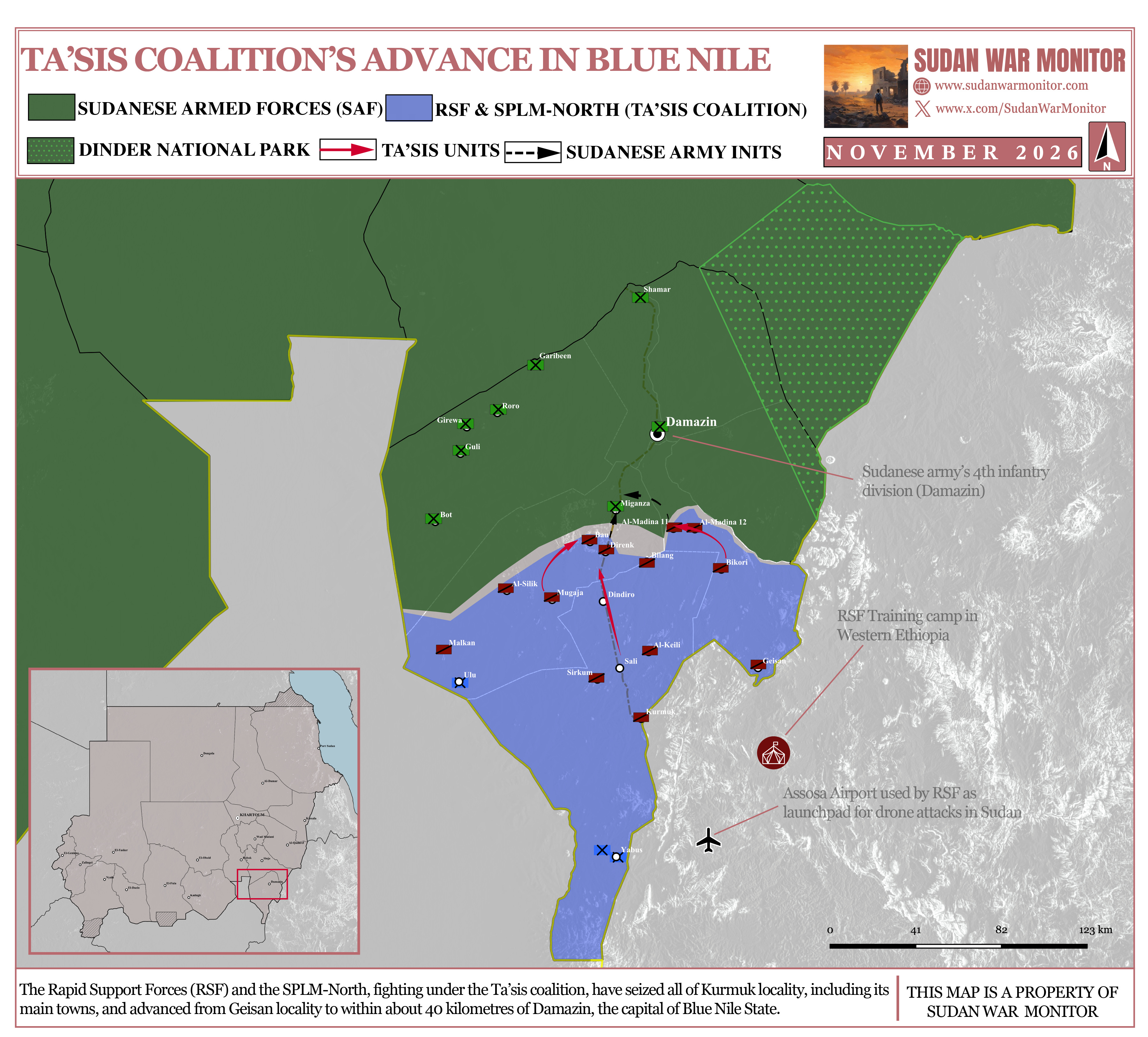
The Rapid Support Forces (RSF) and the Sudan People’s Liberation Movement–North (SPLM-North) advanced on two fronts in Blue Nile State on Thursday and Friday, taking Bau locality headquarters and entering Madina 11 in Geisan locality.
The advance in Geisan brought the fighting to within about 40 kilometers of Damazin, the state capital, where some residents have begun leaving for fear that the fighting will reach the city.
On Thursday, the allied forces entered Bau, the administrative seat of the locality of the same name. Videos filmed by RSF fighters and verified by Sudan War Monitor shows them outside the headquarters building.
Their arrival followed the withdrawal of army units from the town to a smaller town called Miganza, about 20 kilometers to the north. That town lies along the main road toward the state capital, Damazin.
RSF fighters filmed this video in front of Bau locality headquarters on November 19. Sudan War Monitor geolocated the footage to the front of the headquarters building: 11°19’50.44”N 34° 3’50.78”E.
Sudan Tribune, quoting unnamed military sources, reported said the withdrawing troops included former fighters from Malik Agar’s faction of the SPLM-North who had been integrated into the Sudanese army.
The allied forces also took Dayreng, about 8 kilometers to the southeast, on Thursday afternoon. Control of Dindiro, southeast of Bau in neighboring Kurmuk locality, remains unconfirmed.
The force that entered Bau came from within Bau locality, but Sudan War Monitor has been told by security sources that the army in Dindiro withdrew a day before RSF attack on Bau toward Dayreng where they withdrew towards the direction of Damazin on Thursday after fighting with the RSF.
In Geisan locality, the RSF and its allies attacked Madina 12 on Thursday and entered Madina 11 on Friday. The video below from Madina 11 establishes that RSF fighters reached the area on November 20.
The two operations put pressure on the army in separate parts of Blue Nile, with the fighting in Geisan taking place closer to Damazin than the fighting around Bau, which is about 65 kilometers southwest of Damazin.
RSF fighters filming in front of Madina 11 Health Centre. Sudan War Monitor geolocated this video to 11°24’58.62”N 34°23’30.06”E.
The fighting in Blue Nile involves two factions of the SPLM-North on opposing sides. The faction fighting alongside the RSF forms part of the Ta’sis coalition ande is led by Abdelaziz Adam Al-Hilu.
Former members of Malik Agar’s faction serve with the Sudanese army and were among the force that withdrew from Bau, according to the military sources who spoke to Sudan Tribune. The presence of SPLM-North fighters on both sides reflects a split that predates the current civil war.
Residents Flee Damazin
Some residents of Damazin have left as fighting has moved closer to the city. Elham Kamal, a resident who spoke to Radio Tamazuj, said others wanted to leave but could not afford to travel to safer areas.
Ehab Al-Sir, a civil society activist, urged the authorities to give residents clear information about the security situation and prepare for further displacement.
The departures come as people displaced from other parts of Blue Nile continue to arrive in the capital. Bau locality commissioner Abdel Ghani Dagais told a local television on Friday that residents of 35 villages had fled to Damazin following attacks by the RSF. He gave no estimate of the number of people displaced.
Other families have sought shelter elsewhere in Blue Nile. Humanitarian activists told Sudan Tribune that about 500 families had fled Bau locality for Balang, Shitio, and Shitalwa, while roughly 309 families left Madina 12 for Bakori, Yara, and Bambadi.
Another 600 families from Wad al-Mahi reached Al-Mahal, where people displaced by earlier fighting were already sheltering. The figures describe movements on several routes across the state. Aid agencies have reported shortages of food, shelter, and basic services among displaced communities.
Multiple Sudanese army sources told Sudan War Monitor today that it had deployed reinforcements to Blue Nile as new military leadership took command in the state. On Friday, the regional government said it was working with military and political leaders to mobilize more troops and equipment.
A Sudanese news outlet, Al-Zool, also reported the arrival of reinforcements. The size of the force and where it was deployed have yet to be independently established.
Saif al-Nasr Minallah, a spokesperson for the Blue Nile government, urged residents to remain calm in a televised address on Friday. He denied that the advancing fighters were nearing Damazin and said the regional government was coordinating with the army’s 4th Infantry Division.
Army Advances Toward Al-Nahud
The Blue Nile offensive coincides with a Sudanese army advance in the opposite part of the country. The military and allied armed groups entered Al-Khuwai, the headquarters of Al-Khuwai locality in West Kordofan, on November 13 and continued west toward Al-Nahud.
The RSF had held Al-Khuwai since May 2025 and this is the first time the military to reach West Kordofan in over a year. The army and its allies also took Al-Morkib, about 60 kilometers east of Al-Nahud, during the offensive.
The offensive began on November 5 outside El-Obeid, the capital of North Kordofan. The army, the Joint Force of former Darfur rebel movements, and allied Islamist militias attacked on two fronts.
The western advance reached Umm Sumayma, while another force moved south through Kazgil toward Al-Hamadi. The army subsequently widened its offensive toward Al-Khuwai, forcing the RSF to withdraw from several positions west and southwest of El-Obeid.
The offensive in Blue Nile may be intended in part to draw Sudanese army troops and equipment away from Kordofan. By bringing the fighting closer to Damazin while the army pushes toward Al-Nahud, the RSF and its allies are forcing the military to contend with pressure on two fronts.
The army has already sent reinforcements to Blue Nile. It remains unclear where those units came from or whether their deployment has affected the advance toward Al-Nahud.
If the fighting around Damazin requires further reinforcements, the army could have fewer troops and less equipment available to sustain its offensive in West Kordofan.
Support our journalism

Sudan War Monitor is a collaborative of journalists and open source researchers tracking the events of Sudan’s war and the search for solutions. We’re building a platform to battle disinformation and warmongering and amplify the voices of victims, humanitarians and peacemakers.