
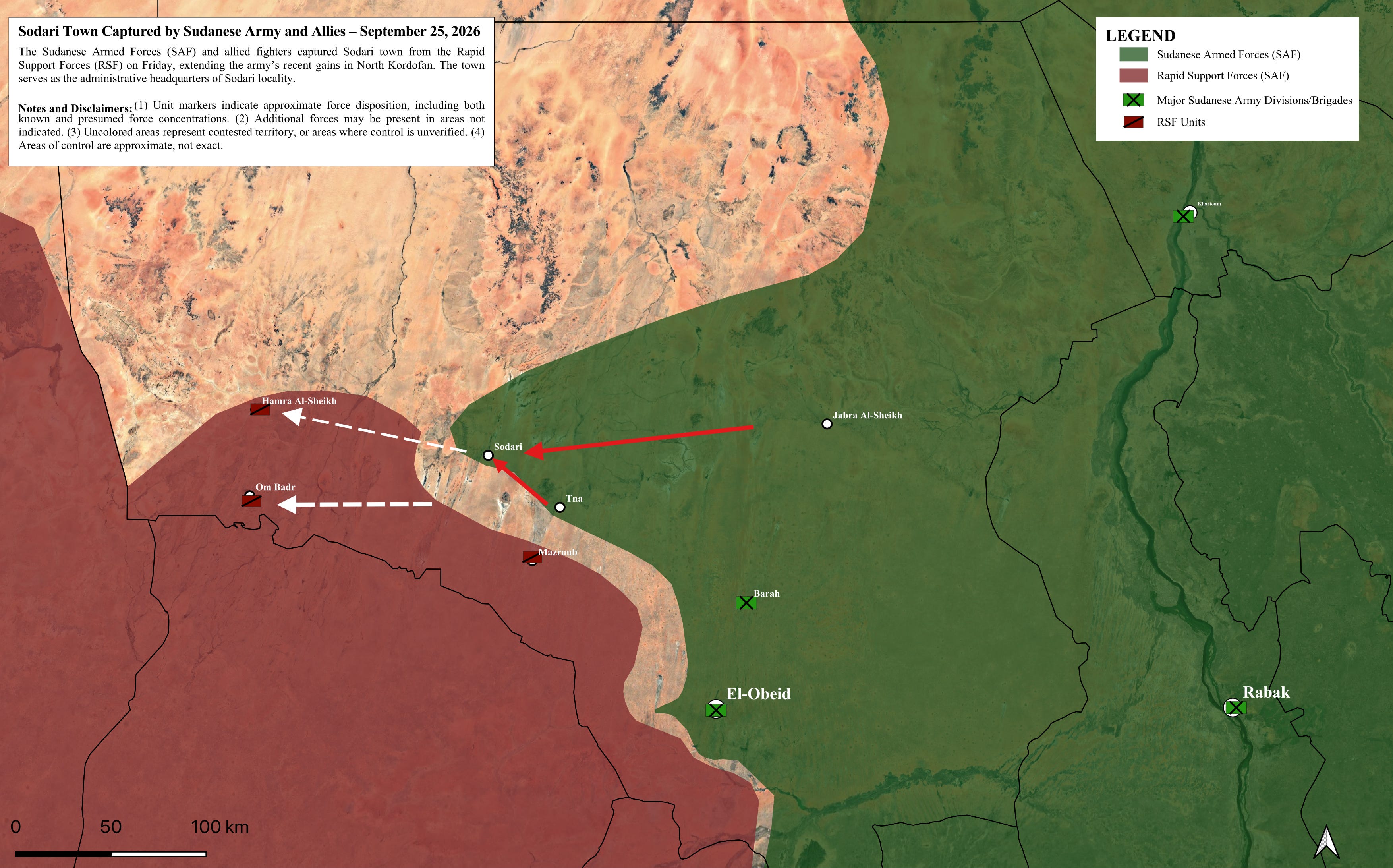
The Sudanese Armed Forces and their allies from the Joint Force of former Darfur rebel movements obn Friday seized control of Sodari town, dealing the Rapid Support Forces (RSF) another defeat in North Kordofan as an offensive against its remaining positions in the state continued.
Videos geolocated by Sudan War Monitor confirmed the presence of Sudanese army elements and allied fighters in several locations inside the town, which serves as the administrative headquarters of Sodari Locality.
For example, the video below shows fighters from the Joint Force of Armed Struggle Movements (JSAMF) in front of Warm Sea Fuel Station in the western edge of Sodari town. Sudan War Monitor geolocated the footage to 14°24′31.98″N, 29°5′27.11″E.
In this video, Joint Force fighters film themselves outside a fuel station on the southwestern side of Sodari town, at [14°24′31.98″N, 29°5′27.11″E]. Their presence there suggests that SAF and allied forces had advanced across the town from their eastern and northern approaches by the time the footage was recorded, although the video alone does not establish full control of the town.
The army’s arrival follows premature claims that its forces had captured Sodari during the opening days of the offensive. In our September 21 report, we established that a video presented as evidence of the town’s capture had instead been filmed in Al-Qa’a, about 100 kilometers to the east.
Other footage at the time placed the army in Tna, southeast of Sodari, while an RSF video showed its fighters outside Sodari Hospital. The available evidence therefore confirmed advances toward the town, but did not support claims that the locality headquarters had already fallen.
Friday’s capture removes the RSF from another administrative centre in North Kordofan. However, the paramilitary still controls Umm Badr and Hamrat al-Sheikh, both to the northwest but located within Sodari locality. Control of the town does not mean the army has taken the entire locality, which extends across a large area bordering Darfur and West Kordofan.
In the second video below, members of the Sudanese army are seen in front of the Sodari branch of the National Health Insurance Fund. Sudan War Monitor geolocated the footage to 14°24′32.11″N, 29°5′32.84″E.
Soldiers from the Joint Force are see outside the Sodari Health Insurance Fund in Sodari locality. This video was shot here: 14°24′32.11″N, 29°5′32.84″E.
The Sudanese army announced Sodari’s capture in a statement issued almost immediately after entry of its forces to the town. The army spokesman said its troops and supporting forces had taken the area after fierce fighting and claimed to have inflicted heavy losses on the RSF.
The army said operations were continuing on several fronts to recover territory held by the paramilitary, describing the Sodari advance as part of that campaign.
“Your Armed Forces and supporting forces continue, with unyielding determination and unbreakable resolve, to conduct operations across the battlefronts to reclaim the homeland from the terrorist Dagalo family militia and its mercenaries.”
“With God’s help and guidance, our forces today liberated the Sodari area in North Kordofan State following fierce battles that inflicted heavy losses in personnel and equipment on the terrorist militia.”
“Your Armed Forces renew their pledge to remain faithful to the homeland, drawing strength from the steadfastness of the people, the sacrifices of the martyrs and the courage of the heroes in the field.”
“We pray for paradise and eternal life for the martyrs who marked the path of honour and dignity with their blood, a speedy recovery for the wounded and injured, and the safe return of prisoners and the missing.”
The military did not provide casualty figures or details of equipment destroyed or captured. Sudan War Monitor could not independently verify the extent of the RSF losses claimed in the statement.
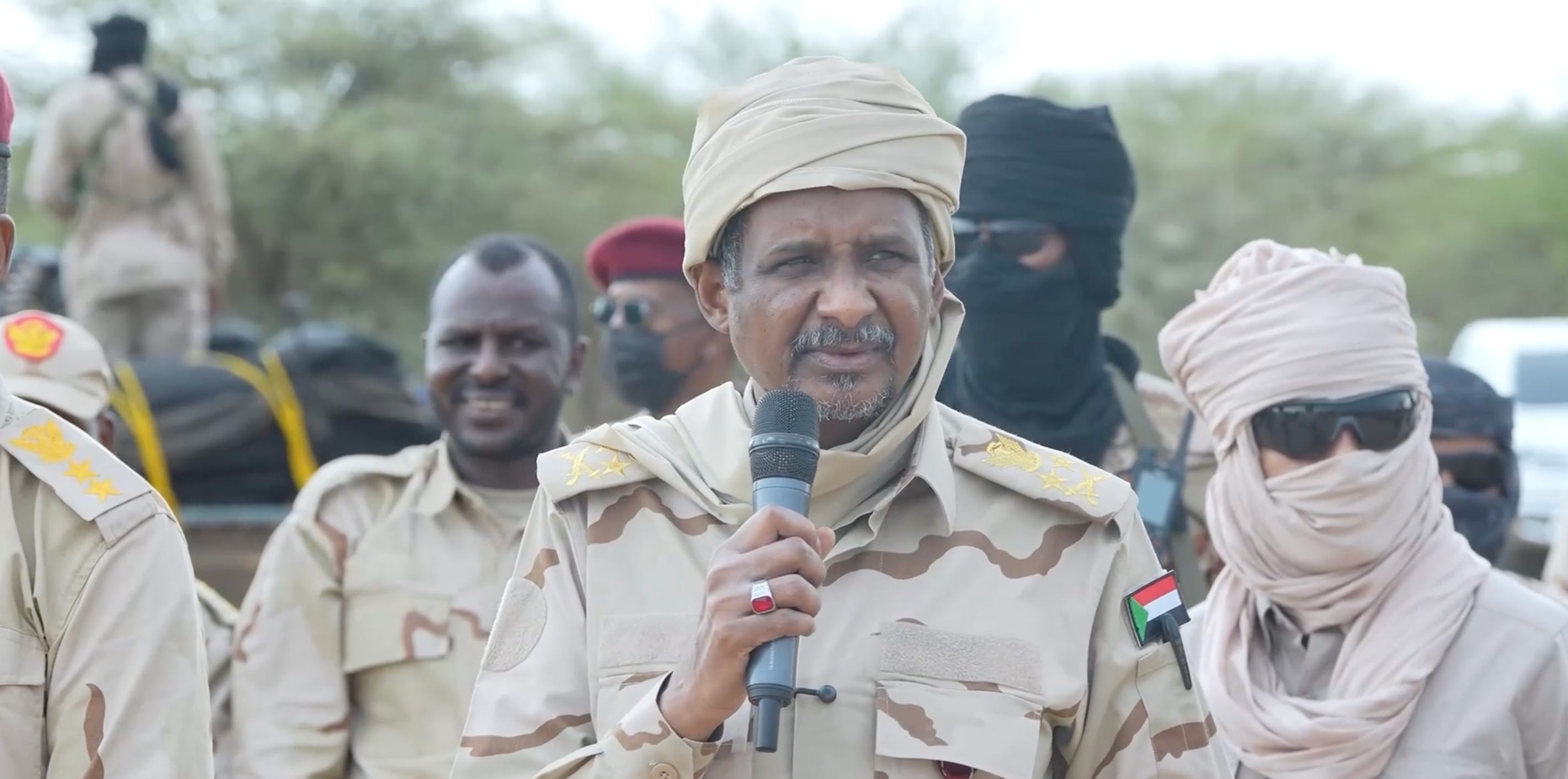
Sodari’s fall comes days after RSF commander Mohamed Hamdan Dagalo, known as Hemedti, saw off a force heading toward Kordofan in an effort to slow the army’s rapid advance. The column was named “Martyr Mudawi,” after a deceased RSF commander.
Addressing the fighters before their departure, Hemedti promised further military action and said the next stage would be decided by force, declaring that “ from now on it is the gun that speaks.”
Hemedti was speaking before an assembled force and pledging to fight ahead of his men rather than behind them. He also praised the commander after whom the column was named.
Hemedti urged the fighters to follow their commanders’ instructions and said military operations required experience and discipline alongside courage. He told them to protect civilians and instructed them not to kill prisoners captured alive.
The RSF leader also discussed the handling of equipment and supplies, and said the leadership would remain in contact with field commanders. His remarks included assurances about wounded fighters and the families of those killed.
It remains unclear whether the Mudawi column reached Sodari before Friday’s battle or whether its fighters participated in the town’s defence. The capture nevertheless shows that the army continued advancing on this front after the RSF publicly announced the deployment of reinforcements.
The offensive began on September 17, with army and allied forces advancing west toward Sodari while separate units attacked RSF positions west of El Obeid, the North Kordofan capital. The operation has targeted positions the paramilitary retained after losing several major towns in July.
Earlier in the offensive, the RSF said it had repelled an army attack on Abu Qa’ud and seized weapons and ammunition. Sudan War Monitor documented army forces in nearby Mamsuka, but could not independently verify the RSF’s account of the losses it claimed to have inflicted.
Those separate fronts remain important to the army’s objective of controlling North Kordofan. The capture of Sodari advances that campaign in the northwest, while RSF positions around El Obeid continue to prevent the military from claiming control of the whole state.
Sodari locality borders North Darfur to the west, West Kordofan to the southwest and West Bara locality to the south. Its administrative headquarters was among the important towns the RSF retained after the army recovered much of North Kordofan’s main road network.
The July offensive brought Bara, Jabrat al-Sheikh and other settlements along the highway between El Obeid and the Khartoum region under army control. That advance restored a direct road connection and removed the RSF from towns it had used to put pressure on El Obeid from the north.
The highway, also known as Al-Sadarat (and sometimes Al-Inqaz Al-Qarbi) Highway, had also provided the paramilitary with a route for moving fighters and supplies between Kordofan and areas closer to Omdurman. Losing the towns along it weakened that connection, although RSF units remained active away from the main road.
Sudan War Monitor warned in its July coverage that reopening the highway did not guarantee security throughout the surrounding areas, but the current SAF advance provides a security buffer for those areas.
Support our journalism
Thank you for reading Sudan War Monitor. We do this work because we believe that journalism is one accountability mechanism that ultimately can contribute toward peace and justice in Sudan—however distant that hope may be. Our work is intended to be a resource for humanitarians, civil society, ordinary Sudanese, diplomats, and news media. Subscribe or share to support our work and #KeepEyesonSudan.