
The Sudanese Armed Forces (SAF) and their allies from the Joint Force of Armed Struggle Movements (JSAMF) announced on Saturday that they had successfully repelled a major assault by the Rapid Support Forces (RSF) on El-Fasher, the capital of North Darfur state.
Eyewitnesses who spoke to Sudan War Monitor on Saturday evening described the RSF assault, which began at around 6:00 a.m. local time from multiple directions as the “mother of all attacks” on El-Fasher. The assault was noted for its intensity, being described as the fiercest since the conflict erupted in April 2023, resulting in an unspecified number of civilian casualties.
“Our forces today crushed a major attack by the terrorist Dagalo militia on the city of El Fasher, inflicting heavy losses on them,” said SAF spokesman Nabil Abdallah following the fighting. However, he did not provide further details about the battle.
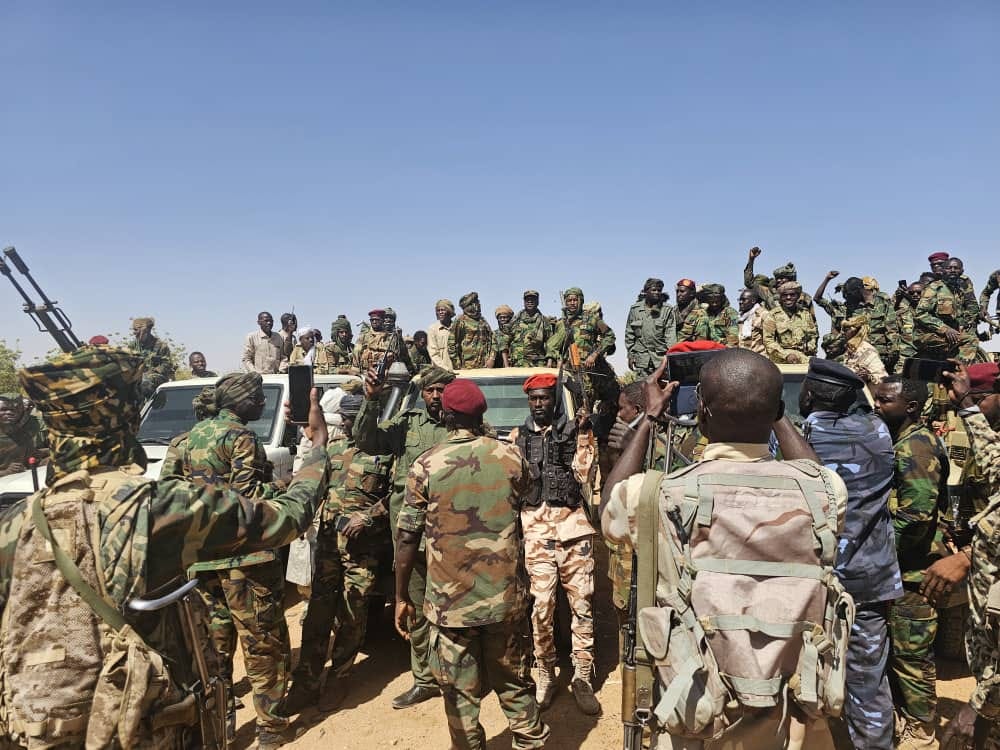
Videos posted online by RSF fighters showed most of the combat concentrated on the outskirts of El Fasher rather than inside the city itself. In one video, for example, RSF fighters were seen on a highland west of El Fasher firing while overlooking SAF soldiers and their allies.
Another video footage shows RSF troops occupying a former United Nations African Union Mission in Darfur (UNAMID) base southwest of El Fasher.
However, despite the SAF and its allies characterizing the assault as “major” attack, RSF fighters appeared less heavily armed than usual, raising questions about the level of preparation or the central command’s organization for the offensive.
Sudan War Monitor was unable to verify reports that Abdelrahim Dagalo, the deputy commander of the RSF, was leading the attack. Abdelrahim is the elder brother of Mohamed Hamdan Daglo, the RSF commander who is largely known by his nickname “Hemedti”.
In a statement, the Joint Force, which is allied with the army, claimed that the RSF initiated the attack with shelling before launching a ground assault from four directions. The statement said the attack was thwarted, with hundreds of RSF fighters killed or captured—a claim that could not be independently verified, though both sides circulated videos showing numerous war dead.
“The terrorist Rapid Support Forces militia attempted to invade the city of El Fasher from all directions: north, east, west, and south. After massing thousands of mercenaries from neighboring countries in recent months and receiving a shipment of modern weapons from their regional sponsor [UAE], the attack on the city began at 6:00 in the morning with artillery shelling and infantry infiltration.
“Our joint forces, the Sudanese army, and the Popular Defense Force engaged in a heroic battle to confront these thugs. The clashes continued for more than 6 hours across the four axes, and our forces taught the terrorist Dagalo mercenaries lessons in combat, killing hundreds of them and repelling all attacking forces.
“The remnants of the mercenaries fled outside the city, and our forces are now pursuing them and combing the outskirts of the city in search of remaining infiltrators. Now, after the failure of the ground attack, the militia has resorted to its old habit of relying on heavy artillery shelling from outside the city to target displacement camps, hospitals, and service centers. We reassure the Sudanese people in all parts of the country that El Fasher is steadfast and will remain steadfast until the country is purged of the tyranny of the Rapid Support Forces militia. We will provide you with further details as soon as security is fully restored in the city,” the joint force’s statement reads.
Combat videos filmed by SAF fighters and their allies from the former rebel movements show them inspecting the outskirts of El Fasher, suggesting that the RSF did not penetrate deep into the city. The RSF appears to have limited its incursion to the southwestern part of the city, occupying the old Zamzam camp, which also serves as a former UNAMID base.
El Fasher remains the only Darfur state capital where the SAF still maintains a presence. The RSF has taken control of the 15th Infantry Division in West Darfur, the 16th Division in South Darfur, the 20th Infantry Division in East Darfur, and the 21st Infantry Division in Central Darfur.
The city was relatively calm on Sunday after the fighting that killed at least 17 civilians and wounded over 140, according to medical sources at the specialized Saudi Hospital. Most victims were civilians from displacement camps and nearby neighborhoods, Darfur 24 reported.
The city’s healthcare system is overwhelmed, with many facilities damaged and a critical shortage of medical supplies.
Securing El-Fasher, which serves as the headquarters of the 6th infantry division, would give the RSF full control of the entire Darfur region, though pockets of armed movements such as the SLM-MM and JEM would continue to operate in the rural areas.
Since the onset of the war, the RSF has made repeated attempts to capture El Fasher, including a major offensive in mid-June that resulted in the killing of their top commander, Major-General Ali Yagoub, by the Joint Force.
Fighting against the RSF in El Fasher is largely conducted by the Joint Force comprised of former rebels. These former rebels’ combat tactics and strategies bear striking similarities to those of the RSF.
This unique experience has made it challenging for the RSF to overrun El Fasher, in contrast to other Sudanese cities where the SAF has been more easily ousted. Notably, the demographic profile of the RSF, predominantly composed of young men, mirrors that of the JEM and SLA, whose ranks have swelled in recent months with thousands of young fighters.
Saturday’s fighting follows numerous other clashes around El Fasher that continue in spite of a demand by the UN Security Council that the RSF refrain from attacking the city. The United States, too, which is now leading efforts for a badly needed ceasefire, has warned against fighting in El Fasher. In May, the U.S. sanctioned two RSF commanders, Ali Yagoub Gibril, who was killed in June while leading an offensive on El Fasher, and Osman Mohamed, the RSF’s overall operations commander, for their roles in attacks on the city. The U.S. stated:
“Attacks by the RSF, the Sudanese Armed Forces, and allied forces have caused civilian casualties and must immediately cease, as should the external support for warring parties. All impediments to humanitarian access—at a time when millions are at risk of starvation due to conflict—must be removed.”
More videos from El Fasher
These videos show Joint Force troops operating on southern outskirts of El Fasher.
Hemedti accuses SAF of undermining peace initiatives
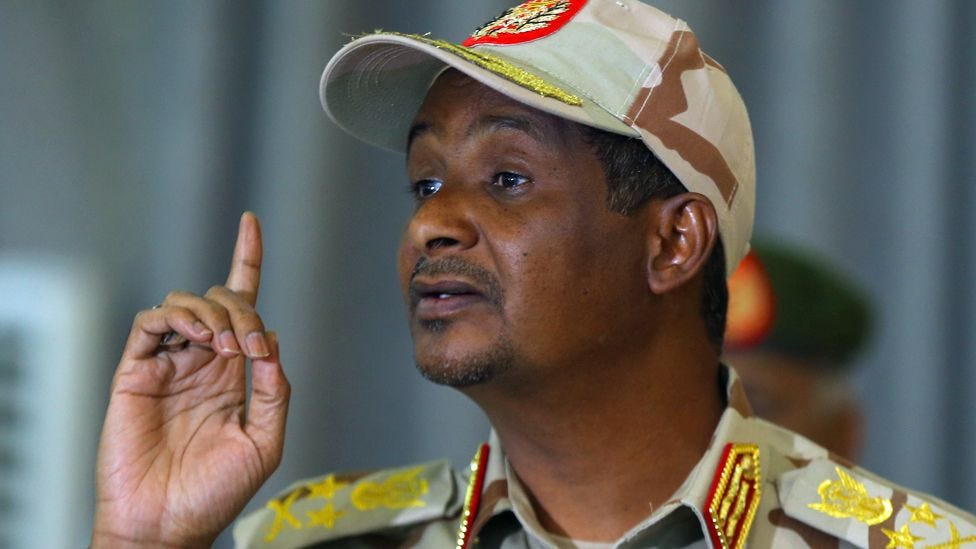
RSF commander Mohamed Hamdan Dagalo, known as Hemedti, on Monday renewed his accusations against the Sudanese Armed Forces (SAF) leadership, accusing them of sabotaging all peace and negotiation efforts “at the behest of the Islamist movement.”
In a pre-recorded video posted on his social media pages handle, Hemedti reiterated his forces' commitment to participating in the U.S.-led Geneva talks scheduled for August 14. He affirmed their acceptance of the U.S. invitation, expressing a firm desire to immediately cease hostilities and end the suffering of millions of Sudanese.
“This is our firm and unwavering commitment to the Sudanese people to go to the upcoming negotiations with a genuine desire to immediately stop the war without delay, in the hope of ending the suffering of millions of Sudanese. Therefore, we call on the other party to respond to the call for peace... We make this call with all courage despite our victory on the battlefield,” he said.
Hemedti argued that there is no legitimate government in Sudan following the October 25 coup and the outbreak of war on April 15, which he claimed led to a “complete constitutional collapse” in the country. He described Sudan's de facto government as a “gang in Port Sudan”. The current military-led government operates from Port Sudan.
The SAF had previously set several conditions for attending the Geneva talks, including participation as a government and not as the army. The invitation of the SAF to the negotiations as military rather than as a government puts the legitimacy of the SAF-led Transitional Sovereign Council in question.
Hemedti criticized the SAF preconditions for attending the Geneva talks, including the insistence on representing the government rather than the military. He detailed the RSF's participation in various peace initiatives, including the Saudi-U.S. initiative and the IGAD summit, where he claimed the SAF repeatedly obstructed agreements under pressure from the Islamist movement.
He also accused the SAF of delaying the Geneva talks and failing to commit to delivering humanitarian aid and protecting civilians, as the RSF has pledged to do.
News in brief
SAF Commander Abdelfattah Al-Burhan in his capacity as the head of the military-controlled Transitional Sovereign Council has met Rwanda President Paul Kagame in Kigali where Al-Burhan was to attend Kagame’s inauguration after winning an election three weeks ago. He met with Egypt’s foreign minister on the sidelines of this event.
RSF commander Mohamed Hamdan Daglo has called for an international probe into who ignited the ongoing conflict in Sudan. In a speech today, Daglo asserted that the RSF has consistently prioritized peace over war and has been receptive to all proposed peace initiatives. He accused the Islamist movement of interfering with the peace process and announced the formation of a special force tasked with protecting civilians in areas under the RSF's control.
A second round of talks aimed at jump-starting Sudan's stalled political transition began in the Ethiopian capital on Friday. The talks drew in previously absent opposition groups, including the Coordination of Civil Democratic Forces, Sudan's anti-war movement led by former Prime Minister Abdallah Hamdok. This group had boycotted the July consultations, accusing organizers of lacking transparency and granting undue influence to elements of the former regime.
The SAF on Saturday repelled an RSF attack on the border between Gadaref and Al Jazira states, according to Othman Abdallah, Executive Director of Al-Faw locality. He claimed the army destroyed 15 RSF vehicles, inflicted heavy casualties, and made advances towards Al Jazirah state. The border region has seen sporadic fighting for months, with a previous army offensive in April halted by RSF ambushes.
Support our journalism
Thank you for reading Sudan War Monitor. We do this work because we believe that journalism is one accountability mechanism that ultimately can contribute toward peace and justice in Sudan—however distant that hope may be. Our work is intended to be a resource for humanitarians, civil society, ordinary Sudanese, diplomats, and news media. Subscribe or share to support our work and #KeepEyesonSudan.