
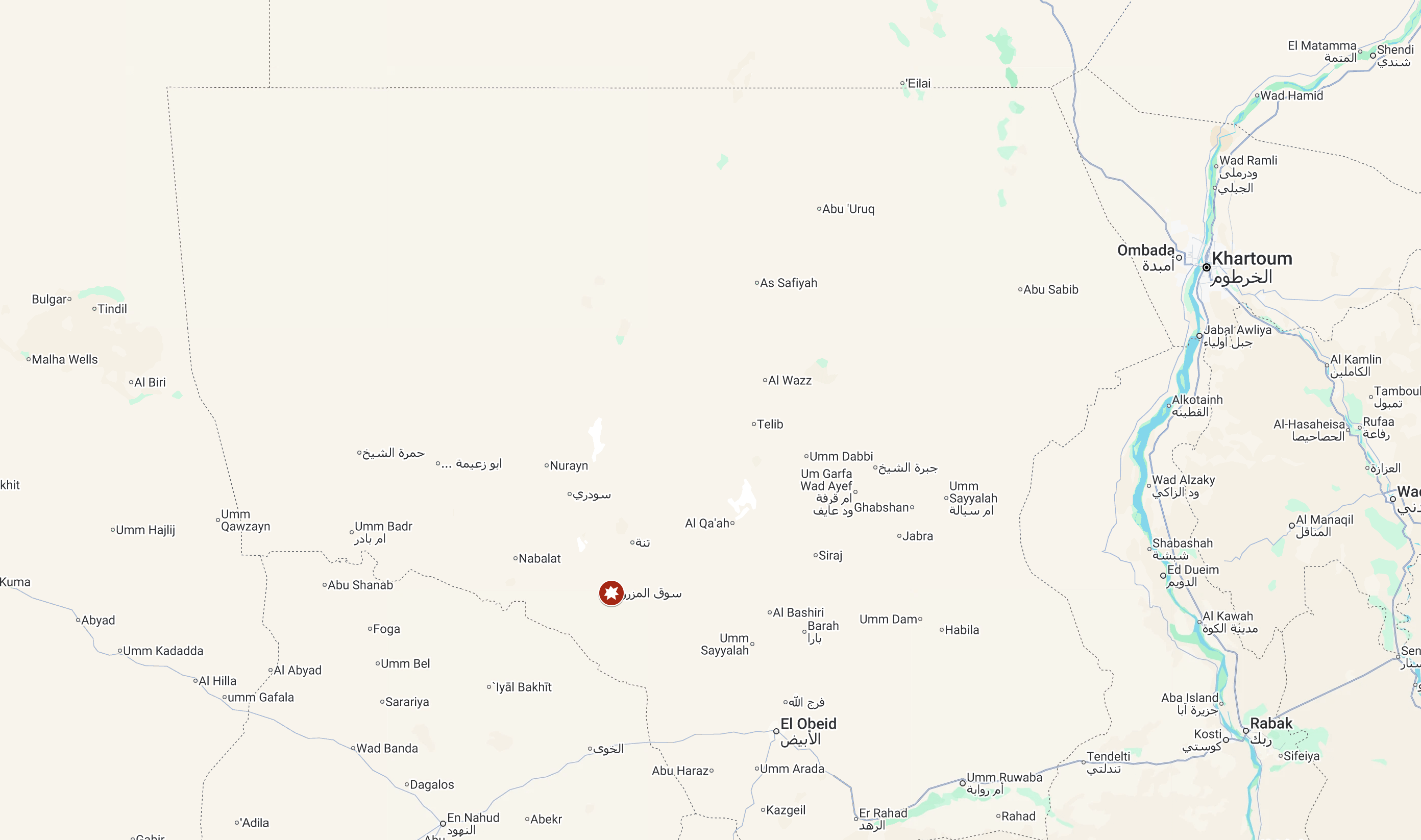
The Sudanese Armed Forces (SAF) on Friday captured Mazroub, the administrative capital of West Bara Locality in North Kordofan, continuing an offensive that has pushed the Rapid Support Forces (RSF) out of much of the northern and northwestern parts of the state.
Videos reviewed and geolocated by Sudan War Monitor confirm the presence of Sudanese army and Joint Force elements in several parts of the town. For example, the video below shows members of the Joint Force in front of the Mazroub court, located in the city center, here 13°54’0.29”N 29°18’55.71”E.
Elements of the Joint Force of Armed Struggle Movements (JSAFM) filming in front of Mazroub Court here: 13°54’0.29”N 29°18’55.71”E.
In a statement following the capture of the town, the Sudanese military said its forces and allied groups captured Mazroub following what it described as fierce fighting, though Sudan War Monitor has not found evidence of fighting in the town.
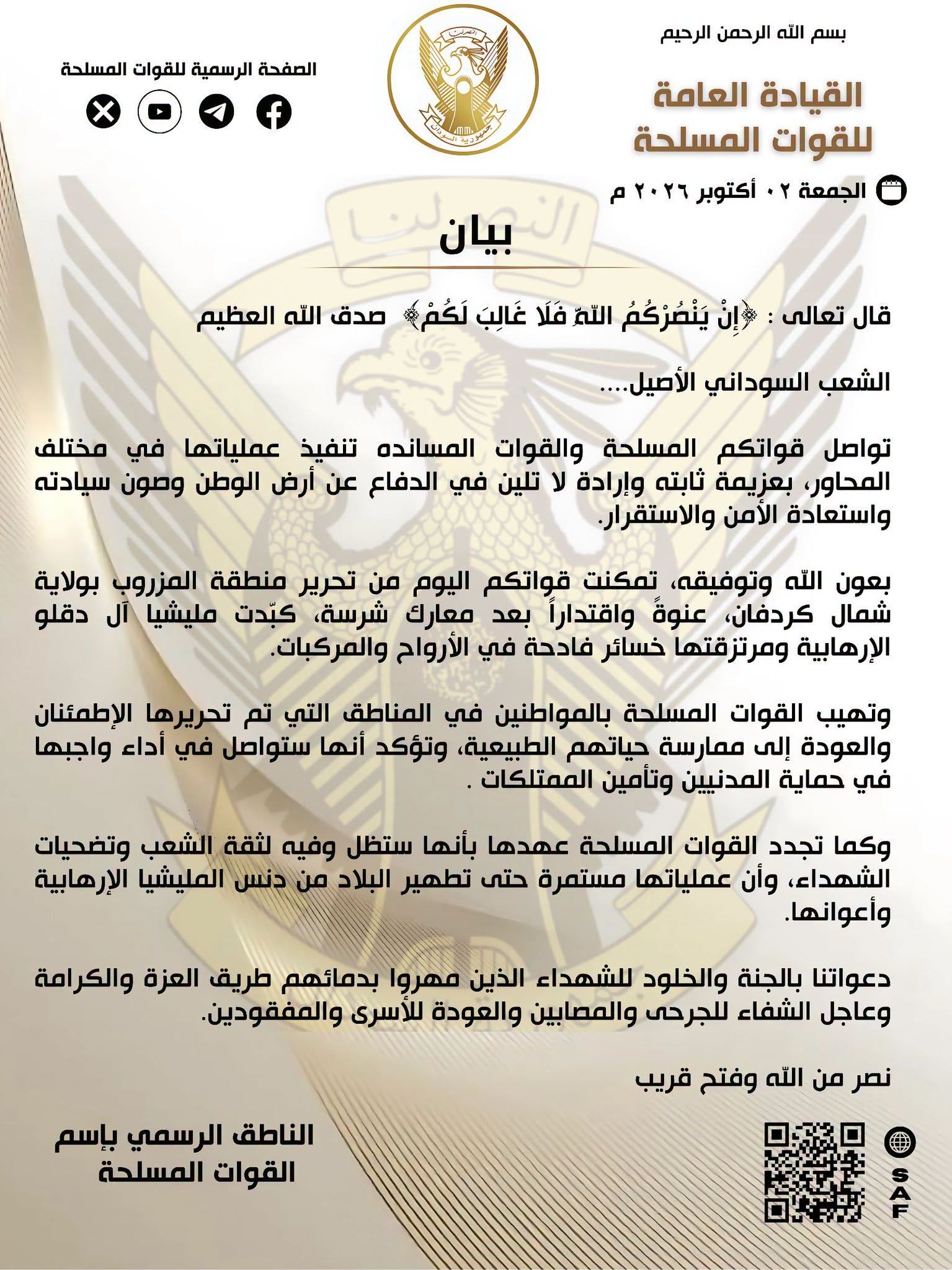
The military did not provide casualty figures or details of vehicles destroyed or captured. Sudan War Monitor could not independently verify its claims concerning RSF losses. The army also urged residents in areas captured by its forces to return to their normal activities.
“Your Armed Forces and supporting forces continue to carry out operations on various fronts with steadfast determination and an unyielding will to defend the homeland, safeguard its sovereignty, and restore security and stability.”
“With God’s help and guidance, your forces today succeeded in liberating the Mazroub area in North Kordofan State by force and determination after fierce battles, inflicting heavy losses in personnel and vehicles on what the Armed Forces described as the ‘terrorist Dagalo family militia’ and its mercenaries.”
“The Armed Forces call on citizens in the areas that have been liberated to remain reassured and return to their normal lives. They affirm that they will continue carrying out their duty to protect civilians and safeguard property.”
“The Armed Forces also renew their pledge to remain faithful to the trust of the people and the sacrifices of the martyrs, and state that their operations will continue until the country is cleared of what they described as the ‘terrorist militia’ and its supporters.”
“We pray for paradise and eternal rest for the martyrs who paved the path of pride and dignity with their blood, for a speedy recovery for the wounded and injured, and for the return of prisoners and missing persons.”
The RSF had not issued a statement on the loss of Mazroub at the time of publication. Both sides in Sudan’s war have often refrained from publicly acknowledging territorial losses, a common wartime practice aimed at preserving troop morale and avoiding disruption along other fronts.
In this video, Sudanese army soldiers celebrate with residents of Mazroub in an area located to the west of the town here: 13°54’15.26”N 29°18’35.64”E.
Mazrub had remained under RSF control after the army launched a large large scale offensive in northern North Kordofan in July in which it opened the Al-Sadarat Highway (also known as Al-Inqaz Al-Qarbi Road) and siezed contro of Jabra Al-Sheikh, Umm Sayalla, Barah and several other towns along the highway.
The capture of those towns followed by another phase of the same offensive in which the SAF seized control of Kajmar, Sharshar, Al-Baniya Al-Kurayniya, Al-Qulai’at, Awlad Hizma, Maquldat, Rishan, Al-Qa’a, Al-Laqad Forest and Al-Kukaiti, as well as areas surrounding Mazroub.
Last week, the Sudanese military captured the town of Sodari, the administrative headquarters of Sodari Locality, and pushed RSF further north to Umm Badr and Hamrat al-Sheikh and south to Mazroub.
The loss of Mazroub leaves SAF in full control of most of North Kordofan’s localities, with the RSF retaining territory mainly in parts of Sodari and Sheikan localities.
In Sodari Locality, the RSF continues to control Umm Badr and Hamrat al-Sheikh despite losing the locality headquarters. In Sheikan Locality, which includes the state capital El Obeid, RSF units remain west of the city around Abu Qa’ud and Umm Sumaima and south of El Obeid around Kazgil.
These positions mean neither Sodari nor Sheikan localities are fully controlled by SAF, even though the army now controls their main administrative centers.
The capture of Mazroub, together with the earlier loss of Sodari and other northern positions, could complicate the situation for RSF units operating west of El Obeid.
Before the latest offensive, the RSF maintained a broad belt of positions north and west of the state capital. The army’s gains farther north could allow SAF and allied formations to approach RSF-held areas in Sheikan Locality from more than one direction.
If the army continues south or southwest from the newly captured areas, RSF forces around Abu Qa’ud and Umm Sumaima could face pressure from their northern flank while also confronting SAF units operating from El Obeid.
Such a development could disrupt RSF movement and supply routes between its positions in Sheikan and areas farther west, potentially forcing units to withdraw or redeploy.
Support our journalism
Thank you for reading Sudan War Monitor. We do this work because we believe that journalism is one accountability mechanism that ultimately can contribute toward peace and justice in Sudan—however distant that hope may be. Our work is intended to be a resource for humanitarians, civil society, ordinary Sudanese, diplomats, and news media. Subscribe or share to support our work and #KeepEyesonSudan.