
Public opinion in Sudan is sharply divided over a U.S. decision to designate the Sudanese Muslim Brotherhood as a “terrorist organization,” a move that U.S. officials explicitly linked to the ongoing campaign against Iran and “the malign influence of Iran” in Sudan.
U.S. Secretary of State Marco Rubio wrote in a press statement,
“The Sudanese Muslim Brotherhood uses unrestrained violence against civilians to undermine efforts to resolve the conflict in Sudan and advance its violent Islamist ideology. Its fighters, many receiving training and other support from Iran’s Islamic Revolutionary Guard Corps (IRGC), have conducted mass executions of civilians.”
Though no group in Sudan goes by the name “Sudanese Muslim Brotherhood,” the State Department asserted in a document circulated Monday that the group is “composed of the Sudanese Islamic Movement and its armed wing, the al-Baraa Bin Malik Brigade (BBMB).”
This definition potentially sets up the United States for conflict with the Sudanese government, because the Sudanese Islamic Movement is deeply intertwined with the Sudanese state and is considered by critical observers to be the unofficial ruling party of Sudan—the shadow power behind the current military government, which purports to be apolitical.
For context, the Sudanese Islamic Movement is an umbrella group of Islamist political parties and leaders, including many former officials of long-time ruling party, the National Congress. It is led by Al Ahmed Karti, who served as foreign minister and deputy foreign minister for ten years.
The group’s armed wing, Al-Baraa Bin Malik, is a paramilitary that fights alongside the Sudanese Armed Forces (SAF). It advocates for Islamist governance and identifies its fighters as mujahideen, or Islamic warriors. It originated as part of the Sudan’s Popular Defense Forces, a paramilitary movement also led by Karti in the 1990s, prior to his ministerial service. The U.S. estimated that the group has at least 20,000 members.
Practically, the new U.S. terrorism designations could impact the ability of Al-Baraa Bin Malik to use U.S.-based social media networks such as Facebook and X, where the group has developed a significant following, as well as WhatsApp, Instagram, and YouTube, and potentially other online services including email platforms, cloud hosting, and digital payment systems.
Additionally, the designation could affect some Sudanese expatriates and Sudanese-Americans, if they provide financial or practical support to Al-Baraa Bin Malik or the Sudanese Islamic Movement. Under U.S. law, it is a federal crime for citizens, residents, or visitors to provide material support to a designated foreign terrorist organization. The offense is punishable by up to 20 years in prison, though in practice sentences are often shorter.
Al-Baraa Bin Malik fighters at a training camp in Sudan’s Northern State, 2025:
Sudanese Opposition Welcomes Designation
Former Prime Minister Abdalla Hamdok and the opposition alliance known as Somoud (“resilience”) welcomed the U.S. terrorism designation. In a television interview, Babiker Faisal, the chair of Somoud’s foreign relations committee, said that placing the Sudanese Islamic Movement on the Foreign Terrorist Organizations list would cut off funding sources and weapons flows to armed groups and leaders fueling Sudan’s civil war.
In a statement, Somoud noted that it had campaigned for such a designation since last year. It claimed that the decision reflects “the will of the majority of Sudanese people who participated in the December Revolution” (pro-democracy protests in 2018-2019, which temporarily ended military rule).

Among professional groups, the Coordination of Sudanese Professionals and Trade Unions and Emergency Lawyers welcomed the decision too. The Sudanese legal organization said:
“This decision represents an important step toward international recognition of the responsibility of the political and organizational networks linked to the Islamic Movement for a wide range of serious human rights violations witnessed in Sudan over past decades. These include arbitrary detention, torture, and enforced disappearances in the so-called ‘ghost houses,’ the suppression of peaceful protest movements, and the use of excessive force against demonstrators.
“This organization [the Islamic Movement] is also linked to a broader context of international crimes committed during armed conflicts in Sudan, particularly in Darfur, the Nuba Mountains, and Blue Nile, which have been documented in multiple international reports as war crimes and crimes against humanity. This decision represents a moral acknowledgment of the suffering of victims of violations in Sudan.”
Additional pro-democracy groups, including the Gedaref Municipality Resistance Committees and the Sudanese Congress Party led by Omer Eldigair, likewise welcomed decision, as did armed groups battling the government, including the RSF, SPLM-North, and the Sudan Liberation Movement led by Abdelwahid al-Nur.
Criticism of Decision
Supporters of the Sudanese government, as well as some of its critics, expressed concerns over the ‘terrorism’ label. Some expressed fears that it could pave the way for Israeli or U.S. attacks or meddling in Sudan. Others worried that new U.S. financial sanctions could complicate the lives of ordinary Sudanese, nonprofit organizations, and grassroots aid groups.
“This classification imposed by America targets the Sudanese people, it does not target the Islamic Movement, because it brings siege upon them, and it brings pressure on the Sudanese people,” said Abdul Hadi Abdul Basit, a retired Sudanese major-general who appears regularly on Arabic media platforms as an expert on military and security affairs.

Many Sudanese commentators questioned why the U.S. had not instead designed that Rapid Support Forces (RSF) as a terrorist organization. Though the U.S. has individually sanctioned certain RSF commanders and officials, citing atrocities committed in Darfur and other parts of Sudan, it has not called the RSF as a whole a “foreign terrorist organization.”
This imbalance is seen by many observers as positioning the United States on the side of the rebel coalition in Sudan’s ongoing civil war, which is now in its third year. Sudan’s Foreign Ministry alluded to this in a statement Tuesday, March 10, affirming its “principled and unwavering stance in condemning all forms of terrorism and violent extremism without exception or selectivity... In this context, the Government of Sudan requests a response to the strong calls to designate the RSF militia as a terrorist group, given its proven crimes, including war crimes, crimes against humanity, genocide, and terrorism.”
The Sudanese embassy in Washington, DC, has hired the law firm of Michael Williams, a former Clinton Administration official and expert on banking matters, to lobby on its behalf. The firm will receive $60,000 per month to provide “strategic council, tactical planning, and government relations assistance on policy matters before the U.S. government, the U.S. congress, as well as think-tanks,” according to a regulatory filing.
The filing is dated March 6, 2026, three days before the U.S. announced its new terrorism designation. However, the agreement between the law firm and the embassy dates to January, a period when the State Department was conducting a review of Muslim Brotherhood branches in several countries, amid expectations that it would designate several as “terrorist organizations.”
Possible Integration of Al-Baraʾun Into Army

During foreign visits and media appearances, Sudan’s military ruler, General Abdel Fattah al-Burhan, has sought to distance himself from the Muslim Brotherhood, portraying himself as an apolitical officer seeking to restore stability to Sudan in the face of existential threats.
On the other hand, state media and supporters of Burhan generally portray him as a supporter of the Islamist cause, a restorer of national pride (the ongoing war is called the “Battle of Dignity”), and a bulwark against Western secularism, Zionist imperialism, and Emirati meddling. His government controls the country’s east and the Nile Valley, but has lost its grip on the western Darfur region and parts of the central Kordofan region.
Critics portray Burhan and his regime as little different from that of Omar al-Bashir, whose government was overtly Islamist in orientation and waged war against separatists and secular rebels for its entire 30-year reign (1989-2019).
Compared to Burhan, several other members of Sudan’s ruling Sovereignty Council are more open about their Islamist convictions, particularly Yasser al-Atta, the Assistant Commander-in-Chief of the Sudanese Armed Forces.

Al-Atta announced in a speech on Saturday, March 7, that Al-Baraa Bin Malik and other auxiliaries will be integrated into the Sudanese military soon. “The coming phase will witness the integration of the support forces into our formal institutions without exception,” he said. The Sudanese general claimed that the integration process would activated soon and will be immediate, but this commitment may be largely rhetorical, perhaps aimed at preempting foreign criticisms and terrorism sanctions.
It is unclear if integration — whether now or in the future — would be acceptable to the Sudanese Islamic Movement and to the fighters of Al-Baraa Bin Malik themselves. On the one hand, the Movement’s influence is already deeply embedded within the army itself and other state institutions.
On the other hand, Al-Baraa Bin Malik has developed a strong brand and media presence, portraying itself as the vanguard of the army’s struggle against both foreign and domestic enemies. In recent battles in the Kordofan region, Al-Baraa Bin Malik fighters appeared prominently at frontline locations even when regular army troops were not present. For example, they were among the first troops to enter Dilling and Kadugli, lifting the siege of those two towns alongside other mobile auxiliaries — even as regular army troops appeared to play a secondary role.
The positioning of these forces at the spear tip of offensive military operations illustrates not only their operational importance to the Sudanese Armed Forces but also their political significance.
Al-Baraa Bin Malik may not accept integration into the Sudanese Armed Forces.
A popular army slogan at the beginning of Sudan’s civil war, “One Army, One People,” has faded from use as the Baraa Bin Malik units have grown in size and number, creating a parallel army.
The leader of the group, Al-Misbah Abuzaid, was briefly detained in Saudi Arabia in 2024 and in Egypt in 2025, underscoring neighboring states’ concerns about the group. Both Egypt and Saudi Arabia officially designate the Muslim Brotherhood as a terrorist organization within their own borders. Despite this, Egypt’s government backs the Sudanese military against the RSF in the ongoing Sudanese civil war.
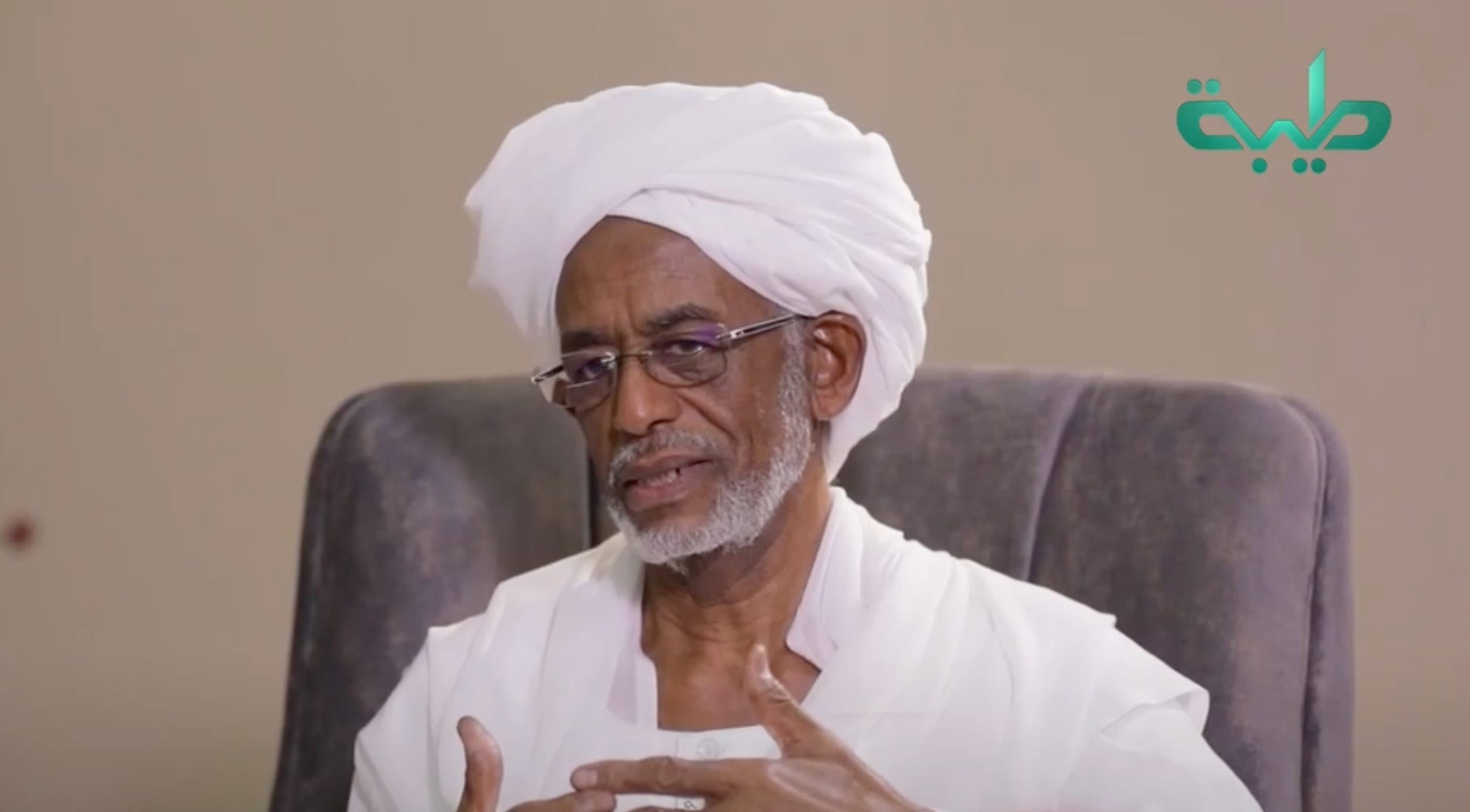
Al-Misbah Abu Zeid Talha, the commander of Al-Baraa Bin Malik Corps:
In announcing sanctions against Al-Baraa Bin Malik, the U.S. Treasury and State departments referred to it as a ‘brigade,’ though in fact the group has taken to calling itself ‘Faliq,’ which better translates to ‘corps,’ or ‘legion.’ The name change points to the group’s continuing political ascent and ambitions.
Al-Baraa Bin Malik has not limited its activities to military operations alone, but rather has cadres working in a variety of fields, including legal, civil, trade, education, and military manufacturing.
The State Department said that Al-Baraa Bin Malik fighters “have conducted mass executions of civilians in areas they captured, and repeatedly and summarily executed civilians based on race, ethnicity, or perceived affiliation with opposition groups.” This claim is corroborated by independent reporting, including by this publication, though the U.S. statement omits that the other party in Sudan’s war, the RSF, has also committed massacres.
RSF Portrays Itself as Secular Alternative

The Rapid Support Forces (RSF) also welcomed the U.S. decision and framed it as validation of its longstanding warnings about Islamist influence in Sudan’s political and military institutions. In a statement, RSF leader Mohamed Hamdan Dagalo—widely known as Hemedti—described the designation as “a victory for the will of the Sudanese people” and argued that isolating Islamist networks was essential to restoring stability and rebuilding Sudan on the basis of rule of law, democracy, and equal citizenship.
Dagalo linked the designation to the RSF’s own political agenda, pointing to anti-terrorism legislation adopted by the RSF-aligned political coalition and its decision to ban the Islamic Movement in areas under its influence. He also called for greater international cooperation to disrupt the financial and organizational networks of Islamist groups and to prevent them from using international platforms to support armed activity in Sudan.
The statement reflects a broader effort by the RSF to portray itself as a secular or pragmatic alternative to Islamist factions associated with the Sudanese Islamic Movement and elements within the Sudanese Armed Forces. In diplomatic outreach and public messaging, RSF officials have increasingly framed the current war as a struggle against the resurgence of Islamist political influence in Sudan’s state institutions.
At the same time, the RSF’s attempt to position itself as a democratic or secular force has been viewed skeptically by many Sudanese and international observers. The paramilitary organization fought on behalf of former president Omar al-Bashir’s Islamist government for many years. RSF leaders also participated in the October 2021 military coup that derailed Sudan’s civilian transition and the RSF has faced repeated accusations of serious human rights abuses, including the 2019 massacre of protesters in Khartoum and large-scale atrocities reported during the current war.
These competing narratives illustrate how the U.S. designation has quickly become part of Sudan’s internal political contest, with rival actors seeking to interpret the decision as validation of their own claims to legitimacy.
Subscribe, Donate, or Share

Our reporting and analysis is made possible by the generous support of paying subscribers and donors. Please consider signing up for a paid subscription or make a one-time donation so that we can sustain our mission and continuously improve the quality of our reporting. Thanks!