

A new front is emerging in Sudan’s 15-month civil war along the western border of Gedaref State and the eastern border of Sennar State, threatening farming communities in a fertile plain crisscrossed by rivers and irrigation canals.
The emergence of this new front follows the conquest of large parts of Sennar State by the Rapid Support Forces (RSF) over the past two weeks.
Sudan’s military, reeling from this latest defeat at the hands of its former paramilitary ally (the RSF), has rejected all negotiations and vowed victory at all costs. Yet problems are mounting for the Sudan Armed Forces (SAF), morale is low, and public confidence in the military leadership has plummeted.
Back-and-forth fighting took place over the past three days in Dinder, a small city located 25 km northeast of the Sennar State capital Sinja. RSF took control of the city and its bridge on July 1-2, shortly after the fall of Sinja.
Simultaneously, 90 km to the north, RSF troops based in Jazira State seized the Doba Bridge, the only other bridge across the Dinder River.
As the RSF breakout continued unchecked, SAF committed reserves based in Gedaref City, capital of Gedaref State. The 2nd Infantry Division is headquartered in this city as well as at least one battalion of the Justice and Equality Movement (JEM), a former Darfur rebel group now allied with the Sudanese military.
A joint force of SAF and allied Darfur militants advanced toward Dinder on July 3-4, retaking the city. Videos filmed in the city during their counterattack showed devastation and looting, which both sides blamed on each other.
Separately, SAF troops based in northern Sennar State—in a part of the state that hasn’t yet fallen to the RSF—recaptured the Doba Bridge on July 3.
These gains evaporated rapidly within the past day.
RSF attacked Dinder again yesterday, July 5, driving out the newly arrived SAF troops and their allies, and capturing a brigadier general. In a statement, RSF’s media team claimed that their troops captured nine combat vehicles and destroyed seven others and killed more than 170 soldiers. Although we cannot verify this death toll, we can confirm from geolocated videos that the RSF are back in control of Dinder.
In the north, RSF again attacked the Doba Bridge, resulting in fierce gun battles yesterday as SAF fought to keep control, according to videos filmed by RSF combatants. At this time, we cannot verify which side controls the bridge. The latest videos, such as this one below, suggest that it was contested.
If the Doba Bridge falls into RSF hands, the army troops in the area could be forced to retreat toward Sennar City.
The coming siege of Sennar
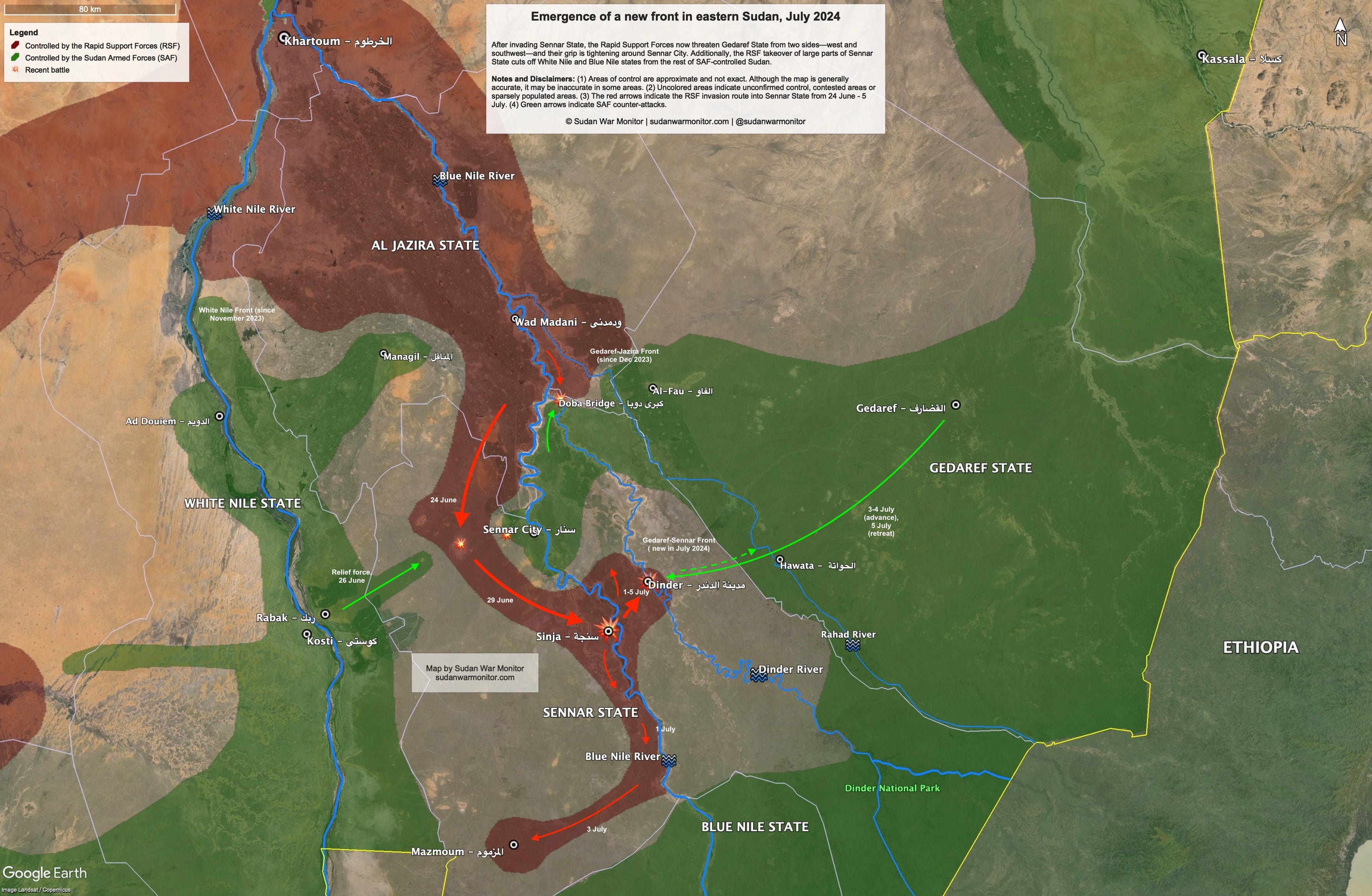
The Rapid Support Forces bypassed the city of Sennar when they invaded Sennar State beginning on June 24 (both city and state go by the same name).
The city is now partly encircled and can only be resupplied or reinforced from Gedaref State. The loss of the bridges across the Dinder River increases the likelihood that the city will be fully encircled in the coming days or weeks. Already the Sennar garrison is quite isolated, owing to the lack of good roads between Gedaref and Sennar.
Nevertheless, it is unlikely that SAF will give up the city without a fight, even if it is surrounded. Unlike Sinja, which was far behind the frontline and fell quickly in a surprise attack, Sennar has been a frontline city since December 2023. Its garrison is therefore more experienced and combat-ready.
A prolonged siege would trap thousands of civilians, and fighting in the villages around the city could displace tens of thousands of more civilians into Gedaref State.
The Dinder axis
The fall of Dinder City and its bridge gives the RSF a new potential invasion route into Gedaref, via the Dinder-Hawata road. In a video recorded in front of the Dinder Locality headquarters yesterday, RSF commander Abdelrahman al-Bishi said, “We say to the people of Gedaref: We are coming for you.”
Al-Bishi is the charismatic RSF field commander who led the RSF assault into Sennar State over the past two weeks. Typically seen carrying two hand-held radios rather than a firearm, he has become a hero among the RSF, eclipsing his former superior, the RSF sector commander in Jazira State, Abu Aqlah Keikel.
Notwithstanding Bishi’s threats, the RSF are unlikely to invade Gedaref right now. They first need to consolidate their position in Sennar, and they may target White Nile State next, before turning east.
The Dinder River currently represents the maximum extent of their advance. It is a large tributary of the Blue Nile and is a natural boundary where the RSF might choose to halt their eastward advance, while extending their control north and south along one or both banks.
Meanwhile, the Sudanese military have retreated back toward Hawata, a town on the banks of the Rahad River, another small tributary of the Blue Nile. The river basin represents a natural defensive boundary as well as a densely inhabited area with a supportive population, though it is a seasonal river that dries up after September.
SAF can be expected now to build up a force along this front to prevent future incursions into Gedaref. This requires them to extend their existing defensive line in western Gedaref by at least 100 km from Al-Fau toward the south.
Beyond Hatawa, large areas of wilderness, including wetlands in the Dinder National Park, will limit the RSF advance.
The RSF takeover of Sennar has forced the Sudanese military to extend its defenses in Gedaref State by at least 100 km
Eventually, SAF could use the Dinder-Hawata route to attempt another counter-attack toward Dinder. This would relieve pressure on Sennar and would be a step toward reopening the east-west route between Kosti and Port Sudan.
Given these motivations of both sides, the coming months could witness a prolonged military buildup on the new Gedaref-Sennar front, as well as active fighting around Sennar, Dinder, and possibly in some western towns of Gedaref State.
In this scenario, the territory between the Rahad and Dinder rivers would become the new frontline, approximately along the state border. Military activity in these two river basins would disrupt critical food production in one of Sudan’s most fertile regions, pushing the nation deeper into a prolonged hunger crisis.
Prolonged fighting in Sudan’s populous eastern states will also add to the nation’s already massive displacement burden, which affects about a quarter of the population of 47 million. According to the International Organization for Migration, a UN agency, an estimated 136,000 people have been displaced from various locations across Sennar State since the RSF launched their invasion of the state on June 24.
They sought shelter in Gedaref, Blue Nile, and White Nile states, before continuing their journey toward Kassala or elsewhere, in some cases.
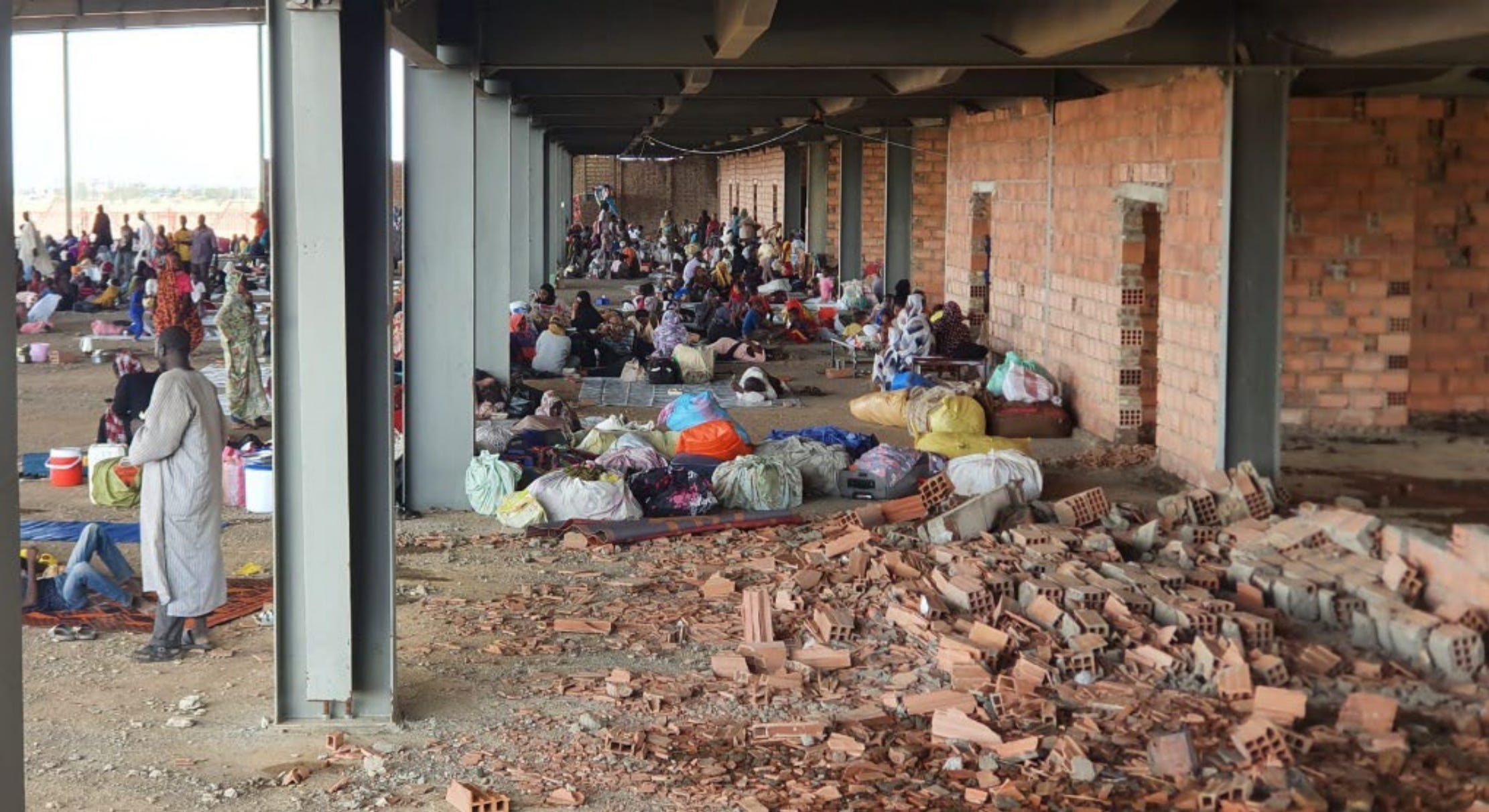
IOM noted in a flash update on July 5, “The displaced people are arriving [in Gedaref] with few possessions and are in urgent need of food, water, and shelter. There are no sanitation facilities in the area.” The report added,
“The conflict in Sinja has significantly exacerbated civilian suffering and increased violations of international humanitarian law. Civilians are now facing multiple protection risks and have reported widespread looting of their homes, cars, and personal belongings, reportedly by RSF, amidst the escalating conflict. In addition, shops and local markets have also been looted, leaving civilians without access to essential resources and heightened insecurity.”
Gedaref was already hosting 50,000 refugees—mostly Ethiopians—and about 600,000 displaced people from elsewhere in Sudan. UN agencies recently concluded a food distribution of sorghum, lentils, salt, and oil for these vulnerable populations, though they were only able to provide 70% rations, according to UNHCR.

