
A drone strike widely attributed to the Rapid Support Forces (RSF) targeted the family residence of a prominent defector from the Rapid Support Forces (RSF) in eastern Al-Jazirah State on Saturday evening, killing several of his relatives while he survived the attack unharmed.
Abu Agla Keikel was the leader of the RSF occupation forces in Al-Jazeera State before defecting to the Sudanese Armed Forces (SAF) in October 2024 and becoming the commander of a SAF-allied militia, Sudan Shield. The attack on his home coincides with a wave of RSF drone attacks in recent days that have hit the Khartoum Airport, a fuel storage facility at the Kenana Sugar Company Limited in White Nile State, a military vehicle on the outskirts of Omdurman, and other military and economic targets in central Sudan.
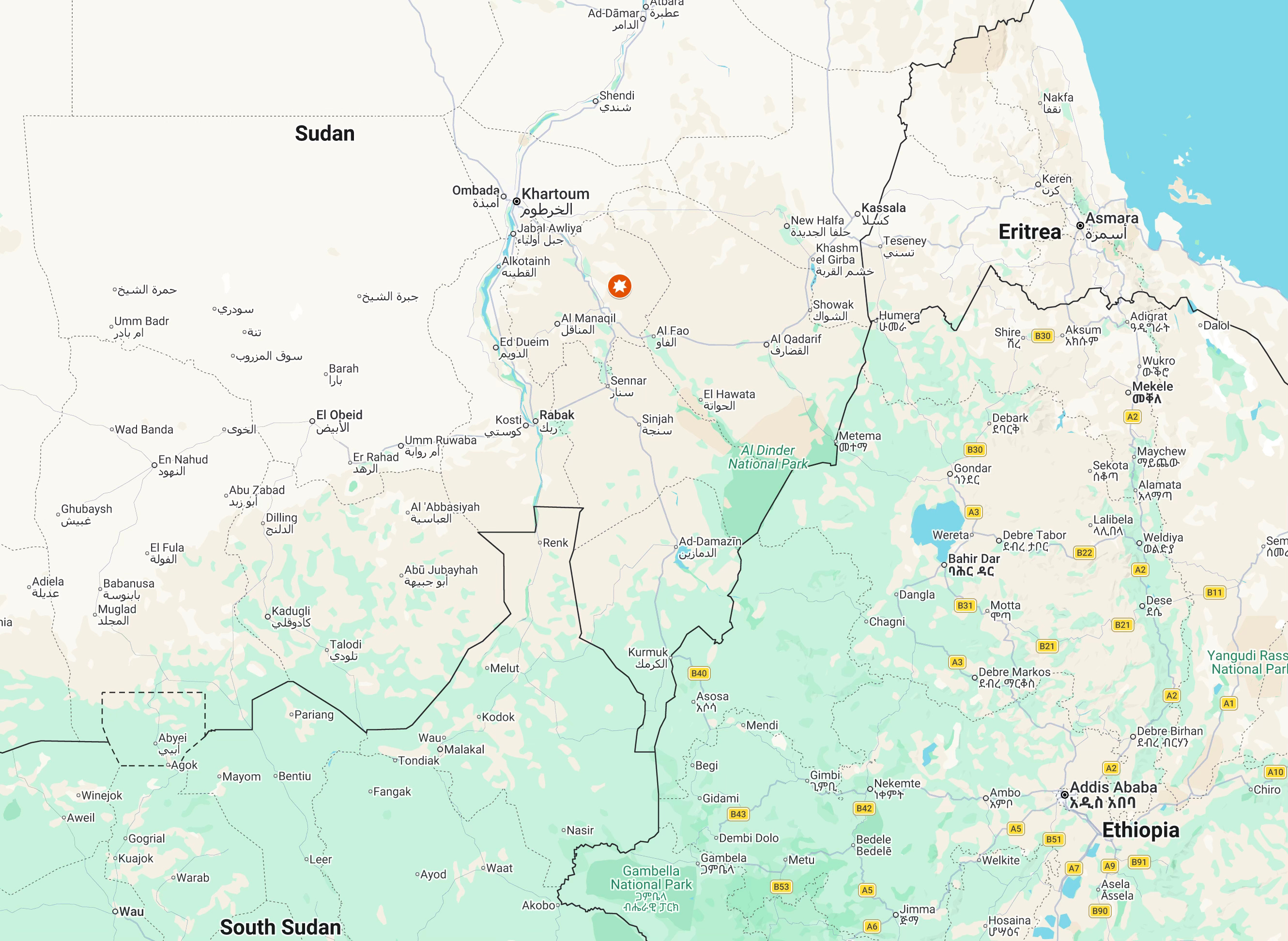
Local sources told Sudan War Monitor that an unmanned aerial vehicle was observed circling above the village of Zaidan al-Kahli (14°40’12.78”N, 33°41’47.38”E) for several minutes before launching a series of strikes on the residential compound. Witnesses described the sound of at least two explosions, followed by smoke rising from the targeted structures.
The strike killed six individuals, including Keikel’s brother, Major Azzam Keikel, who held a command role within the Sudan Shield Forces. Other victims included members of the extended Keikel family and individuals who were present at the residence at the time of the attack. Several additional casualties were reported among nearby residents, though the full toll remains unclear due to limited access and communications in the area.
TikTok video of damage to the Keikel family compound:
Keikel himself was said to be in close proximity to the residence during the strike but was not injured. The commander, who recruits his troops mostly from the Butana region in Al-Jazirah and Gedaref states, has been a frequent target of RSF vitriol and insults since his defection in October 2024.
There was no official statement from the Sudan Shield Forces at the time of publication, but in remarks delivered from Kordofan two days after the strike, Keikel himseelf said his forces “expect everything,” including the loss of children and women, framing the attack as retaliation for what he described as “the lessons we have taught the militia.”
He was present in the village at the time of the strike and has not publicly addressed the incident since. His appearance in Kordofan for the speech appears intended to project resilience following the attack on his family home, signaling that the loss of relatives has not altered his stance.
Individually, people affiliated with the group have also publicly mourned the victims, describing the strike as a deliberate targeting of non-combatants and family members. The incident marks at least the third known drone strike targeting Sudan Shield positions or personnel.


Punishing Disloyalty
The targeting of Keikel’s residence appears consistent with a broader RSF pattern of retaliatory strikes against defectors and aligned commanders. In recent months, several individuals associated with the SAF or allied groups have been targeted in remote or rear-area locations, often through drone strikes rather than direct ground engagements.
Recent high-profile defections from the RSF, including that of Nur al-Qubba, a senior RSF commander in North Darfur, and Safana, another influential officer currently abroad, have increased pressure on the RSF leadership to deter further defections. Targeting family networks and residential compounds serves both punitive and signaling purposes within this context.
In Omdurman, drones were used to target both military positions and civilian vehicles along key routes, including the Triangle al-Jumuiya road. This activity follows reports of deployments by forces associated with Nur al-Qubba in the area, although the strikes appear to have hit Joint Force vehicles. In El-Obeid, a strike reportedly hit the state television headquarters, causing significant damage to infrastructure. Meanwhile, in Kenana, a fuel depot was struck, suggesting an effort to disrupt supply chains and economic activity in SAF-held areas.


This pattern indicates a widening operational envelope for RSF drone capabilities, extending well beyond active frontlines in Kordofan and Darfur into deeper areas under SAF control. The use of drones allows the RSF to project force across long distances without maintaining a continuous ground presence, reducing exposure to SAF counterattacks.
Origin of Drone Attacks
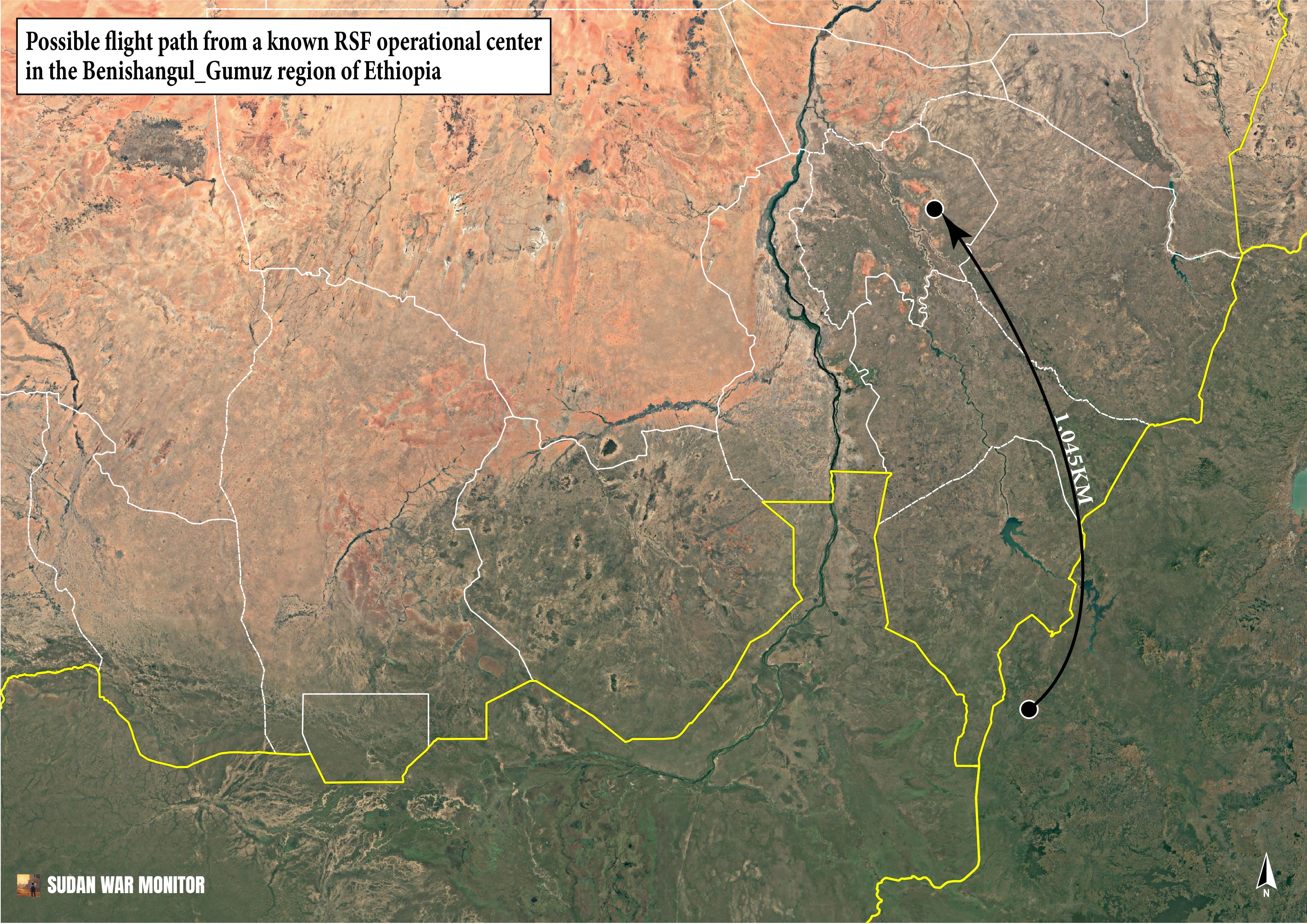
The origin point of the recent drone attacks in central Sudan remains unconfirmed. The RSF currently lacks sustained ground positions in central Sudan, and frontline positions in North Kordofan remain contested and vulnerable to SAF airstrikes.
Given these constraints, one plausible launch axis is from western Ethiopia, particularly from Assosa Airport (10°01’32.32”N, 34°34’30.18”E), an area of known RSF activity. An investigation by Reuters has identified RSF-linked logistical and training activity in Ethiopia’s Benishangul-Gumuz region, including facilities used for cross-border operations and force mobilization.
Launching drones from Ethiopian territory would allow the RSF to preserve high-value UAV systems by keeping them outside the reach of SAF’s own air assets, while still conducting long-range strikes into central Sudan. The RSF has used Ethiopian territory for training and logistics purposes.
Alternatively, the RSF could be using a temporary launch site in North or South Kordofan. While the group is unlikely to base high-value drones in these frontline states, it might be launching cheaper ‘kamikaze’ drones from these areas. The RSF is known to have both long-range CH-95 guided missile drones and cheaper Shahed-style Delta-Wing UAVs (‘kamikaze’ drones). The type of drone used in the latest attacks remains unclear, though the ability to loiter, identify specific targets, and deliver multiple munitions across long distances suggests a system more advanced than commercial quadcopters.
The Sudanese military has increasingly faced challenges in countering such threats. In the meantime, it has escalated its own aerial campaign in the Darfur region, which is controlled by the RSF. Recent targets include the El Daein Teaching Hospital, two market in Nyala, the Al-Hamadiya IDP camp in Zalingei, the Abash gold mine in Songo area, and a wedding in Kutum,
Individual and Organisational Subscriptions
Sudan War Monitor is used by NGOs, newsrooms, policy teams, and research institutions working on Sudan or related policy issues. We offer team subscriptions that cover your whole organisation under a single annual payment, managed through Substack and processed securely by Stripe. Seats can be added or reassigned at any time.


