
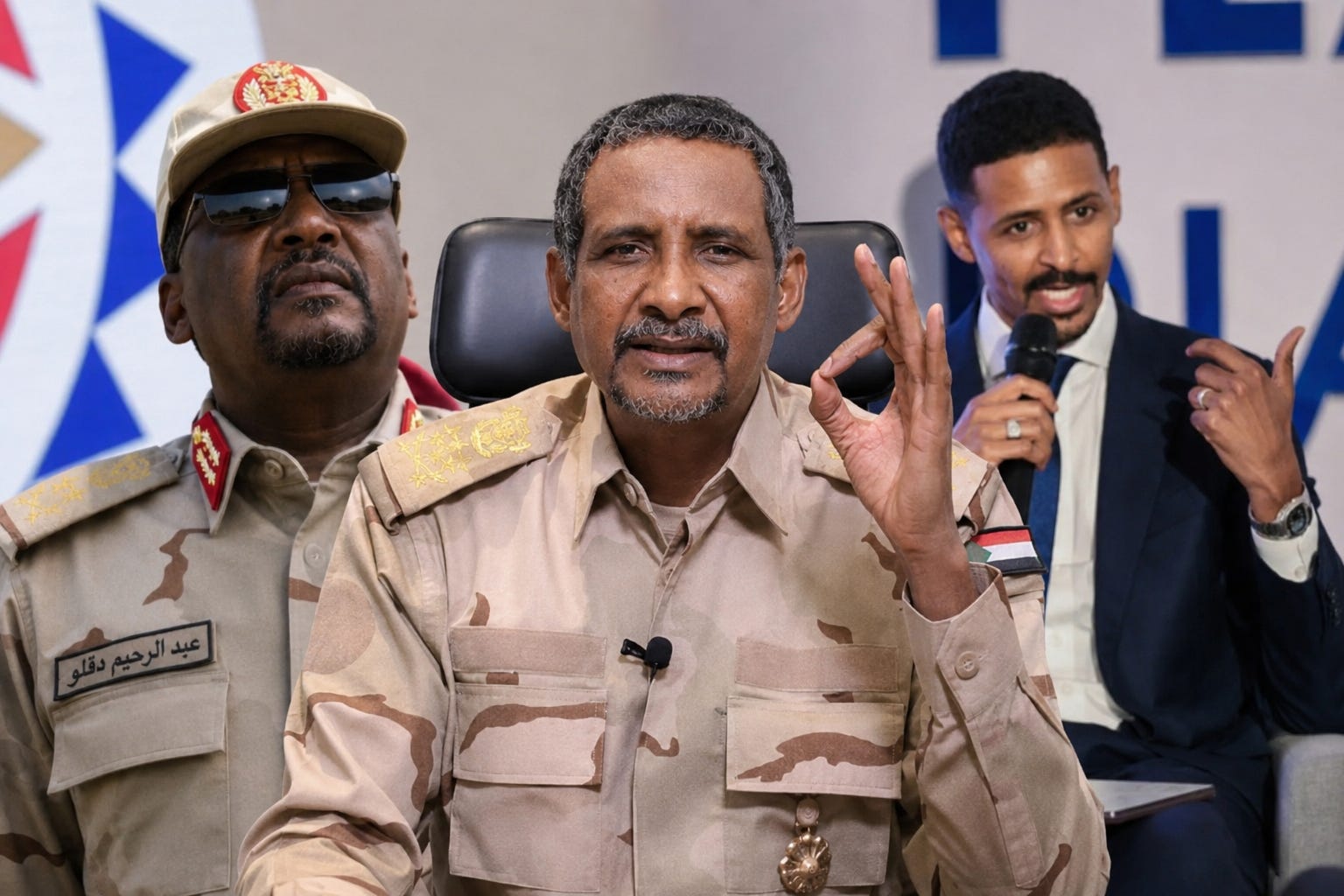
A Sudanese counter-terrorism court on Sunday sentenced Rapid Support Forces (RSF) commander Mohamed Hamdan Daglo, widely known as Hemedti, to death in absentia alongside two of his brothers and 13 other commanders, officials and allies after convicting them of genocide, crimes against humanity and war crimes committed during the 2023 assault on El Geneina in West Darfur.
The verdict, delivered by Judge Mamoun Al-Khawad in Port Sudan, marks the most consequential judicial ruling issued by Sudan’s courts since the civil war erupted in April 2023. It targets the RSF’s top leadership over one of the conflict’s deadliest episodes, including the murder of West Darfur Governor Khamis Abdullah Abakar and the campaign of mass killings, forced displacement and ethnic violence against the Masalit community.
The court sentenced Hemedti to death by hanging after convicting him under Articles 186, 187, 188, 189 and 191 of Sudan’s 1991 Criminal Act, covering crimes against humanity, genocide, war crimes against persons, war crimes against property and the use of prohibited methods of warfare.
His brother and deputy, Abdelrahim Hamdan Daglo, received the same sentence after being convicted of participating in planning and directing the crimes. Another brother, Al-Goney Hamdan Daglo, was also sentenced to death for facilitating the assault on El Geneina despite knowing atrocities were being committed by RSF forces and allied militias.
“The first convicted person, war criminal Mohamed Hamdan Dagalo (”Hemedti”), was sentenced by the court in absentia to death by hanging until death, as a discretionary punishment (ta’zir), following conviction under Articles 186, 187, 188, 189, and 191 of the 1991 Criminal Act.”
“The second convicted person, war criminal Abdel Rahim Hamdan Dagalo, was sentenced by the court in absentia to death by hanging until death, as a discretionary punishment (ta’zir), following conviction under Article 21 read together with Articles 186, 187, 188, and 191.”
“The third convicted person, Al-Qouni Hamdan Dagalo (as written in the Arabic text), was sentenced by the court in absentia to death by hanging until death, as a discretionary punishment (ta’zir), following conviction under Article 21 read together with Article 186 of the Criminal Act,” the judge said as he read out the verdicts.
The remaining defendants, all tried in absentia, included West Darfur RSF commander Abdelrahman Juma Barkallah, former West Darfur deputy governor Al-Tijani Al-Tahir Karshoum, current RSF commander in the state Idris Hassan Ibrahim Haroun, tribal leaders accused of coordinating with the paramilitary force, and London-based pro-RSF activist Abdelmoneim Abdelmahmoud Ahmed, known online as Abdelmoneim Al-Rabea.
Judge Mamoun Al-Khawad reads out the verdicts during a court session in Port Sudan.
All 16 defendants were convicted on varying combinations of genocide, crimes against humanity and war crimes.
The court ordered the confiscation of all RSF assets in favour of the Sudanese government and instructed Sudanese authorities to seek international arrest notices through INTERPOL and relevant regional police organizations to secure the defendants’ arrest and extradition.
Judge Al-Khawad also referred the case to the Supreme Court’s Endorsement Chamber for mandatory review before the death sentences can be confirmed under Sudanese law.
The judge said international crimes such as genocide and crimes against humanity carry no statute of limitations and cannot be erased through political settlements or amnesties because Sudan remains bound by its international legal obligations.
The convictions stem from the RSF’s capture of El Geneina during one of the bloodiest phases of the war. Human rights organizations, United Nations investigators and independent researchers have documented widespread killings, systematic looting, sexual violence and forced displacement targeting the predominantly non-Arab Masalit population.
The violence reached its peak in June 2023 when Governor Khamis Abakar publicly accused the RSF and allied Arab militias of committing genocide against civilians during a televised interview. Hours later, RSF fighters detained him while he was travelling through El Geneina.
Video footage later verified by investigators showed Abakar being escorted into an RSF-controlled compound under the supervision of West Darfur RSF commander Abdelrahman Juma Barkallah. Another video, circulated shortly afterward, showed his bloodied body after he had been killed.
The killing triggered international condemnation and became one of the defining moments of the conflict in Darfur.
During Sunday’s judgment, the court concluded that Hemedti bore overall criminal responsibility for systematic attacks against civilians, the destruction and looting of public and private property, and deliberate assaults on residential neighbourhoods, schools and places of worship. The judgment held that the RSF leadership directed a coordinated campaign against protected civilian populations rather than isolated battlefield operations.
The court found Abdelrahim Daglo responsible for planning the siege of El Geneina, imposing conditions intended to destroy civilian life, forcibly displacing residents and participating in acts of genocide against the Masalit.
Al-Goney Daglo was convicted of facilitating military operations despite knowledge that widespread atrocities were being committed by forces under RSF command.
Barkallah, the RSF commander in West Darfur at the time, was found guilty of directing military operations during repeated assaults on Masalit neighbourhoods and coordinating with allied Arab militias responsible for large-scale killings.
The court also convicted former deputy governor Karshoum, who later joined the RSF administration, after concluding that he had collaborated with the paramilitary group during the campaign.
Current RSF commander Idris Hassan Ibrahim Haroun and several local militia leaders were likewise found guilty of participating in the attacks.
The ruling follows more than a year of legal proceedings that began in April 2025, when Sudan’s Attorney General formally opened criminal proceedings against the RSF leadership before the special terrorism court in Port Sudan.
Throughout the trial, prosecutors argued that the attack on El Geneina formed part of a broader military strategy launched by the RSF shortly after the outbreak of war.

Attorney General Al-Fatih Tayfour told the court at the time that the campaign began with the RSF’s deployment to Merowe Airport two days before the conflict officially erupted and expanded into coordinated attacks against military installations and state institutions before reaching Darfur.
He described the killing of Governor Abakar as part of what prosecutors characterized as a deliberate effort to dismantle state authority while eliminating local leadership capable of organizing civilian resistance.
According to the prosecution, Abakar was arrested while carrying out his constitutional duties as governor before being unlawfully detained, assaulted and ultimately killed. The prosecution relied on documentary evidence, witness testimony and widely circulated videos documenting both the governor’s detention and the aftermath of his killing.
Judge Al-Khawad previously stated during earlier hearings that the case included substantial evidence despite the defendants’ absence from court.
Sudanese law allows criminal proceedings to continue when accused persons remain outside the country’s jurisdiction after being formally summoned. The RSF has consistently rejected the legitimacy of judicial proceedings conducted in areas controlled by the Sudanese Armed Forces.
When the trial opened last year, Hemedti’s adviser Al-Basha Tabiq dismissed the case as politically motivated and accused the army of manipulating the judiciary to advance its wartime narrative. He denied RSF responsibility for Abakar’s killing and instead blamed Sudanese military intelligence and local tribal rivalries for the violence in El Geneina.
The RSF itself issued a statement immediately after Abakar’s death in June 2023 claiming that “outlaws” were responsible for the killing and calling for an investigation. That position has been rejected by international investigators and multiple human rights organizations, which concluded that RSF personnel and allied militias were directly involved.
Independent investigations conducted over the past three years documented evidence of systematic ethnic violence against the Masalit community. Satellite imagery showed extensive destruction across El Geneina and surrounding villages, while survivor testimony described coordinated attacks by RSF fighters and allied Arab militias.
Numerous videos recorded during the violence reinforced those findings. One video showed armed men celebrating the expulsion of Masalit residents while referring to dead civilians using ethnic slurs. Another featured an armed fighter declaring that Dar Masalit had become “for Arabs only,” statements widely cited by researchers examining evidence of genocidal intent.
The attacks forced tens of thousands of Masalit civilians to flee on foot toward neighbouring Chad under constant threat of attack. International agencies later documented one of the largest displacement crises of the Sudan war along the Chad-Sudan border.
In January 2025, the United States formally determined that the RSF and allied militias had committed genocide in Darfur. Washington concluded that RSF forces systematically murdered men and boys on ethnic grounds while targeting women and girls from specific communities with widespread sexual violence.
The United States had earlier imposed sanctions on Abdelrahman Juma Barkallah over his alleged role in the killing of Governor Abakar and atrocities committed in West Darfur.
Sunday’s judgment also carries symbolic importance for Sudan’s judicial system, which has continued operating from Port Sudan after much of the country’s legal infrastructure collapsed during the war.
Although the proceedings cannot immediately secure the defendants’ arrest, the convictions establish judicial findings assigning individual criminal responsibility to senior RSF leaders.
The RSF continues to control extensive territory across Darfur and parts of western Sudan, while Hemedti and most of the convicted individuals remain outside government custody. So, it is very difficult to tell whether the sentences will ever be enforced.
The court nevertheless directed Sudanese authorities to seek international cooperation through INTERPOL and regional police bodies to locate and arrest the convicted men. INTERPOL’s ability to act depends on member states and does not guarantee arrests, particularly where suspects remain in territories beyond government control or in countries unwilling to execute such requests.
Support our journalism

Sudan War Monitor is a collaborative of journalists and open source researchers tracking the events of Sudan’s war and the search for solutions. We’re building a platform to battle disinformation and warmongering and amplify the voices of victims, humanitarians and peacemakers.
Brilliant post, thank you!!!!!