


The fall of Wad Madani has sent shockwaves—political, social, and humanitarian—throughout Sudan, including growing calls for a coup to oust the current leadership of the Sudan Armed Forces (SAF).
Although Sudan’s military has suffered previous defeats at the hands of the Rapid Support Forces (RSF), this one took place in the nation’s Nile Valley heartland, and with breathtaking speed. It happened only a day after the army had claimed a victory over the RSF on the outskirts of Wad Madani, raising expectations for victory.
Instead, the RSF stormed into the city, which is the capital of Jezira State, on the morning of December 18. Yesterday, the RSF consolidated their control over the city, amid growing fears that they could continue their offensive toward other cities.
In disbelief over these events, many Sudanese have embraced a narrative of betrayal, claiming that the army abandoned the defense of the city and didn’t put up a fight. In fact, the army fought for four days in the eastern suburb Hantoob; however, they put up little resistance in Wad Madani itself, in spite of the significant advantage normally afforded to a defender in urban terrain.
The military announced that it would review the circumstances of its loss of Wad Madani—something it never did after defeats in Khartoum and Darfur. Brigadier General Nabil Abdallah, the Armed Forces spokesman, said in a press statement, “The 1st Division forces withdrew from Wad Madani city yesterday, Monday. An investigation is underway to scrutinize the reasons and circumstances behind the forces’ withdrawal from their positions.”
The fall of the city has shattered the sense of safety of millions of Sudanese living in cities previously unaffected by conflict, stoking widespread disillusionment. This disillusionment extends beyond the pro-democracy constituency that already viewed the army with deep skepticism and advocated for a negotiated settlement.
Ali Karti, leader of the Islamic Movement, which is influential in military circles, issued an audio recording yesterday that included a veiled warning to the military leadership: “Opportunities do not come again, and the people’s support for you depends on you standing with them in moments of adversity and affliction.”
Karti, a former minister in the government of Omar al-Bashir, also called on the military to expedite the training and arming of recent recruits. “It will be a witness for you or against you in the book of history,” he said. Tens of thousands of men have volunteered for military service since the outbreak of the war, but many of them have not completed their training or received weapons.
Karti also implicitly criticized the military for misleading the public about the war: “Address the people with the facts, do not leave them preyed on by rumors and the machinations of the rebels who aim to weaken the people’s confidence in you.”
Another critic, Mohamed Sayed Ahmed al-Jakoumi, leader of the Northern Track Entity of the Juba Peace Agreement, issued a statement calling for a more offensive strategy: “We demand the army leadership to change its strategy of defending its bases and adopt new operational ideas based on attacking the militia.”
Ataf Mohamed, editor of al-Sudani newspaper, compared the fall of Wad Madani to the fall of the ancient city Troy in Greek literature, posting a photo of the fabled “Trojan horse,” which the Greeks used to sneak into the city. But in this case, the attackers did not even wait until nightfall, he said: “The doors in Madani were opened for the Janjaweed while the sun was in the middle of the sky!”
For their part, RSF propagandists sought to amplify the public’s sense of abandonment and betrayal, circulating a video of a helicopter, which they claimed showed the commander of the 1st Infantry Division fleeing Wad Madani to Sennar.
“The area where people feel safe in our country is shrinking by the day.”
In military terms, SAF’s defeat at Wad Madani represents a major loss of men and materiel. It also completely changes the military geography of the war. Whereas previously the RSF had been contained in Khartoum State and neighboring parts of Jezira State, now they can move freely throughout most of Jezira State and could strike in several several directions, including Gedaref, Sennar, or Kosti.
This makes it more difficult for the army to predict the RSF’s next move and will force the army to either consolidate its forces, leaving some cities undefended, or stretch thin its remaining forces.
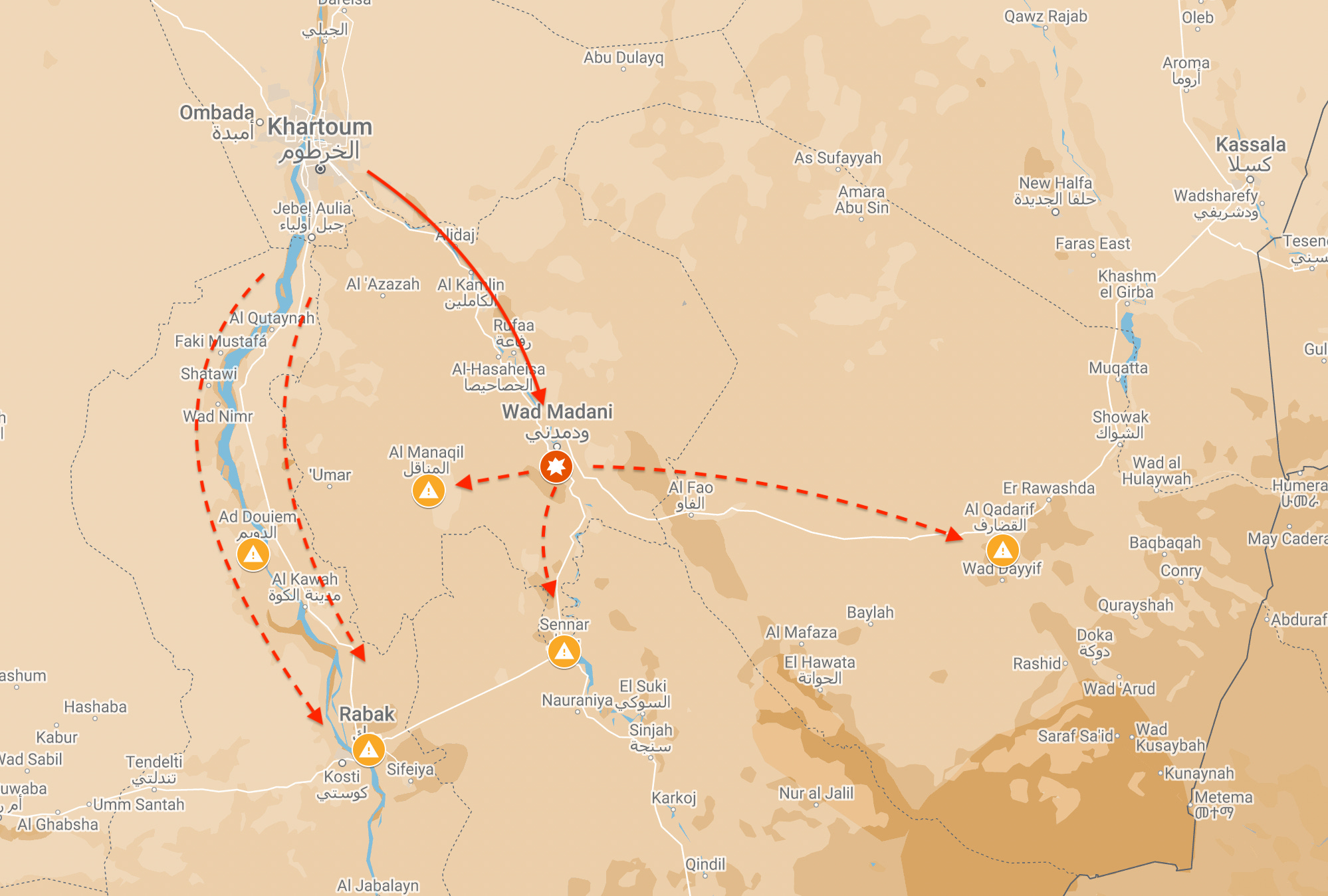
Meanwhile, southeastern states are flooded with refugees from Wad Madani. About 300,000 people fled the city in a 72-hour period, crowding the roads south and overwhelming the cities of Sennar and Gedaref.
“Tens of thousands of people previously fled to Wad Madani believing it was safe. They’re now on the move again,” said Elsadig Elnour, country director of Islamic Relief, who was in Wad Madani when the fighting broke out. “Many have fled further south to Sennar, where many people are now sleeping on the streets. Others are going to Gedaref in eastern Sudan. The area where people feel safe in our country is shrinking smaller by the day. We fear this fighting will now spread east to Gedaref, which is a hub for the humanitarian response across the country.”
Ahmed Omer, communications coordinator for Norwegian Refugee Council in Sudan, described Sennar as “a panicked city,” noting that some people fleeing from Wad Madani had to journey by foot, due to fuel shortages.
“They are hungry, they are panicked, they are ill, and the situation in the city is getting difficult. There is no fuel in the city even for the cars, that’s why the transportation fees are soaring. There is no fuel, even in the black market it is difficult to find… What I’m seeing right now in front of me are people in the streets just carrying their luggages and walking, just people walking.”
In Wad Madani itself, RSF troops yesterday deployed throughout the city and engaged in widespread looting and robbery of citizens, according to the Wad Madani Resistance Committees (former leaders of the 2018-2019 protest movement). This is in spite of a statement by the RSF commander-in-chief, Mohamed Hamdan Dagalo, claiming that he issued orders to all forces in the city “not to attack any citizen or trespass on public or private property.
Dagalo also issued orders concerning the governance of the occupied territory, appointing one of his commanders, Abu Aqlah Kikel, as “head of the security committee in the state.” That role makes him, in effect, military governor of Jezira State. However, Dagalo said, “The RSF will leave the administration and functioning of Wad Madani and al-Jezira State to civilian dignitaries and leaders.”
According to the World Health Organization, the situation in Wad Madani is “rapidly deteriorating.” Aid organizations suspended activities in the city, hospitals face a critical shortage of staff, several hospitals have closed down, and treatment of cholera and cardiac patients is at risk.
Health systems are severely strained in both RSF-controlled and SAF-controlled parts of Sudan. Save the Children published an analysis yesterday forecasting that nearly 30,000 babies will be born in Sudan over the next three months without any medical assistance, putting the mothers and babies at risk of complications or death.
Growing urgency in Eastern Sudan
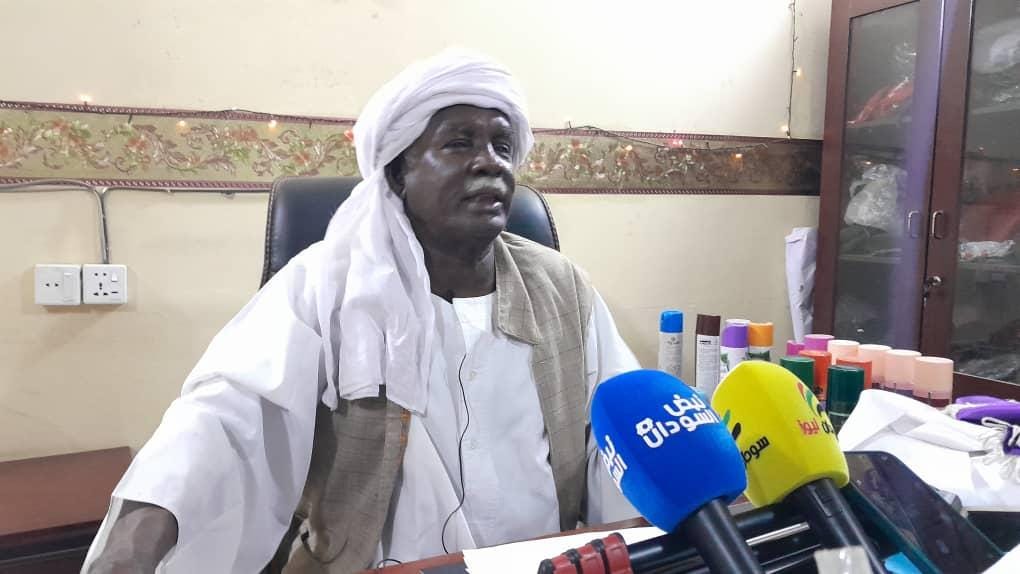
In response to RSF’s invasion of Jezira State, political leaders in Kassala State and Red Sea State, which is home of SAF’s de facto capital, Port Sudan, have caled for mobilization of more troops, and greater readiness on the part of allied armed groups.
On Sunday, Dirar Ahmed Dirar, known as Shaybah Dirar, “called on the Sudanese people, with their various societal and political components, to unite and stand behind the Armed Forces to defeat the mercenaries and the rebel militia,” according to the official Sudan News Agency. He said, “The attack on Jezira State is a matter of concern to all Sudanese, and they must unite to protect Sudan.”
Dirar is head of the Alliance of Eastern Sudan Parties and Movements, a successor of the historic Beja Congress armed group. He commands hundreds of Beja fighters in Red Sea State. In September, tensions briefly flared between Dirar’s forces and the Armed Forces, but the two sides reconciled publicly within a week.
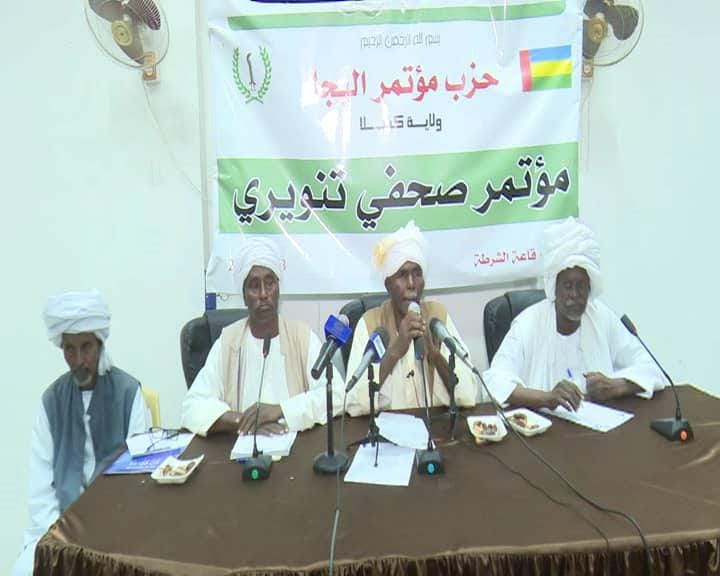
In a related development, the Beja Congress Party in Kassala State held a press conference yesterday calling on its demobilized fighters to prepare for war in eastern Sudan. SUNA reported,
Engineer Jaafar Muhammad Muhammad Adam, a member of the party’s leadership office, explained that the country is going through a pivotal stage and is witnessing serious repercussions… Jaafar noted the importance of preparing to confront the rebellion, which expanded until it reached the state of Al-Jazira, which requires preparations for fear that it will expand to other regions.
Jaafar sent a number of messages to the people to come to defend their land and honor. He added that we are ready to train and arm everyone who has the competence to defend the country, calling on the components of eastern Sudan to unite the internal front to be one hand behind the homeland and the East.
Videos
RSF with a captured tank near the 1st Division base in Hantoob (graphic: one body):
SAF soldiers fleeing during clashes in Hantoob, December 18:
RSF with a captured SAF position in Hantoob, Dcember 18:
Fire at the Central Bank of Sudan, Wad Madani Branch, December 19
Support our journalism
Sudan War Monitor began as a volunteer project after the outbreak of war in April 2023. If you like our work, please consider upgrading to a paid subscription so that we can sustain our mission and continuously improve the quality of reporting.