
Elite Air Defense Equipment Destroyed on Kordofan Front
Drone war escalating despite lull in ground fighting
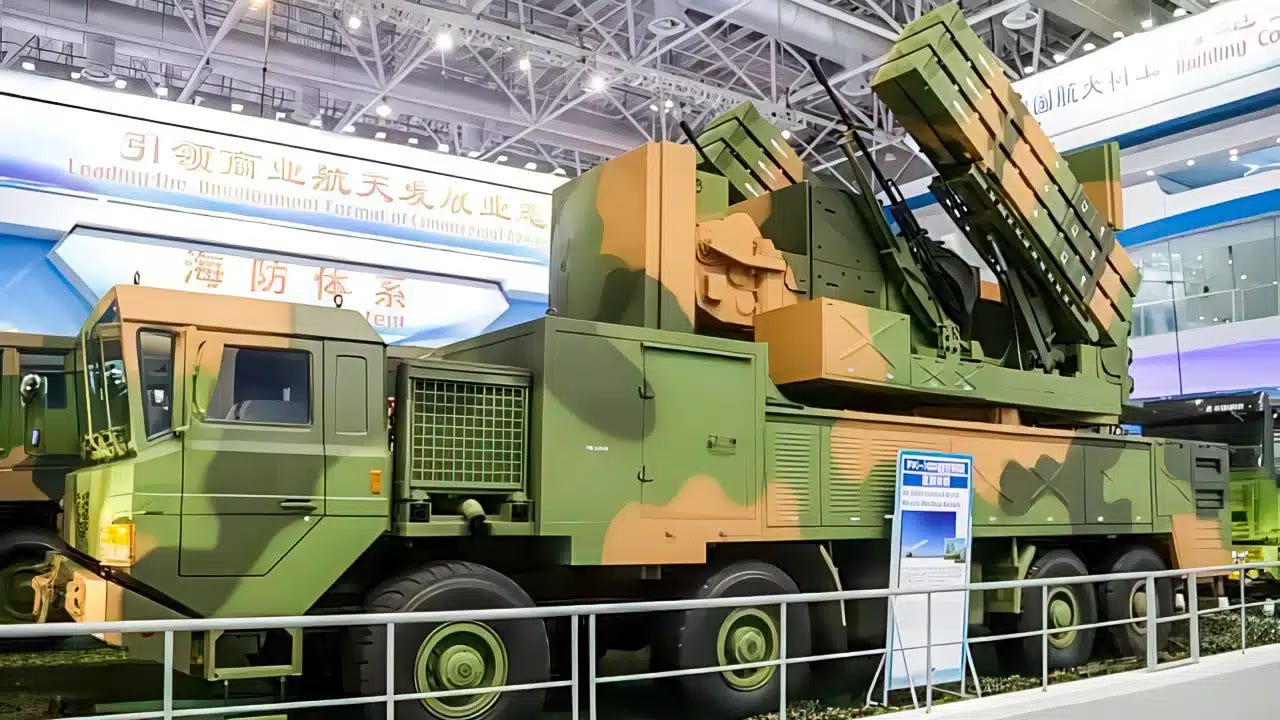
The Sudanese military published evidence of destroying a Chinese-made advanced air defense system operated by the Rapid Support Forces (RSF) in a key frontline area in South Kordofan State.
The FK-2000 short-range air defense system is produced by China Aerospace Science and Industry Corporation and likely was provided to the RSF by the United Arab Emirates. It is equipped with 12 launch containers for surface-to-air missiles and two Gatling-type cannons.
The design is similar to Russia’s Pantsir missile system, which has played a key role in the Russo-Ukraine war.
On Thursday, state-run Sudan News Agency (SUNA) published a video showing the success of an operation targeting the Chinese FK-2000 air defense system operated by the RSF. The video appeared to be footage from a Turkish-made guided missile executing a strike against the FK-2000.
SUNA said that the Armed Forces carried out two attacks, one against the FK-2000 radar station, and the other against the FK-2000 launcher.
The video feed comes from a Roketsan MAM-L precision-guided missile, which transmits footage back to its controller until the point of impact. The Sudanese military uses these missiles on its Baykar Akinci and TB2 drones.
RSF sources denied the loss of the air defense system, saying the circulating footage came from Ukraine. However, BBC Verify journalist Peter Mwai geolocated SUNA’s video to 12.505212, 29.753751, 5 km due west of Al-Debeibat.
This city is militarily significant because it commands the highway between El Obeid and Dilling/Kadugli. As long as the RSF still holds this city, they can threaten Dilling, whereas loss of the city would potentially end the RSF threat to Dilling and make it easier for SAF to reinforce and resupply Kadugli.
FK-2000 air defense systems are credited with having downed some of the Sudanese military’s most important air assets, including Ilyushin cargo planes and as many as three of the new Bayraktar Akinci drones, which are long-range attack aircraft operated from a covert base in the Egyptian desert.
The RSF has employed the FSK-2000 not only along the frontline but also around the RSF capital, Nyala, South Darfur. The deployment of the Chinese air defense systems in Nyala succeeded in downing several SAF warplanes and drones, and facilitated the resumption of regular cargo flights to Nyala from the UAE, carrying weapons and supplies, as well as military buildup at the Nyala airport, where the RSF has been assembling its own ‘Air Force.’
However, the air defense zone around Nyala has not proven impenetrable; and SAF continues to conduct attacks against the city, despite losses. The Sudanese military is looking to replenish its Air Force with jets and drones with new weapons purchased from Pakistan.
It is unknown how many FSK-2000 systems the RSF still have in operation. If they cannot replace lost air defenses, their troops will be highly vulnerable to SAF drones. Lately, the Sudanese military has succeeded in carrying out a series of successful attacks against fuel markets and convoys in RSF territory.
News in Brief:
The RSF has begun constructing a micro-refinery at the Sufyan oil field in East Darfur State, according to a report by Darfur24. If successful, this would reduce the RSF’s reliance on fuel imports from Chad, Libya, and South Sudan. Eyewitnesses in the Badi area reported seeing foreigners wearing RSF uniforms in the area’s market late last year. The oilfield contains approximately 23 wells and is currently not producing.
The World Food Programme issued a statement condemning recent attacks on its operations in the Kordofan region of Sudan. Neutral observers have implicated the RSF in a series of recent drone attacks that hit a bus carrying IDPs, WFP food trucks, and a warehouse in Kadugli.
After a UN Security Council session yesterday, Chair James Kariuki (United Kingdom) spoke out against demands by the South Sudanese government to close two UN bases. He said, “The members of the Security Council expressed concerns over demands to close critical bases in Wau and Bentiu, which would pose a serious threat to UNMISS and UNISFA [United Nations Interim Security Force for Abyei], weakening their capacity to carry out their mandates, including the protection of civilians’ component and facilitation of the delivery of aid...”
Journalist Eiad Husham reported that the personal envoy of the UN Secretary-General for Sudan, Ramtane Lamamra, will leave his post at the end of the month. It is unclear if he will be replaced, amid ongoing budget cuts at the UN headquarters. The former Algerian foreign minister spoke at the African Union Peace and Security Council on Thursday, calling for for “an immediate ceasefire, de-escalation, and a credible Sudanese-led political process.” He said, “a military victory is an illusion.”
The Quintet of the African Union, European Union, United Nations issued a joint statement calling for “immediate halting of any further military escalation, including the use of increasingly destructive means of warfare, which is inflicting devastating harm on civilians.” The Quintet called for a humanitarian truce during the upcoming month of Ramadan.
Fighting between SSPDF and SPLM-IO troops erupted in Guit County of Unity State, resulting in the death of at least eight SSPD soldiers and dozens of wounded. Lt. Col. Chuol Puot Dual Diu, Deputy Spokesperson of the SPLA-IO, told Sudans Post that government forces launched an attack on their positions using about 30 local canoe boats from Bentiu.
Lagawa Locality in West Kordofan has seen an influx of displaced people arriving from Kadugli and other towns in South Kordofan. Despite army claims to have lifted the siege of Kadugli, a mass exodus of civilians continues, as many residents still fear fighting in the area. Radio Dabanga, quoting a local activist named Buthaina Hammad, said that the arriving people suffer widespread malnutrition amid the absence of aid agencies:
“Buthaina Hammad pointed out that the displaced are currently living in the open and under trees, with a near-complete lack of the most basic necessities for a dignified life, such as shelter, food, and drinking water. She confirmed that no humanitarian aid has reached them so far, forcing them to rely on daily searches for food using rudimentary methods, despite their physical weakness and poor health.”
“Activist Buthaina Hammad warned of grave security risks facing displaced people in Lagawa locality, revealing that gatherings of displaced people in open areas have been targeted by drones, resulting in civilian casualties. She added that the threats are not limited to displacement camps but have extended to markets within cities, where drones have targeted civilians, leading to casualties among innocent people and exacerbating the climate of fear and insecurity.”
“Buthaina Hammad emphasized that women and children are the most vulnerable and affected by the current situation, noting that 46 widows were identified within one group of displaced people, each supporting several children.”
“She added that many women are suffering from deep psychological trauma (war trauma) as a result of losing husbands and relatives, and their exposure to forced displacement, violence, and constant fear. She explained that some women are unable to speak when asked about their situation and break down in tears, in the absence of any psychological support or specialized interventions.”
Sudan War Monitor is an independent publication covering Sudan’s civil war through OSINT, reporting, Arabic-language sources, and political-military analysis. We publish maps, verified videos, news, and investigative reporting. If you have the means, please consider subscribing to support this effort.


