
The Sudanese Armed Forces (SAF) launched a large-scale offensive on Saturday aimed at reopening the El-Obeid–Dilling road, triggering one of the deadliest confrontations in recent months in North Kordofan, according to geolocated footage and statements from the warring sides.
The operation, involving thousands (or several hundreds) of troops and allied forces, quickly escalated into intense multi-axis fighting across Kazgil, Hamadi, and El-Debeibat, with all parties claiming battlefield gains while evidence suggests a contested and fluid frontline.
Videos geolocated by Sudan War Monitor indicate that SAF units advanced from El-Obeid southward through Kazgil and toward Hamadi, before pushing further south to reach El-Debeibat by the afternoon. However, the same footage suggests that the advance was not sustained, with SAF elements later withdrawing back toward Hamadi.
As of Sunday afternoon, control over Hamadi itself remained unclear, with no independently verified evidence confirming a stable SAF presence in the area.
The offensive appears to have unfolded along two main axes. One force advanced southward from El-Obeid along the Kazgil–Hamadi route, while a second contingent moved from the east via desert off-road tracks linking Al-Rahad to Habila. The latter axis connects to areas held by SAF, suggesting an attempt to encircle RSF positions or bypass fortified chokepoints and landmines along the main highway.
The attacking force mainly consists of a substantial deployment from the Joint Force of former Darfur rebel groups, which have been aligned to the Sudanese military since early 2024. These units, known for their mobility and desert warfare capabilities, appear to have played a central role in the advance.
Geolocated combat footage reviewed by Sudan War Monitor shows active fighting in multiple locations, including inside El-Debeibat and Hamadi, indicating that clashes persisted across a wide area rather than a single breakthrough point.
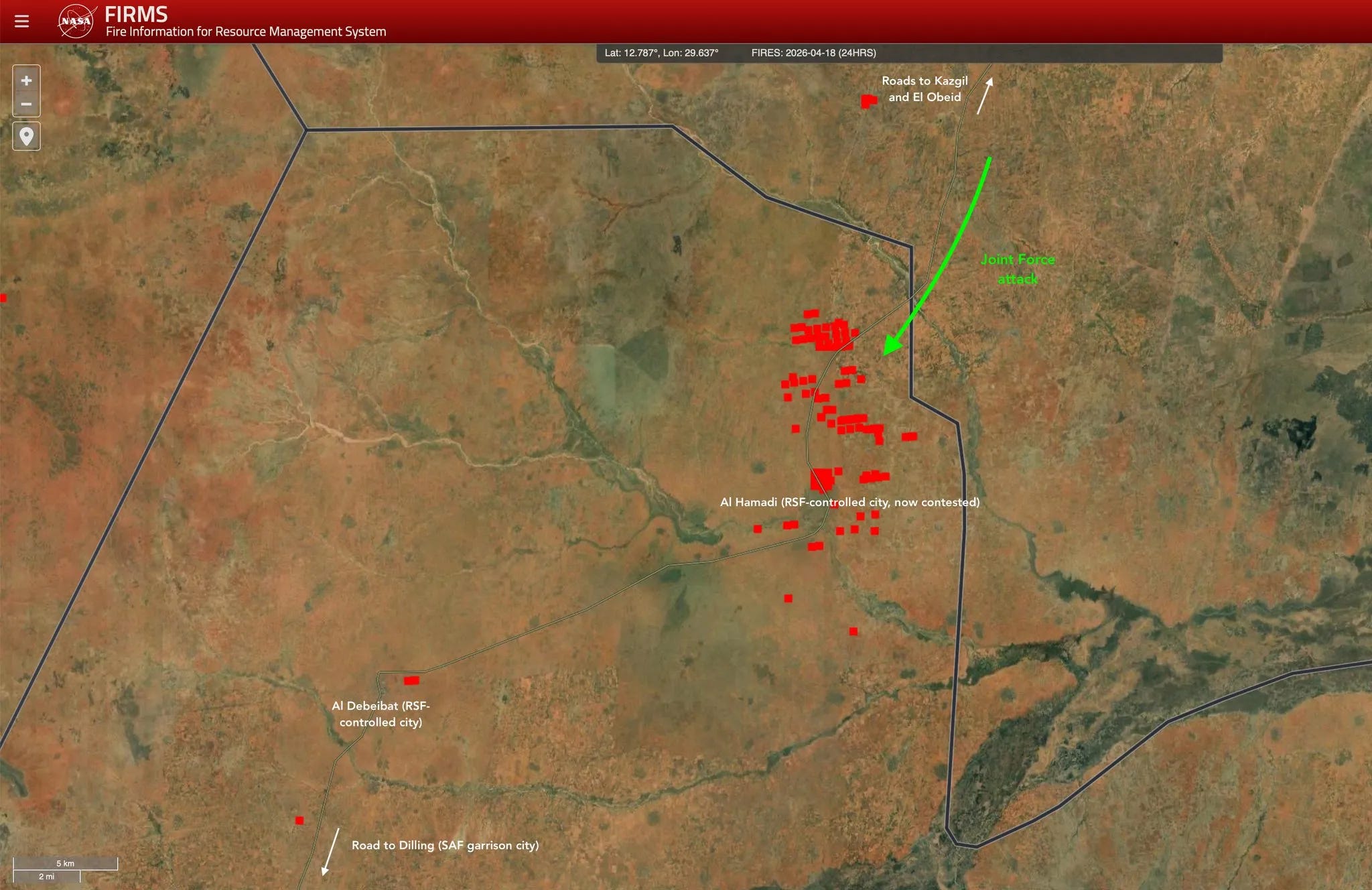
Satellite fire detection systems, including data from NASA FIRMS monitoring, show clusters of heat signatures in these areas, suggesting active burning consistent with combat-related destruction, such as vehicles, vegetation, and structures.
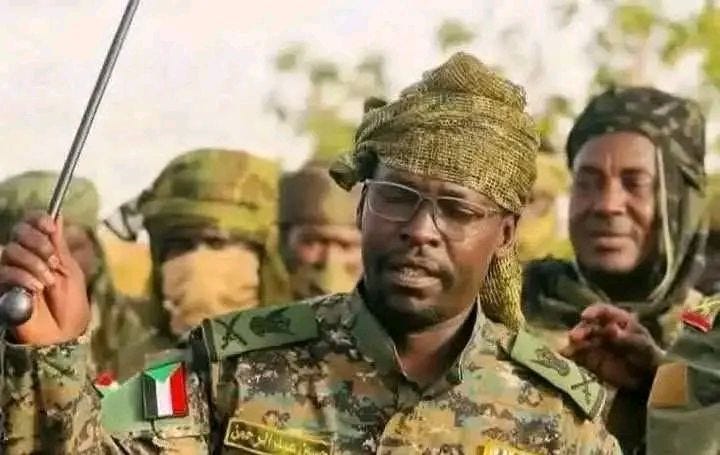
Further visual evidence underscores the heavy toll of the fighting. In one video reviewed by Sudan War Monitor, RSF fighters are seen gathered around the body of Joint Force operations commander in Kordofan Major-General Hussein Abdulrahman. The fighters appear to mock the slain commander, whose body is shown lying on open ground, suggesting he was killed during frontline engagements.
His death represents a significant loss for SAF-aligned forces and may partly explain the apparent withdrawal following the initial advance.
In another video, Joint Force fighters are seen holding a group of captured RSF combatants, with the detainees seated on the ground under guard. The footage indicates that at least some prisoners were taken during the clashes, though the exact location and timing could not be independently confirmed.
A separate video shows multiple destroyed pickup trucks and military vehicles, reportedly belonging to Joint Force units. The vehicles appear heavily damaged or burned, consistent with recent combat activity, though it remains unclear which side was responsible for their destruction.
Despite the scale of the operation, the outcome remains highly contested, with sharply conflicting claims issued by the SAF, the Joint Force, and the Rapid Support Forces (RSF). In an official statement released Saturday, the Sudanese military described the operation as a sweeping success, claiming to have carried out “wide-scale clearing operations” across the North Kordofan axis, including Kazgil, Shawaya, Hamadi, and El-Debeibat.
“The Armed Forces and supporting units continue their field operations with determination. Today, they carried out wide-scale clearing operations along the North Kordofan axis, including the areas of Kazgil, Shawaya, Al-Hamadi, and El-Debeibat.”
“These operations resulted in heavy losses for the terrorist militia in both personnel and equipment, including the destruction of several of its combat vehicles, leading to the collapse and dispersal of its elements and the flight of its remnants under the strikes of our forces,” the army statement reads.
However, claims from the Joint Force present a different version of events, particularly regarding territorial control. In its own statement, the Joint Force asserted that it had fully captured and secured Kazgil and Hamadi, describing the battles as a “decisive military epic” that resulted in a comprehensive defeat of RSF forces in those areas. It did not make claims over El-Debeibat.
The Joint Force also claimed to have inflicted heavy losses, including the destruction of over 36 combat vehicles and seven armored vehicles described as Emirati-made “Kashkash” units. It further stated that 57 operational vehicles were captured and that entire RSF combat groups had been “completely destroyed,” naming several unit identifiers.
At the same time, the Rapid Support Forces offered a statement, claiming that it had repelled the SAF offensive and inflicted catastrophic losses on the attacking forces. In its statement, the RSF said it had “crushed” the assault along the Kazgil and Hamadi axes, describing the battle as a decisive defensive victory.
The RSF claimed that more than 500 enemy fighters were killed and that its forces captured 85 fully equipped combat vehicles, in addition to destroying more than 40 others. These figures, like those provided by the SAF and Joint Force, could not be independently verified and likely reflect inflated battlefield reporting typical of the conflict.
“The valiant fighters of the Rapid Support Forces achieved a major victory on Saturday morning by repelling an attack launched by militias of the Islamic Movement’s army, terrorist brigades, and mercenary groups along the Kazgil and Al-Hamadi axis. Our heroic forces fought a fierce battle in which they displayed rare bravery, ending with breaking the قوة of the attacking force and completely routing it.”
“The battle resulted in the killing of more than 500 enemy elements. According to the preliminary tally, our forces seized 85 fully equipped combat vehicles, in addition to quantities of various weapons and ammunition that are still being counted, while more than 40 combat vehicles were destroyed.”
“This heroic operation confirms the high readiness of our forces and proves that any desperate attempt to reposition the Islamic Movement’s army will be met with decisiveness and force, until the path of liberation and salvation is completed.”
Sudan War Monitor is an independent publication covering Sudan’s civil war through OSINT, reporting, Arabic-language sources, and political-military analysis. We publish maps, verified videos, news, and investigative reporting.
The offensive must be understood within the broader context of repeated SAF attempts to reopen the El-Obeid–Dilling corridor, a key logistical route linking North and South Kordofan. Previous efforts to secure this highway have consistently failed due to RSF ambushes, mine warfare, and entrenched positions, particularly around El-Debeibat, which has served as a major RSF stronghold.
SAF had previously resorted to unconventional tactics to bypass these obstacles, including off-road movements through rural terrain and desert routes. These methods allowed temporary breakthroughs, such as the January operation that reached Dilling, but did not result in lasting control of the main highway, which remains contested and largely unusable for both military and humanitarian logistics.
The El-Debeibat chokepoint remains especially critical, sitting along the main highway and serving as a gateway between North and South Kordofan. RSF control of this area has effectively blocked SAF from maintaining a steady supply line, forcing reliance on irregular and vulnerable routes. Saturday’s offensive appears to have been another attempt to break this deadlock through overwhelming force and multi-axis coordination.
However, the apparent inability of SAF forces to hold El-Debeibat after reaching it suggests that the RSF retains strong defensive capabilities in the area. The contested status of Hamadi further indicates that the frontlines remain unstable, with neither side able to establish clear dominance across the axis.
Videos
⚠️ Warning: The following videos contain graphic content. Viewer discretion is strongly advised.
In this video, Sudanese army fighters and seen during combat in Al-Hamadi. This video is geolocated to this location: 12°35’25.71”N 29°59’46.41”E.
Sudanese army soldiers and allied Joint Force at teh southern entry into El-Debeibat, here: 12°31'3.55"N 29°48'52.78"E.
In this video, RSF soldiers are seen mocking the body of slain Joint Force commander.
In this video, RSF soldier in custody of teh Joint Force say he was captured in Hamadi on April 18, 2026.
In this video, RSF soldiers are seen with captured Joint Force and Sudanese army trucks captured following fighting.
In this video, a landmine explode during operations. The troops are from the Joint Force.
In this video, RSF soldiers are seen with another captured SAF/Joint Force vehicles
In this video, RSF soldiers are seen with destroyed Sudanese military and their allies’s vehicles.
How are POWs typically treated by both sides? I can’t imagine it being pleasant.