Islamist Leader Says Militias Formed Due To ‘Existential Threat’
Sanaa Hamad says Bara’ Ibn Malik fighters are volunteers mobilized to defend state, rejects fears of parallel army
A controversial Sudanese Islamist leader has defended the mobilization of pro-army militias in the ongoing conflict, arguing that groups such as the Bara’ Ibn Malik brigade and other militias were created in response to an “existential threat” against the state rather than as a parallel military structure.
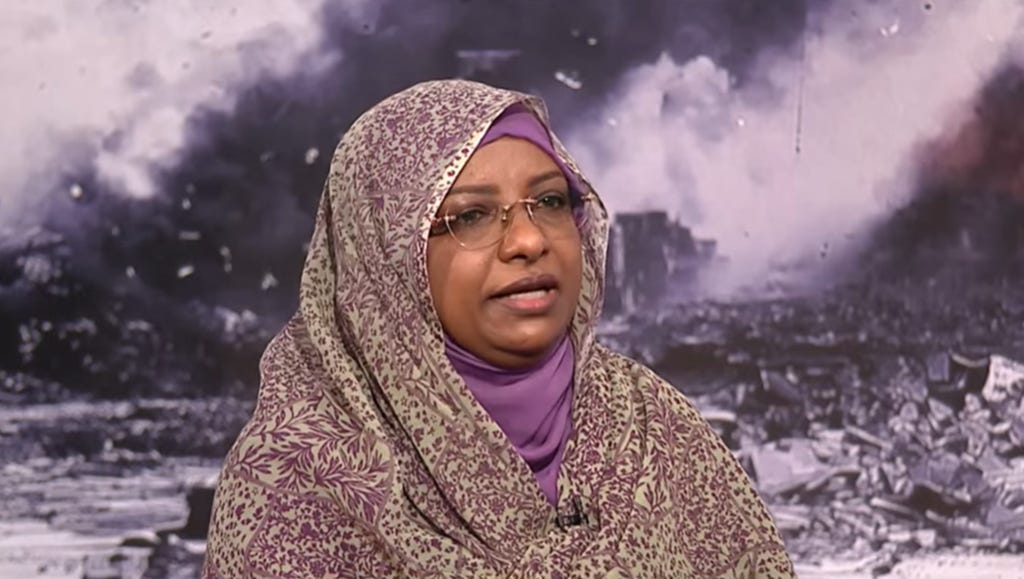
Sanaa Hamad, a former diplomat and senior member of the Sudanese Islamic Movement, was speaking in an interview on the Doha-based Al Jazeera channel on Monday. Her remarks come as Sudan’s civil war between the Sudanese Armed Forces (SAF) and the Rapid Support Forces (RSF), which began on April 15, 2023, continues into its third year, with SAF increasingly relying on allied militias and auxiliary forces to sustain operations.
Hamad framed the emergence of pro-army Islamist brigades and other volunteer formations as part of what she described as Sudan’s historical pattern of mobilizing auxiliary forces during national crises, rather than a new institutional development.
She characterized the current mobilization as a defensive response to what she described as an existential threat to Sudan’s sovereignty and civilian population.
“These groups were established under exceptional circumstances. They were established in response to an existential threat to the state. They were established in response to a powerful force that had no limits, whose main target was the Sudanese citizens and their properties, as well as the institutions of the Sudanese state and the Sudanese army. These groups were established because their communities were threatened, their areas were threatened, and their existence was threatened.”
“They were called under the command of the armed forces, following a call from the Commander-in-Chief of the armed forces to the Sudanese people to join these groups. These groups, let’s say the Bara’a Ibn Malik brigade, are the ones that are being discussed. Other forces are not being discussed, even though there are many other forces besides Bara’a Ibn Malik participating in this war,” she said.
The Bara’ Ibn Malik Brigade is an Islamist militia fighting alongside the SAF in its war against the RSF. Named after a companion of the Prophet Muhammad associated in Islamic tradition with battlefield courage, the group emerged from Islamist mobilization networks linked to Sudan’s former ruling establishment and broader Islamic Movement.
It initially appeared early in the war as a volunteer battalion and has since expanded into a brigade-level force with structured leadership, training camps, and its own media apparatus documenting combat operations.
Although it has no formal legal status within Sudan’s military hierarchy, Baraa Ibn Malik operates with unofficial sanction from SAF and has participated in offensives that pushed RSF forces out of parts of central Sudan. The group remains active on frontlines in the Greater Kordofan region.
Its fighters are primarily drawn from Islamist youth networks, university students, and civilian volunteers mobilized through religious and political channels. The group has also conducted drone operations and urban combat missions, indicating access to advanced weaponry and coordination with military command structures.
Despite operating alongside SAF units, the command relationships between these militias and the formal military hierarchy remain unclear, raising questions about long-term integration, accountability, and post-war demobilization.
Bara’ Ibn Malik is just one of many militias currently fighting alongside the SAF. Other allied armed groups include the Sudan Shield Forces, former Darfur rebel groups such as the Sudan Liberation Army (SLA) and Justice and Equality Movement (JEM), tribal militias, and newly formed regional militias, including one in eastern Sudan. These forces collectively form a loose network of auxiliary units supporting SAF operations across multiple fronts, reflecting the army’s reliance on irregular forces.
The use of militias has long been embedded in Sudan’s military doctrine. During the Islamist-led government of Omar al-Bashir, the army relied heavily on proxy forces, including Islamist brigades collectively called the Popular Defense Forces, to fight insurgencies in southern and western Sudan.
The RSF itself originated from such militia structures, evolving from local Arab ethnic militias, often called the ‘Janjaweed’ (a derogatory term now embraced by the RSF’s own foot soldiers) into a semi-autonomous paramilitary force that ultimately turned against the army establishment in April 2023, triggering the current war.
Hamad emphasized that fighters in the Bara’ Ibn Malik brigade and similar formations should be understood as civilian volunteers temporarily integrated into the war effort rather than independent armed actors seeking political power.
“These young people are either employees in state institutions, or students in universities, or they work in free labor. They don’t have military ranks. They don’t have their own weapons. As soon as this war ends, they hand over what they have and return it to the army.”
“You hand over your weapon from the armed forces’ warehouses according to the rank and file of the armed forces, including Bara’a Ibn Malik and others. You return this weapon, which becomes a personal pledge, you return it, according to this pledge, to the armed forces’ warehouses and you hand it over to them.”
Her remarks appear aimed at countering growing domestic and international concerns that Islamist brigades could evolve into permanent paramilitary forces similar to the RSF, which was originally formed as a government-backed militia before developing into a rival military institution.
Hamad rejected comparisons between Bara’a Ibn Malik and the RSF, arguing that the motivations and organizational structures were fundamentally different.
“Al-Misbah [the leader of Al-Bara’ Ibn Malik] is one of the distinguished young men in Sudan. The circumstances surrounding Hemedti and the Rapid Support Forces are completely different from the circumstances surrounding Al-Bara’a Ibn Malik. Al-Bara’ Ibn Malik includes young men from all over Sudan. They are volunteers without any financial compensation. They are under the leadership of a number of military officers.”
“When the battles in Khartoum ended, the army sent to units asking them to reduce the number of fighters. These young men handed over their military equipment to the military. They were able to go back to their homes and work very peacefully because they did not join for the sake of power.”
UAE role and U.S. ‘red lines’
Hamad also addressed recent remarks by U.S. envoy Massad Boulos, who described engagement with Sudan’s Islamic Movement as a “red line” during an interview on Al Jazeera. She said the movement welcomed dialogue with international actors, but argued that Sudan’s political future should be shaped through a Sudanese-led process rather than external conditions or exclusions.
In her comments, Hamad drew a distinction between engagement and blame, saying she had “no objection” in principle to communicating with the United Arab Emirates (UAE) for the sake of stability, while simultaneously pointing to UAE’s role in sustaining the conflict. She argued that foreign intervention—rather than internal Sudanese political dynamics—has been the primary factor prolonging the war.
“The United Arab Emirates is another matter. In principle, in terms of the dialogue for stability, we have no objection to communicating with it. With the clear indication of the role of the Emirates now in the continuation of this conflict in Sudan. In the meeting with Massad Boulos in Munich, it was one of the things that I was thinking about when I listened to him about the Sudanese-Sudanese dialogue. The main issue in Sudan is not the Sudanese.”
“The issue is now in foreign intervention, in foreign support to continue this battle. If this issue was confined to the Sudanese among themselves, I don’t think it would have lasted all this time. We are now more than a thousand days of suffering, isolation and ruin in Sudan,” she said.
The UAE has provided financial, logistical, and military support to the RSF. Abu Dhabi has consistently denied any links to the paramilitary group. SAF leadership, including General Abdelfattah al-Burhan and senior commanders, have publicly linked the RSF’s sustained operational capacity—including its access to drones, armored vehicles, and ammunition—to the UAE.
They alleged that foreign supply networks operating through neighboring countries have enabled the RSF to maintain combat effectiveness despite losing control of key urban centers in central Sudan.
Independent investigations by journalists, researchers, and monitoring organizations have documented extensive RSF financial and procurement networks operating outside Sudan’s formal state system, including revenue streams from gold exports, commercial entities, and foreign financial channels.
The RSF developed autonomous funding structures during its evolution into a formal paramilitary force under former President Omar al-Bashir, allowing it to sustain operations even after its rupture with the military establishment.
Islamists overstay in power
Hamad acknowledged internal criticisms within the Islamist movement regarding its three-decade rule under Bashir, particularly the concentration of power and governance failures that contributed to Sudan’s political instability.
The National Congress Party (NCP), the political arm of the Islamic Movement, dominated Sudanese politics from 1989 until Bashir’s overthrow in 2019. During this period, the regime faced persistent insurgencies, economic crises, and growing opposition, culminating in mass street protests that ended Islamist rule.
Reflecting on that period, Hamad conceded that the prolonged tenure of Islamist leadership had produced structural weaknesses.
“I cannot say that staying in power for 30 years is a mistake in the literal sense. However, the continuation of the ruling party and the president and the number of people in power for 30 years was a mistake. Personally, I wrote articles on this matter and talked about it, and there were a lot of people who were for reform within the National Congress Party and in the Islamic Movement.”
“There were very big comments on the governmental apparatus, the way it was chosen, the effectiveness of the institutions of the National Congress Party, and the extent of monitoring and accounting of performance at the level of those assigned with duties within the state.”
She also acknowledged that centralized governance had weakened Sudan’s political cohesion, particularly by concentrating power in Khartoum while neglecting peripheral regions.
Hamad further defended the Islamist government’s decision to allow South Sudan’s independence following the 2011 referendum, describing it as a political settlement intended to end decades of war rather than a strategic failure.
South Sudan seceded after more than half a century of intermittent conflict, resulting in the loss of a large portion of Sudan’s oil reserves and territory.
“The Islamists took a very respectful and courageous step. They told the people of the South, if you want to be a part of Sudan, welcome, dear brothers. If you want to separate from Sudan, welcome, dear neighbors. This is after a war that has been going on since 1955.
“The political settlement, the political negotiation, the moral responsibility, people sat with the people of the South. Oh, people of South Sudan, what do you choose? They chose independence from Sudan by 98%. I think that the experience of Islamists in power and the experience of Islamists with South Sudan deserves appreciation.”
Militia mobilization and the post-war outlook
The growing role of militia formations alongside the SAF has raised significant questions about Sudan’s future security structure. Historically, Sudan’s reliance on militias has produced mixed outcomes.
While militia groups have helped the army maintain territorial control during crises, they have also contributed to fragmentation of the security sector and, in some cases, evolved into independent military actors.
The RSF itself followed this trajectory, transforming from a state-backed ethnic militia in Darfur into a powerful paramilitary organization capable of challenging the army directly.
Hamad rejected the idea that the Islamic Movement had contributed to Sudan’s current crisis, arguing instead that its members had mobilized defensively after the outbreak of war.
“We were never part of the problem. We were not a cause of the Rapid Support Forces’ rebellion. We did not have a weapon to face the Rapid Support Forces at the beginning of the war. Despite this, we were the initiators to participate in the protection of the Sudanese citizen, to defend the Sudanese citizen, to participate in the defense process.”
Support our journalism
Sudan War Monitor is an independent publication covering Sudan’s civil war through OSINT, reporting, Arabic-language sources, and political-military analysis. It publishes maps, verified videos, news, and investigative reporting. Please consider subscribing or sharing this article to help sustain our work.


Her remarks reflect a familiar pattern in Sudan’s modern history: framing irregular armed mobilization as a temporary, patriotic response to an “existential threat,” while downplaying the long-term risks of empowering ideologically driven militias outside clear legal and institutional accountability.