Islamist Liberation Party Escalates Criticism of Sudan's Military
Group Denounces Foreign Mediation and Targets Al-Burhan
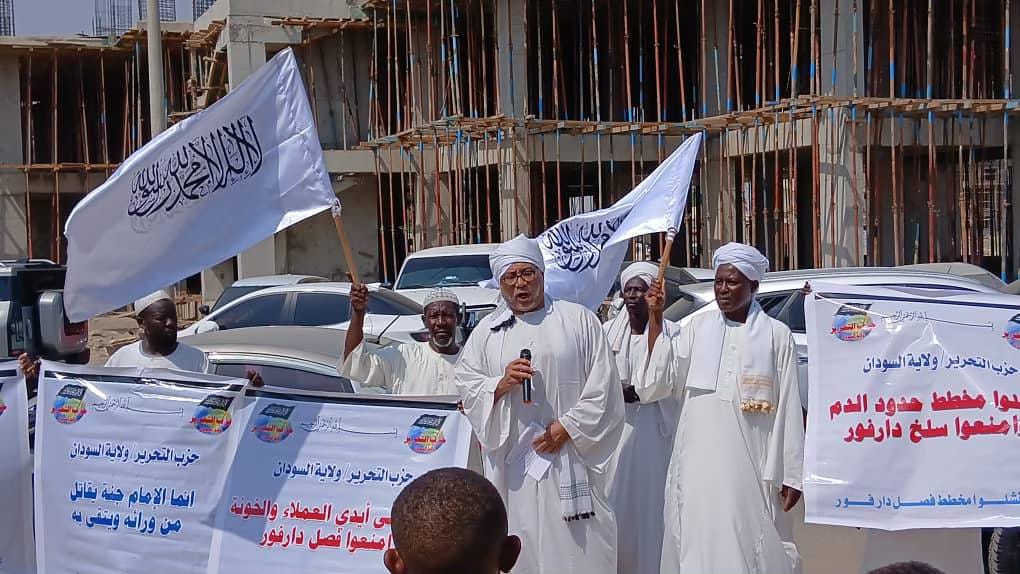
Sudan’s Liberation Party (Hizb al-Tahrir) has intensified a campaign of public protests and political statements accusing the country’s military leadership of subordinating Sudan’s future to U.S.-led diplomacy and facilitating what the party describes as a foreign-backed plan to fragment the country.
In recent weeks, party activists have staged small but recurring demonstrations across cities in eastern Sudan, delivered political addresses after Friday prayers, and issued a series of sharply worded statements attacking the military government’s engagement with Washington and its regional partners, particularly Saudi Arabia.
Though limited in size, the protests mark an escalation in rhetoric by a movement that rejects Sudan’s nation-state framework altogether and frames the war through a transnational Islamist worldview.
“The Rapid Support Forces is the tool through which America intends to separate Darfur. America is also the same state that separated South Sudan under the banner of so-called peace... Its current talk of Sudan’s unity and peace is nothing more than throwing dust in people’s eyes until it achieves its objective from this war.” — Ibrahim Othman, official spokesman of Hizb al-Tahrir
The Liberation Party believes in the establishment of a global Islamic caliphate and uses the same flag as the Taliban and a range of other transnational Islamist movements. Unlike Sudan’s more influential Islamist parties, which historically have sought power within national institutions, the Liberation Party rejects the nation-state as illegitimate in principle.
That worldview is reflected in how the group describes itself. Rather than presenting itself as a Sudanese political party, it refers to itself as the “Liberation Party in the Governorate of Sudan,” framing Sudan as a territorial unit within a future global caliphate rather than a sovereign political entity.
The party’s positions have led several governments to classify it as extremist. Hizb al-Tahrir is banned in the United Kingdom, Germany, Pakistan, and most Arab countries, where authorities have accused the party of promoting violence, radicalizing followers, and undermining the constitutional order.
Background Reading:
Rejection of US-Saudi Diplomacy
The focus of the party’s latest criticisms is General Abdel Fattah Al-Burhan, President of Sudan’s Sovereignty Council. Although he has repeatedly rejected U.S. proposals, including calls for a humanitarian truce and an invitation to peace talks in Geneva, the Liberation Party argues that these public rejections mask a parallel track of private engagement.
Last week, Al-Burhan travelled to Saudi Arabia where he met with the Saudi Crown Prince, senior ministers, and a visiting U.S. delegation headed by Massad Boulos, the top State Department official for Africa policy. He had met with Boulos on several prior occasions too. These meetings yielded no publicly acknowledged outcomes, as Al-Burhan and other members of the army leadership criticized Boulos and continued to insist on a military solution to the ongoing war with the RSF, rather than a negotiated solution.
Yet Hizb al-Tahrir argues that the mere occurrence of these meetings demonstrate acquiescence to an externally managed political process detrimental to the national interest. At a press conference last week, the party’s official spokesman, Ibrahim Othman (Abu Khalil) said,
“Al-Burhan met secretly with [US Envoy] Massad Boulos in Switzerland, then in Egypt, and finally in Saudi Arabia, without any disclosure of what took place in these meetings. This confirms that America is, in practice, the one holding the file—not to achieve peace or end the war, but to sever Darfur from the body of Sudan, after entrenching the Libyan scenario of having one government in Darfur and another in the rest of Sudan.”
“In this atmosphere, despite declarations by military leaders that they are determined to liberate all of Kordofan and Darfur, in reality there is no serious military action in this direction, because America does not want the army to defeat the RSF militarily. Hence its repeated assertion that there is no military solution to the conflict in Sudan.”
The party has portrayed Saudi Arabia’s role as providing diplomatic cover for this process, dismissing regional initiatives as political theater designed to legitimize US involvement in the region. The party’s critique ultimately extends beyond the military’s conduct of the war to a wholesale rejection of participation in diplomacy with non-Muslim states. Ibrahim Othman stated,
“It is not permissible under Islamic law to establish relations with America, let alone entrust it with managing the crisis in our country. Allah Almighty says: ‘Do not grant the disbelievers authority over you’ (Qur’an 4:141). Moreover, America, being a disbelieving state, cannot bring any good… So how can one who does not wish good for us from our Lord bring good to us? America is an enemy, not a friend. Allah Almighty says: ‘Indeed, the disbelievers are to you a clear enemy’ (Qur’an 4:101). Accordingly, the Islamic ruling is that America is a hostile, belligerent state—one that killed our brothers in Iraq and Afghanistan, and most recently in Gaza.”
Protests Tolerated Amid Broader Repression


Hizb al-Tahrir’s street preaching echoes its official statements. In cities including Port Sudan, Omdurman, and Gedaref, as well as smaller towns, party activists have given public lectures outside mosques and in markets. Demonstrators have raised banners criticizing the government and demanding a more aggressive prosecution of the war.
Notably, these activities have taken place in an environment where Sudan’s military authorities generally do not permit anti-war demonstrations, labor protests, or pro-democracy mobilization. Since the outbreak of the war in 2023, security forces have routinely dispersed or preempted civilian protests calling for peace or civilian rule.
Hizb al-Tahrir is outside the mainstream of Islamist politics in Sudan. Most Islamist networks—including those associated with the long-time ruling party, the NCP—continue to support the military and emphasize national sovereignty within existing borders. Yet Hizb al-Tahrir’s rejection of peace negotiations and international mediation resonates within the broader Islamist mainstream. This helps explain the continued tolerance of the party’s activities and the reluctance of authorities to crack down on the group; doing so could just draw attention to its agenda.
One recent attempt by local authorities to crack down on the group appears to have backfired. In Al-Shawk, Gedaref State, security forces on Friday arrested five party loyalists, including a local community leader, after a demonstration outside the town’s Old Mosque. They unfurled banners saying, “Foil America’s plan to separate Darfur,” “Foil the plan of blood borders and prevent the severing of Darfur,” and “Establish the Caliphate to uproot the influence of the disbelieving West from your lands.”
The arrests failed to deter party leaders; Hizb al-Tahrir responded with a defiant press statement condemning the arrests, saying, “This behavior by the security apparatus confirms that the government is proceeding with the American plan to fragment Sudan by severing Darfur, after it had already separated the South using the same method now being applied… these arrests and silencing voices will not deter us from speaking the truth and acting upon it, even if the price is our lives and blood.”
Al-Baraa Bin Malik Continues Expansion
Meanwhile, the majority of Sudanese Islamists continue to support the Sudanese military and work within it, or alongside it. The paramilitary Al-Baraa Bin Malik has grown into the largest armed group fighting alongside the Sudanese military. Explicitly Islamist and jihadist, Al-Baraa Bin Malik is a descendant of the Popular Defense Forces of the 1990s and early 2000s.
Al-Baraa Bin Malik has no formal legal status but operates with unofficial sanction. It appears to have ample funding, access to advanced weaponry, and sophisticated media and recruitment operations. The group takes its name from a companion of the Prophet Muhammad remembered in Islamic tradition for his battlefield courage.
Attempts by some military leaders to control the growth of the paramilitary or put it under an institutional framework have failed. Al-Baraa Bin Malik began the war in 2023 as a self-styled battalion, before rebranding as a brigade and most recently as a “corps.” This signals rising ambition and power, despite rumored tensions with army high command.
Last month, Al-Baraa Bin Malik relocated its headquarters from Atbara in River Nile State — the birthplace of Omar al-Bashir and many other leaders of the former regime — to Ad-Duiem in White Nile State, which is near the North Kordofan front. Al-Baraa Bin Malik has recruited thousands of boys and university-aged men, who have few educational or employment opportunities. Schools and universities in large parts of Sudan are closed, and the government has prioritized military training camps rather than economic rebuilding. Below are some videos from Al-Baraa Bin Malik training camps.
Shine a Light on Sudan’s Crisis
Most of our content is free to read, while paid subscriptions fund continued coverage and investigations. Sudan War Monitor is independent and not affiliated with any party in Sudan’s ongoing conflict. We publish news, maps, and analysis based on field sources and open-source research.


