
The war in Sudan has triggered an outpouring of jihadist music, which is spreading in training camps, in the streets, and online. Poets have revived and adapted long-buried jihadist tunes of the 1990s, while also composing new ones or importing lyrics from international contexts.
These songs frame military service as a religious obligation, lionize fallen warriors, and portray Sudan’s ongoing war as part of a wider historic Islamic jihad. Called nasheed (Arabic: نَشِيد, pl. anasheed), they are sung without instrumental accompaniment, except for clapping or simple percussion.
The Sudanese Armed Forces (SAF), which portrays itself internationally as an apolitical institution battling to uphold the state against an existential threat, promotes the circulation of such songs on state media, in military training camps, and at public gatherings to shape public opinion about the war.
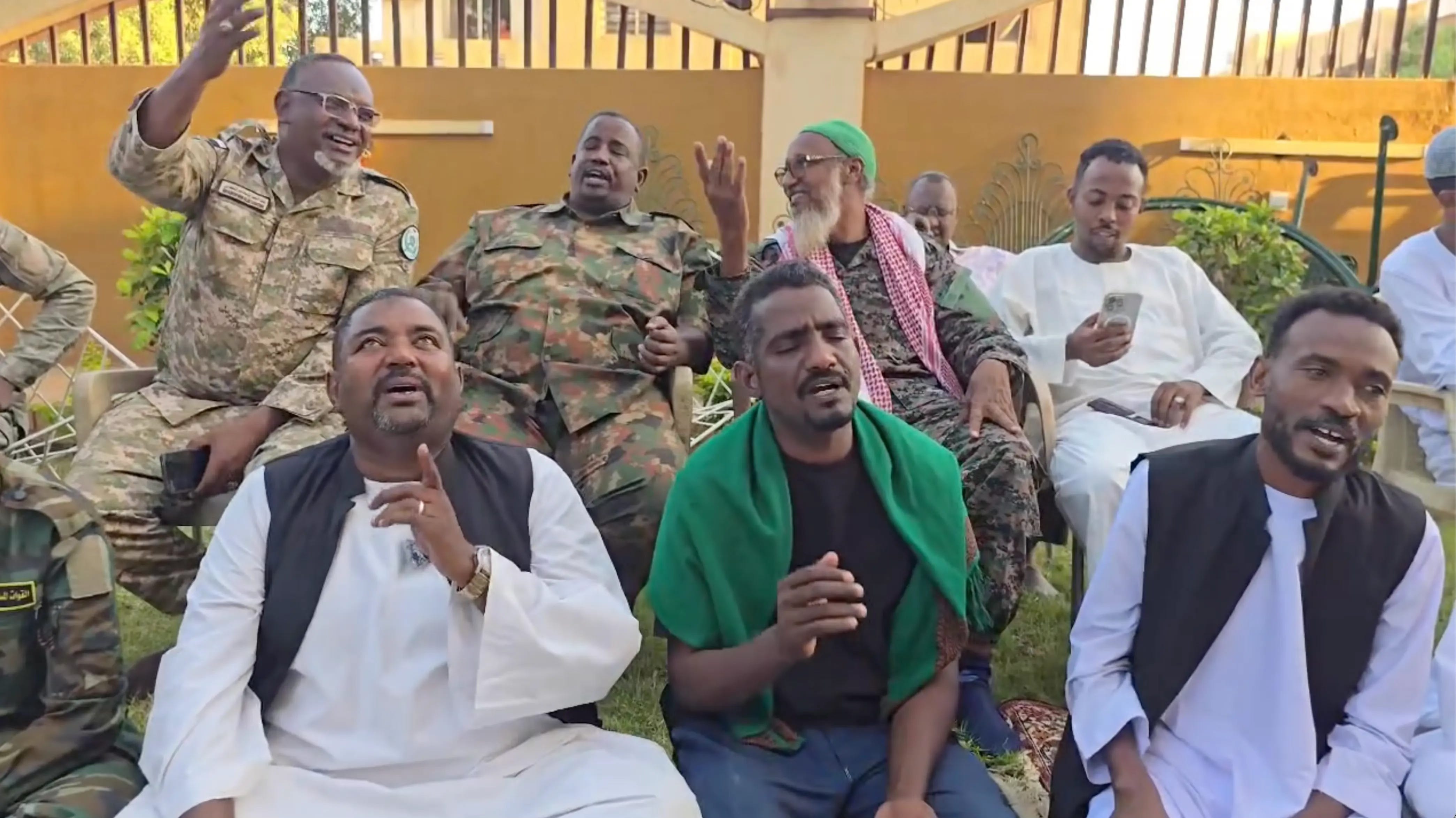
In the course of preparing this article, our researchers identified numerous videos in which top SAF commanders and officers sing jihadist songs alongside Islamist militants. This illustrates that this music is a deep-rooted part of Sudanese military culture, especially on the SAF side of the conflict.
Like nasheed in international jihadist contexts, Sudanese nasheed go beyond mere battle hymns and elegies. They also address political and cultural themes, promoting a counter-cultural “Islamic Resurgence” that opposes secularism, democracy, and alleged non-Islamic conceptions of society.
For background, Europol (the European Union’s law enforcement intelligence agency) defines jihadism as “a violent sub-set of Salafism, a revivalist Sunni Muslim movement that rejects democracy and elected parliaments, arguing that human legislation is at odds with God’s status as the sole lawgiver.”
“Jihadists aim to create an Islamic state governed exclusively by Islamic law (shari’a), as they interpret it. Unlike other Salafist currents, jihadists legitimise the use of violence by referring to the classical Islamic doctrines on jihad, a term that literally means ‘striving’ or ‘exertion’, but which jihadists treat as religiously sanctioned warfare. All those who oppose jihadist interpretations of Islamic law are considered as ‘enemies of Islam’ and therefore considered legitimate targets. Some jihadists include Shi’a, Sufis and other Muslims in their spectrum of perceived enemies.”
In Sudan, the Salafist jihadist project encompasses both conventional military violence against external threats, and purification of the state and society from perceived internal threats — including democrats, communists, religious minorities, feminists, anti-war activists, and other dissidents. Its goals include but are not limited to defeating the RSF and SPLM-North, and they reject non-military means of ending the conflict with these groups.
Each of the jihadist songs below is verified as coming from the Sudanese context within the past three years. This represents only a small sample of the musical performances available through social media pages affiliated with the Sudanese Armed Forces (SAF) and its auxiliaries.
The popularization of this type of music poses a barrier to resolution of the ongoing conflict and creates conditions for the further radicalization of the country’s jobless youth and out-of-school children.
Where is the Army of Jihad?
Performed here by combatants on the North Kordofan front, this song identifies the Sudan Armed Forces (SAF) and its auxiliaries as “the Army of Jihad.” The lyrics and playful call-and-response create a celebratory mood, anticipating battle and victory.
Older videos of this song indicate that it pre-dates the current conflict (likely originating in the 1990s conflict in South Sudan or the 2011-2018 conflict in the Nuba Mountains), but that the lyrics have been adapted with new place names to fit with current events in the ongoing civil war.
Translated Lyrics
Oh Mujahid, arise—the call to battle is upon you,
the call to battle is upon you.
They are the chosen ones; they have attained Paradise.

From An-Nuhud, they arose, onward to Nyala,
From Al-Da'in, they arose, onward to Nyala,
Where is the Army of Jihad?
The Army of Jihad has gone forth (x2).

From Baraa, how? Shell [them].
From Um Sarha, how? Shell [them].
From Jabra, how? Shell [them].
Katyusha, how? Shell [them].
Islam, where? Shell [them].
Don't stop! Shell [them].

From An-Nuhud, they arose, onward to Nyala.
From Al-Da'in, they arose, onward to Nyala,
Where is the Army of Jihad?
The Army of Jihad has gone forth (x2).

Talk to the machine gunner
Tell him not to forget, tell him not to forget (x2).
Where are Hisham's people? [Different martyr names inserted here]
Up in paradise now.

Where is the Army of Jihad?
The Army of Jihad has gone forth.
Advance, Mujahid
This song urges soldiers to attack without fear of death, promising eternal rewards. SAF Deputy Commander-in-Chief Yasser Al-Atta appears in this video alongside army soldiers and Al-Baraa Ibn Malik paramilitary members.
Translated Lyrics
Why, why, O Mujahid (fighter) — why do you not advance?
Toward the virgins of Paradise and its delights, you will gain and profit.
Read the Book of God and understand it.
Pray during the night, rise early so you won't regret it.

Recite your supplications, speak with them;
Pray for your Prophet and your worries will be removed,
Understand your Kalashnikov and your G-gun [Heckler & Koch G3];
Aim for the head — show no mercy!

Advance quickly to meet your enemies.
Do not fear the shells, do not fear the mines.
The enemies of God live in delusion,
Forgetting the Hereafter, the greatest Day.

Distracted by this world, by pleasure and music.
They have no worship, no religion, no understanding,
They submitted to the West, they sold their honor,
They walked a path that destroyed their values.

But by God, we will never surrender,
Even if the whole world, Arabs and non-Arabs, comes against us,
The lasting covenant — we forged it as an oath;
For none but God have we any concern.

Our enemy we will destroy with crucifixion and fire;
Our country we will rebuild — our mark will remain.
God’s blessings cover the Most Noble,
The Messenger of God, the guiding banner.

No fighter steps into the ranks without moving forward,
No one becomes a martyr without the shedding of blood.
Our Lord, the Worshipped One
This simple nashid in the form of call-and-response refers to two frontline battle zones: Dar Hamar (actively contested in mid-2025) and the presidential palace in Khartoum (recaptured from the RSF in March 2025). The song links traditional expressions of religious piety (prostration, prayer, and Quranic recitation) with wartime violence. The singers are trainees and leaders of Al-Baraa Bin Malik Corps, a paramilitary backed by the Sudanese Armed Forces.
Translated Lyrics
Our Lord, the Worshipped One — our Lord
We call upon You in prostration — our Lord
We swear by God — our Lord
Dar Hamar will return — our Lord
Allah, Allah, our Lord.

O Messenger of God, O our beloved — our Lord
Who teaches us our Quran — our Lord
in the recitation of Al-Dudi — our Lord
We reclaimed our honor — our Lord
[To] our Republican Palace — our Lord...
Against the Kharijites
The singers cast their enemies as “kharijeen” — "those who go out," i.e. renegades or dissenters — invoking the Kharijites, the first major rebel faction in Islamic history, who broke from the Caliph Ali ibn Abi Talib following the Battle of Siffin in 657 CE. By borrowing this label, the singers position themselves as the legitimate Islamic order and their opponents as rebels against God's community — not technically non-Muslims, but traitors who have broken ranks from within. The framing is woven into a martyrdom war chant promising paradise to those who fight and fall, placing the singers in an unbroken line stretching back to the Companions of the Prophet himself.
The lead singer is wearing insignia of the Sudanese General Intelligence Service (GIS). Also pictured is Al-Naji Abdullah, a preacher nicknamed “prince of the mujahideen,” also wearing a GIS uniform, while others wear SAF uniforms. The video was filmed in North Kordofan State earlier this year.
Translated Lyrics
We are a weapon forged against the renegades [Kharijites]
O Sudan, rejoice — a glorious victory is won
We are a weapon forged against the Kharijites.

The gates of paradise have opened for the faithful warrior
Within it, goodness is complete, and the Heavenly Virgins await
Within it, rivers run to quench the thirsting
…A paradise of endless bliss — the prize of those who fall victorious.

O Sudan, rejoice — a glorious victory is won
We are a weapon forged against the renegades

We have left behind the world of those already gone
A world of fleeting pleasures, luring the weak astray
Our Lord has honored us — we shall win one of two glories
In paradise, we shall stand beside the finest of His messengers.

O Sudan, rejoice — a glorious victory is won
We are a weapon forged against the renegades

For Your sake, Lord, we marched to battle, seeking paradise
Toward Your presence we advance, our hands raised in surrender
Accept our jihad, Lord — we come before You in devotion
Forgive us our sins, that we may stand among the pure.

O Sudan, rejoice — a glorious victory is won
We are a weapon forged against the Kharijites.
In the end… in the end You summoned us, O Creator of all souls
In the gardens of heaven we shall muster, every one
We shall stand among the Companions and all who followed them
At the Kawthar, our Prophet waits — we drink with our right hand.
O Revolution of the Martyrs
In secular Sudanese political discourse, ‘the Revolution’ often refers to the mass protests that toppled Omar Al-Bashir’s Islamist regime in 2019, ushering in a brief period of civilian rule. This song inverts that, reclaiming the word for the Islamist cause. In this context, “revolution” recalls the “Salvation Revolution” that brought the National Islamic Front to power in 1989, as well as the October 2021 coup that toppled the transitional Hamdok government and restored Islamist influence, and the current armed struggle against the RSF.
The named individuals in this translation are casualties of the current war. One of them, Anas al-Duwalab, is confirmed by a death notice issued by the Sudanese Islamic Movement’s secretary-general as having fallen in May 2023, the son of a senior figure in the movement. The song’s theology draws on classical Islamic martyrdom doctrine.
Based on dialect and references to specific persons, the song appears to have been composed by a poet of the Shaygiya tribe of River Nile State, which is historically a stronghold of the long-time ruling party.
Translated Lyrics
O devotee of the Beautiful One [the revolution personified] —
How much you sang for her,
From the day you journeyed forth and composed your final verse —
In the Revolution are those with firm resolve,
Who carried forward the tamkeen [the Islamist project of embedding loyalists throughout the state] — men of thought and faith —

O revolution of the martyrs, that stirs men's souls! (x3)

Among the fighters I remember our brothers in faith:
Hamdi the cheerful one, who brought calm to our souls,
Who spent his years not in vain but in service of the brethren.

O revolution of the martyrs, that stirs men's souls! (x3)

Numan, my brother, who parted from those he loved,
We had barely said our farewells — the heart still aches with longing.
And Nizar rests among the brethren at peace in paradise.
The revolution has its companions — the people of thought and faith.

O revolution of the martyrs, that stirs men's souls! (x3)

Anas Al-Duwalab gave himself in service of his brothers,
Until the day he found his beloved ones,
In the garden of God’s eternal pleasure,
To whom does the banner pass, if not to his faithful brother
We Shall Return
This song exemplifies the jihadist theme of oppression under what they view as Western influences, secularism, and non-Islamic rule within Muslim lands. The ‘new dawn’ described in this song involves both a military triumph and a religious restoration. The performer Abu Algasim is seated between Owais Ghanem (left), a leader in the Al-Baraa Bin Malik Corps, and Naji Mustafa (right), an Islamist preacher, who praised Iran in March for executing dissidents and spies and for successfully resisting U.S. and Israeli aggression.
Below, after the translation, another video featuring this song (pre-recorded), overlaid on images of Al-Baraa Bin Malik military training in Khartoum State.
Translated Lyrics
At the new dawn, we shall return and beseech God with praise in prostration.
We shall return to fill the streets with cries of tahlil [“there is no God but God”] and takbir [“God is great”] as the multitudes assemble.
We shall shake every quarter like a volcano, with all the worlds as witness.
We shall return from where endings become beginnings,
Wearing down all who dare oppose our ascent.

We shall return though darkness reigns
and oppressive gloom covers the land —
for darkness is no barrier to our longing,
our devotion, our consecration, and our steadfastness...

We shall return with Al-Qa’qa’, with Al-Bara’ [early Islamic commanders],
With the martyrs and thousands of soldiers,
We shall return to saddle our horses for glory and an eternal legacy...
The summer of victory, and returning, the Soldiers of God...
We shall return either to glory, or to live in Paradise [as martyrs].
I Shall Return
Unlike the a cappella style of the videos above, this song is set to musical instruments in traditional Sudanese style. The lyrics are drawn from a poem by the Egyptian-Qatari Muslim Brotherhood scholar Yusuf al-Qaradawi (1926–2022), a controversial cleric known for his theological endorsement of Palestinian suicide bombings, including against civilian targets.
The poem constitutes a total rejection of non-violent political process in favor of armed struggle, declaring: “The language of blood is my language, and nothing but blood — I have shut my mouth to all the arts of speech, and left it to the rifle to do the talking.” The poem closes with an appeal to follow the example of Salah al-Din al-Ayyubi, the medieval Muslim commander who recaptured Jerusalem from the Crusaders in 1187.
The music is overlaid on footage of Sudan Shield Forces (a SAF-backed paramilitary) in North Kordofan State, with Islamist media personality Farhat Wad Alomda visible in the foreground — placing a poem written about Palestine squarely in the ideological register of Sudanese Islamist armed factions, for whom the Palestinian resistance tradition and the Sudanese civil war are part of a single continuous jihadist struggle.
Translated Lyrics
I am returning — I have sworn that I am returning,
and the truth bears witness for me, and what a witness it is.
With me is the projectile and the eternal Book [Quran],
and faith leads me — what a leader it is.

I have grown weary of poetry lamenting my catastrophe,
and I refused to hear anything but the poetry of revolution.
So leave off the wailing — for nothing shall restore my homeland
but the roar of fire on the day of the raid.

The language of blood is my language, and nothing but blood —
I have shut my mouth to all the arts of speech
and left it to the rifle to do the talking,
to turn the enemy’s lairs into hellfire.

The idol of fears and desires I have smashed,
and the routine of my life I have scorned and grown sick of.
The rage-filled hatred in my chest I have kept suppressed —
until what I have resolved gives it release.

O holy Jerusalem, O land of sacrifice,
I have sworn to make of you the graveyard of the enemy.
I have tasted death’s bitterness if I do not return to you as master —
the taste of perishing is better than a life of exile and wandering.

I do not fear death when it approaches —
rather I hasten my steps toward it at a run,
for it is the path to victory for a people in trial,
and beyond it lies Paradise — what a blessed dwelling.

O my brothers, rise for the appointed day.
Here is my hand — place your hands in mine.
Do not remind me of yesterday; we are with tomorrow,
and we have Salah [al-Din al-Ayyubi] as our example — let us follow his lead.
We Have Not Faltered
This song declares that its singers are ‘descendants of Al-Muthanna,’ a 7th-century conqueror of Iraq and Persia in the first generation after the Prophet Mohamed. Originally written by Palestinian poet Jihad al-Turbani, it was adopted by Sudanese militants who portray the present-day military struggle in Sudan as part of a wider history of religious wars and conquests.
Translated Lyrics
Chorus:
We have not faltered, we have not faltered—
We are the descendants of al-Muthanna.
On the road of glory we marched—
Ask history about us.

Our glory is Dhāt al-Salāsil [a battle fought in 629 CE / 8 AH],
Our honor is the walls of Tustar [Khuzestan].
And ask the Palace of al-Madā’in [Ctesiphon],
Where al-Qaʿqāʿ [a commander] raised the cry.

We do not care — if we wished,
To tear off the peaks of mountains,
In the path of God we marched,
Across the fields of battle.

O history, we have returned—
We have come back anew
With blood we have written
A page of ancient glory.

Ask the soldiers of the Cross,
Ask the soldiers of the Tatars:
Did we ever despair of battle,
Or were we broken by any siege?

And remember the conquest of Mecca,
After patience and waiting —
And Tariq [Umayyad commander] in the valley of Lakka [Guadalete, Spain],
Who rode the waves of the sea.

Ask Dhāt al-Sawāri [Arab naval victory over Byzantium, 655 CE / 34 AH],
Ask the deserts about us.
We are seekers of high deeds—
We are devotees of the night.
We are the Islamists
This simple call-and-response chant features heavy rhyming and wordplay and is well-suited to contexts of military training, for purposes of indoctrination and morale. The song boasts of the singers’ devotion to the Islamist cause, declaring, “We are the mujahidin [fighters], we are the keezan [Islamists].”
The use of the word ‘keezan’ defiantly repurposes an anti-Islamist slur popularized during the civilian uprising of 2018-2019, when secular pro-democracy protesters succeeded in temporarily ousting Sudan’s long-time Islamist rulers. In this context, the singers proudly identify with the label, rejecting any negative connotations.
Two video versions of this song are presented here (above and below). The song lyrics vary slightly depending on the performer. Some versions include lyrics praising Omar Al-Bashir, Al-Misbah Talha, and Abdel Fattah Al-Burhan.
Translated Lyrics
We are the mujahidin [fighters/jihadists] — ya Allah [O God],
Against the rebels — ya Allah,
Al-Baraa Battalions — ya Allah,
We are the Keezan — ya Allah,
In every place — ya Allah,
We are the Brotherhood — ya Allah,
On the field [of battle] — ya Allah,
Either we will rule — ya Allah,
Or we will die as martyrs — ya Allah,
There's no coward among us — ya Allah,
'56 [Sudan's year of indepedence] — ya Allah,
For the protection of religion — ya Allah...
Additional Songs
Several additional songs are included here without translation, to provide a larger sample of music from the ongoing conflict.
Al-Baraa Bin Malik cadets recite jihadist song at presence of high-ranking Sudanese Armed Forces officers reciting with them, Blue Nile State:
Indoctrination of cadets in Blue Nile State, filmed at the same location:
Commander of SAF Armored Corps Maj-Gen. Nasr El-Din Abdel Fattah singing “Pillars,” which says in part, “The path of our call is Jihad, and death is the aspiration of those called to the truth.” The lyrics are by Walid Al-Azami, a prominent 20th-century figure in the Muslim Brotherhood in Iraq.
Al-Baraa Bin Malik commanders in Khartoum State:
Individual and Organisational Subscriptions
We are an independent group of journalists and open source researchers unaffiliated with either side in the conflict. Sudan War Monitor is used by NGOs, newsrooms, policy teams, and research institutions working on Sudan or related policy issues. We offer team subscriptions that cover your whole organisation under a single annual payment, managed through Substack and processed securely by Stripe. Seats can be added or reassigned at any time.