

Video: Burning UN logistics base in Kadugli, South Kordofan, 13 Dec. 2025
The Sudanese military stormed across North Kordofan in early 2025, capturing nearly all cities in the state and reopening the key highway between Kosti and El Obeid. Outnumbered, outgunned, and demoralized, the Rapid Support Forces (RSF) fled west in a chaotic retreat.
By mid-year, however, the RSF had regrouped and the army offensive had stalled in the west, failing to penetrate West Kordofan and relieve isolated garrisons in Babanusa, Dilling, Kadugli, and An-Nahud.
The onset of a new dry season has seen the RSF regain its morale and momentum. The renegade paramilitary captured El Fasher on 26 October 2025, Babanusa on 1 December 2025, and Heglig on 8 December 2025.
Today, El Obeid is again effectively under siege. The North Kordofan capital is surrounded by RSF forces on three sides, while the only open road is targeted by RSF drones. The cities of Kadugli and Dilling likewise are besieged, and several smaller Kordofan towns once held by the Sudanese Armed Forces (SAF) — Um Sumeima, Al-Khowai, Barah, and Kazgil — are again in RSF hands.
Video: Burning supply truck outside the village of Allah Kareem along the Kosti-El Obeid highway, 7 Dec. 2025
The RSF succeeded in blunting the army’s numerical superiority by outmaneuvering it, acquiring sophisticated drones, shooting down SAF cargo planes and drones, and striking an alliance with the SPLM-North (a decades-old guerrilla movement controlling parts of the Nuba Mountains). RSF forces are almost entirely mobile, operating in columns of light combat vehicles that melt away in the face of SAF offensives, only to return and strike more vulnerable targets, including weakly defended outposts and supply lines.
The next target for the paramilitary appears to be Dilling, which the RSF has been shelling in recent days as it masses troops nearby. Dilling hosts only a brigade, not a full division, and is therefore vulnerable than El Obeid or Kadugli.
As the fighting in Kordofan grows more intense, both sides are employing drones for both short-range and long-distance attacks, terrorizing troops and civilians alike throughout the vast arid region. To help readers understand the scope of the drone war, as well as the lines of control in the Kordofan region, Sudan War Monitor prepared a map of the current situation.
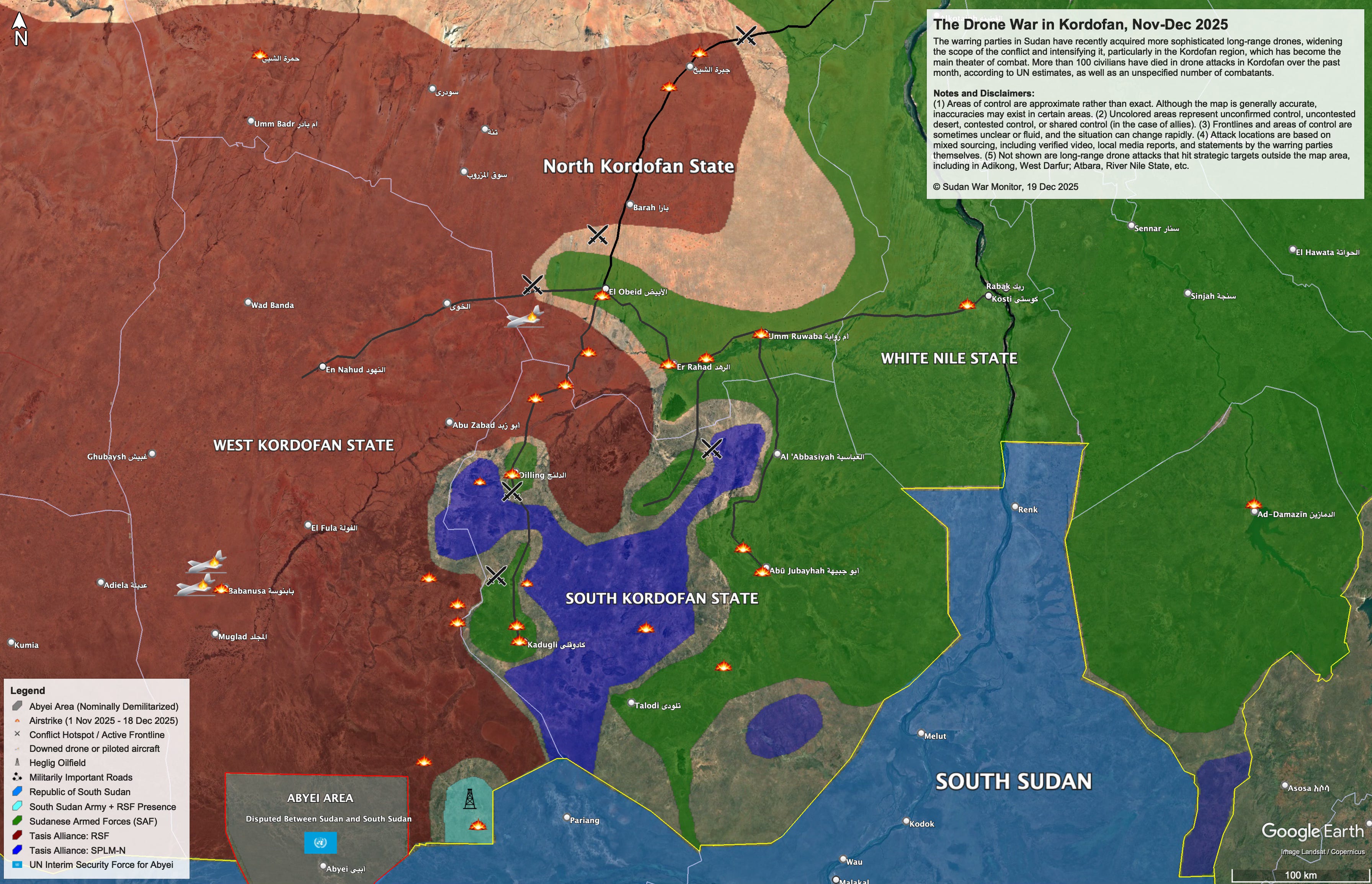
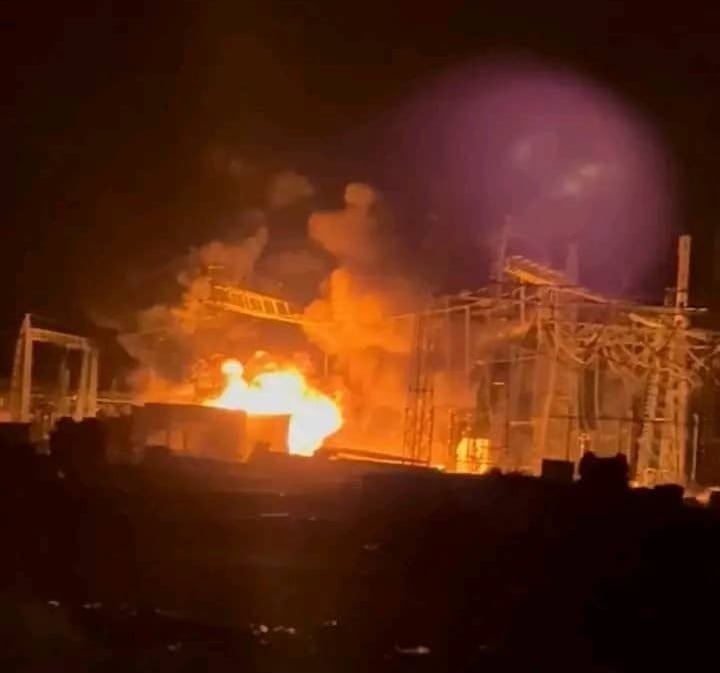
In addition to the attacks shown on this map, the RSF has attacked civilian infrastructure farther east, including most recently in Atbara. Before dawn on Thursday, anti-aircraft fire erupted in Atbara as swarm of suspected RSF drones attacked the city. Several civilians reportedly were killed, and a fire at the Al-Mogran electricity transmission station caused widespread power outages. Meanwhile, the Sudanese Air Force has hit both military and civilian targets in Darfur, including recently in Adikong, Katila, and Melit.
The UN Human Rights Office in Geneva warned last week that it fears another wave of atrocities in Sudan, particularly in the Kordofan region, amid a surge in fighting. The agency said that since 25 October, it has documented 269 civilian deaths in Kordofan from aerial strikes, artillery shelling, and summary executions; it noted that phone and internet outages hinder accurate reporting, therefore, the number of casualties is likely much higher.
Many civilians have been detained for ‘collaborating’ with opposing parties. UN Human Rights Chief Volker Türk expressed concerns about the use of hateful and divisive speech that risk fueling the violence. “It is truly shocking to see history repeating itself in Kordofan so soon after the horrific events in El Fasher,” said the High Commissioner, referring to a city in Darfur where massacres took place two months ago.
“We cannot remain silent in front of yet another man-made catastrophe. This fighting must end immediately, and life-saving aid allowed to reach those who face starvation.” At particular risk are Kadugli and Dilling. The UN Human Rights office noted in a press statement that in these cities, “The humanitarian situation is dire, with famine confirmed in Kadugli and risk of famine in Dilling. All parties are blocking humanitarian access and operations.”