

Below: Promotional video showcasing capabilities of the TB2, a drone produced by the Turkish defense company Baykar and supplied to the Sudanese military.
A Turkish-made attack drone operated by the Sudanese Air Force crashed near frontline RSF positions in North Kordofan yesterday, December 10, 2025, after being brought down by gunfire or a mechanical failure.
This follows the loss of at least four other SAF Bayraktar drones in recent months, plus an Ilyushin Il-76 cargo plane in November. Substantial aircraft losses of this kind reduce the Sudanese military’s reconnaissance and strike capabilities just as the RSF escalates its own drone war and a dry season offensive that has dealt several defeats to the Sudanese military already.
RSF-linked accounts on social media reported that they had shot down the drone in Abu Gaoud, a town just off the tarmac road that connects West and North Kordofan, approximately 50 km west of the army stronghold of El Obeid, capital of North Kordofan.
Sudan War Monitor was able to verify footage of RSF fighters with TB2 wreckage in Al Khuwai, West Kordofan. They had brought it to the city on pickup trucks, after collecting it at the crash site farther east. The aircraft did not appear to have suffered fire damage, nor were there bullet marks.
The drone bore Sudanese air force insignia. Labels on intact aircraft parts recovered from the scene indicated that the TB2 was manufactured in 2023.
Below: Videos of RSF troops celebrating with TB2 wreckage, 10 Dec. 2025. NB the second video below is noisy due to the sounds of celebratory gunfire.
Bayraktar TB2 is a lightweight drone used for precision strikes. It fires small, laser-guided bombs and has a narrow fuselage roughly the length of a car but a wingspan of about 12 meters. Although the manufacturer advertises an endurance of more than 20 hours, in practice TB2 missions usually last only a few hours and stay within 50–150 kilometers of their launch point.
The location of the wreck, Abu Gaoud, suggests that this drone was conducting a mission in support of frontline SAF troops. It may have taken off from El Obeid in North Kordofan or Wadi Saidna Airbase in Khartoum State.
RSF troops in the Abu Gaoud area previously claimed to have shot down another Bayraktar in September. Abu Gaoud has traded hands several times. In November, SAF carried out operations in the area before withdrawing.
North Kordofan has emerged as one of two main active fronts of the current phase of the war. Recent RSF victories in El Fasher, Babanusa, and Heglig have freed up thousands of fighters and vehicles for deployment in North and South Kordofan. These states have also become the focus of the drone war, though both sides also conduct long-range attacks into adjoining regions.
Recent SAF Successes and Losses
Each Bayraktar TB2 costs at least $2–3 million, not including maintenance, training, and the cost of precision-guided munitions. Sudan’s military likely has only a handful of these drones, perhaps 3-6, plus a smaller number of Akinci (a newer and far larger model from the same manufacturer).
The Akinci are being used for long-range strike missions into Darfur, while the TB2 carry out tactical missions in Kordofan. Two recent strikes in Darfur were attributed to Akinci drones, far from SAF-controlled territory. At the Adré border crossing last week, an RSF fuel convoy exploded shortly after crossing into Sudanese territory. Then on Monday, a suspected Akinci drone struck a public gathering in Katila, South Darfur, killing dozens of people, amid conflicting reports whether the victims were civilians or RSF soldiers.
These strikes demonstrate that the Sudanese military is still capable of inflicting damage from the air, notwithstanding recent aircraft losses.
Background on the Air War
Drones, also called UAVs, played only a limited role in the first year or so of Sudan’s war (2023-2024), as infantry and mobile ground units dominated on the battlefield. Fixed-wing aircraft operated by the Sudanese Air Force played a secondary role, carrying out a relentless bombing campaign on cities and villages of Darfur, far from the battlefield.
The Sudanese Air Force targeted market stalls, livestock markets, schools, hospitals, IDP camps, and other civilian infrastructure. Many of these attacks took place on market days, demonstrating a deliberate effort to maximize civilian casualties. According to monitoring by the Centre for Information Resilience, an OSINT organization, SAF airstrikes across Sudan have resulted in at least 1,719 reported civilian deaths and over 1,000 injuries.
Accounting for the deaths and injuries that the researchers were unable to verify, the real toll is likely far higher. Centre for Information Resilience noted in a report published yesterday,
“These figures are conservative: Sudan Witness applies a high threshold for registering a reported airstrike, and where casualty reports vary, records the lowest reliably reported number. Therefore, the actual number of strikes and casualty counts are likely much higher.”
SAF’s air campaign in 2023-2024 relied mostly on high-altitude, manned cargo planes adapted for bombing missions. This year, however, SAF’s manned air campaign slowed down, before mostly grinding to a halt. There are several possible reasons behind this development:
international or domestic criticism over civilian casualties;
the limited military utility of high-altitude attacks using unguided bombs;
maintenance costs and shortage of parts;
a shortage of qualified crew and pilots,;
improved RSF anti-aircraft capabilities.
The RSF shot down IL-76 cargo planes operated by the Sudanese military in October 2024, February 2025, and November 2025, plus Antonov planes in April and June 2025. Earlier, in 2023-2024, the RSF shot down a large number of SAF’s fighter jets, including MiG and Sukhoi models.
Faced with improved RSF anti-aircraft defenses, the Sudanese military has turned to unmanned Turkish, Chinese, and Iranian attack drones.
Meanwhile, RSF fighters are using a variety of anti-aircraft weapons: shoulder-mounted FN-6 heat-seeking missiles, truck-mounted ZPU-4 anti-aircraft machine guns, and advanced Chinese FK-2000 systems, likely provided recently by the UAE. They also employ jamming devices that affect drones’ navigation and communication systems.
On 5 November, debris from a Chinese-made FK-2000 air defense missile was spotted near the crash site of a Sudanese army cargo plane downed outside Babanusa. Later that month, the RSF shot down a Bayraktar Akinci drone near the same city. SAF’s inability to continue providing air support to the garrison in Babanusa contributed to its capture on 1 December 2025.
Photos: ‘Symbol of Hope’
Marie-Helene Verney, UNHCR Representative in Sudan, shared these images on social media after a UNHCR visit to Ad-Dabbah, Northern State. She wrote, “10-days old Azzadin was born in Al Raffa IDP site: a symbol of hope in a bleak landscape of armed conflict and decreased [humanitarian] funding. His mother was over 8 months pregnant when she fled El Fasher—an 8-day journey to safety. Azzadin deserves peace.”


News in Brief
Chinese oil workers evacuated from Heglig oil field before the RSF takeover Monday. It’s unclear if they will return. China National Petroleum Corporation (CNPC) reportedly informed authorities in Juba and Port Sudan that it would exit the oil sector after three decades of involvement in Sudan. The cost of maintaining pipelines and drilling infrastructure in and around conflict zones, plus the ongoing risk to company personnel, may have motivated the decision.
A drone strike in the Heglig area killed seven South Sudanese soldiers after they crossed into the RSF-controlled border zone of Sudan. The RSF and South Sudanese military coordinated the takeover of the oilfield from Sudanese army troops after CNPC’s decision to withdraw. South Sudanese military officials have claimed that SAF consented to this. “Our people were attacked with a drone, and we lost seven soldiers. A vehicle mounted with a heavy machine gun was also destroyed,” said Santo Dominic, a senior SSPDF officer, as quoted by Radio Tamazuj. He said the Heglig oilfield is currently under SSPDF protection.
Residents told Ayin Network that security authorities in El-Obeid are preventing families from leaving the city, turning them back at the main bus terminal while allowing individuals to travel alone. Ayin reported, “The move comes amid mounting fears of an RSF advance after the fall of Babanusa and the Heglig garrison, leaving El-Obeid encircled from three sides with only the eastern road still open.” SAF remains in control of eastern North Kordofan, but recent RSF operations demonstrate an ability to threaten roads to El Obeid and potentially re-encircle the city.
The International Criminal Court sentenced Darfur militia leader Ali Kushayb to 20 years in prison for 27 counts of murder, crimes against humanity, and war crimes. He committed these crimes more than 20 years ago during the previous war in Darfur, which led to the emergence of the RSF, one of two main warring parties in the current conflict. Meanwhile, the ICC prosecutor’s office said it has opened investigations into more recent atrocities in the cities of El Geneina and El Fasher.
The Sudan People’s Liberation Movement (North) issued a statement saying it is only a matter of time before it captures the cities of Dilling and Kadugli. Signed by the SPLM-N Chief of Staff Izzat Kuku Angelo, the statement appealed to “the honorable and rational members of the so-called Sudanese Armed Forces and their militias to withdraw immediately and surrender without casualties.” The guerrilla group also called for the opening of corridors to allow citizens to flee before fighting commences.
The statement may indicate ongoing preparations for an offensive. SPLM-N controls territory in the Nuba Mountains of South Kordofan but has not previously controlled any large cities. The long-time guerrilla group, which has historic ties to South Sudan’s SPLM (which is now the ruling party) was neutral in 2023-2024 before allying with the RSF in 2025.
The U.S. Bureau of African Affairs at the Department of State issued a scathing statement against the South Sudanese government, accusing it of wasting oil revenues, extorting aid workers, exorbitantly taxing humanitarian shipments, and obstructing UN peacekeeping operations:
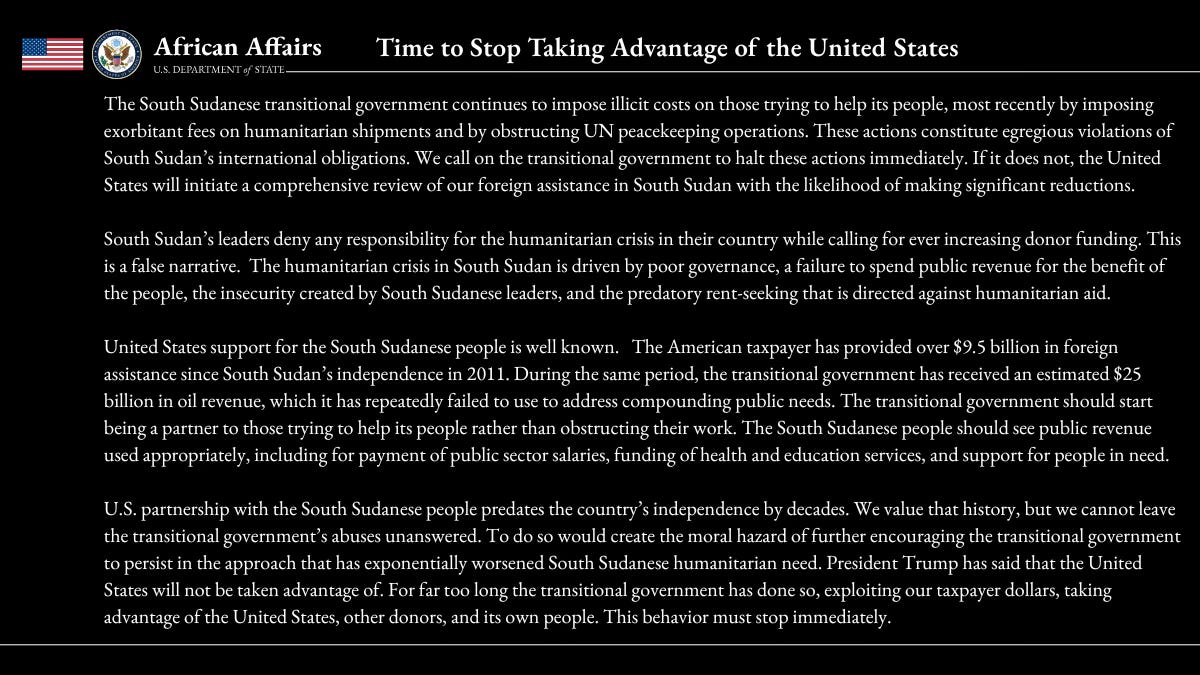
The U.S. statement came the same day that the top State Department official for Africa policy, Massad Boulos, met with UK Foreign Minister Yvette Cooper. Boulos wrote on social media afterwards that they held a “productive discussion” over Sudan’s conflict. He said two nations are working to securing a humanitarian truce, adding, “The United States and United Kingdom renewed our commitment to cut external financial and military backing for the belligerents and to push forward coordinated pressure that can help stop the violence and ease human suffering.”

Sudan War Monitor Is Reader-Supported
This work is possible thanks to the generous support of subscribers and donors. Sudan War Monitor is independent and does not support any party in the ongoing conflict. We report on conflict events, human rights abuses by all warring parties, peace efforts, and the humanitarian consequences of the war.