
The fall of El Fasher to the Rapid Support Forces on October 26, 2025 produced one of the worst documented atrocities of the 21st century. This investigation brings to light new testimonies of those who survived it, and reconstructs how it happened.
Al Jazeera Fault Lines, in collaboration with Lighthouse Reports and Sudan War Monitor, interviewed survivors and eyewitnesses, and drew on satellite imagery and open-source video analysis.
Our investigation corroborates findings by the UN Human Rights Office (OHCHR), which documented more than 6,000 killings carried out by the RSF in the first three days after they entered El Fasher.
It documents in particular the RSF’s entrapment of civilians inside the North Darfur city, the extreme ethnic violence during the cataclysmic final days of the siege, and the systematic use of sexual violence by RSF fighters.
The findings of the joint investigation are presented as written reports in Arabic and English (below), and as a video documentary on YouTube.
Reporting, editing and production by Julia Steers, Klaas van Dijken, Jack Sapoch, Tessa Pang, Wael Eskandar, A.M., Amel Guettatfi, Laila Al-Arian, Adrienne Haspal, Srdjan Stojiljkovic, the Sudan War Monitor team, and additional unnamed Sudanese investigators and journalists.
Encircled: RSF Entrenchments Around El Fasher
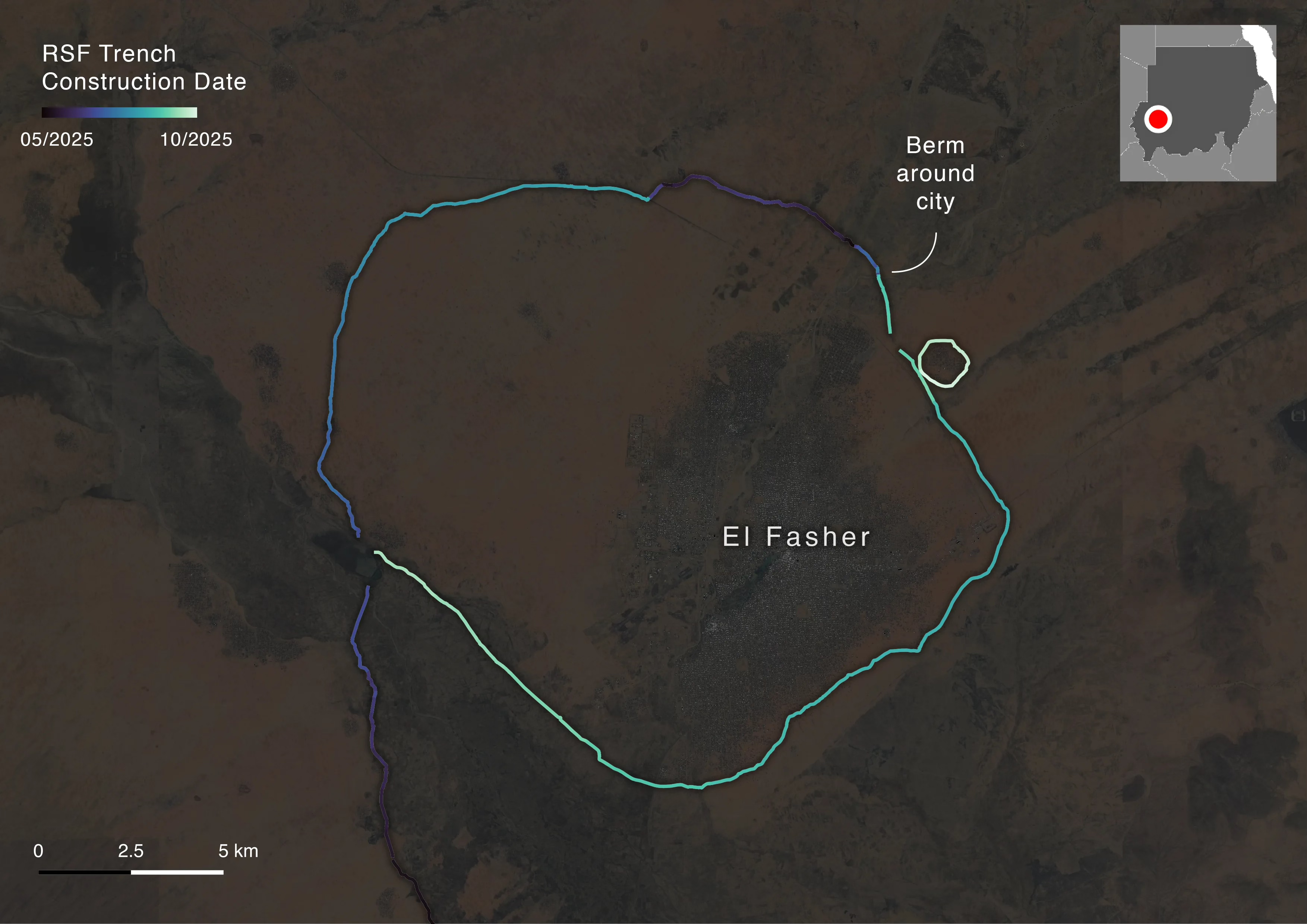
For more than eighteen months, the Rapid Support Forces besieged El Fasher, the capital of North Darfur, bombarding the city, blocking supplies, and slowly tightening their grip. The Sudanese Armed Forces and their allied paramilitaries, known as the Joint Forces, defended the city from within. El Fasher was the last major city in Darfur not under RSF control.
In April 2025, the RSF seized Zamzam Camp, located 15 kilometres south of El Fasher, which had sheltered approximately 500,000 displaced persons. They then dug a berm and trench system encircling the rest of the city, cutting off the flow of goods, humanitarian aid, and civilian movement.
Constructed with heavy machinery over the course of several months, the trench reached approximately three to four meters deep.
Indiscriminate bombardment continued from multiple directions, killing and wounding civilians and destroying much of the city. Occasional fighting raged in the city’s neighborhoods, as it progressively became more uninhabitable. Food and fuel ran out, and essential services collapsed. Residents were left with an impossible choice: stay and starve, or attempt to flee.
Starting in July 2025, leaders within the RSF-affiliated Ta'sis coalition issued statements calling on civilians to leave El Fasher, declaring the city a military operations zone and promising safe passage toward Garni. There was no safe passage. The RSF had installed checkpoints at the few remaining exits, enabling systematic screening, searches, and confiscation of goods. Those trying to bring food into the city were detained or summarily executed. On the roads, civilians faced robbery, beatings, and sexual violence — with women, girls, and men from non-Arab communities specifically targeted.
Even as the RSF and its allied forces repeatedly called on civilians to leave the city, they had in practice already locked down the city’s exits.
Running the Gauntlet: The Road to Garni
The main designated exit ran through the Garni area toward Tawila. At checkpoints along the way, RSF forces searched those fleeing for any evidence linking them to the Sudanese Armed Forces or the Joint Force.
One survivor described the reasons why they decided to leave: “The siege had become suffocating, food was scarce, and the water had stopped.” Another survivor left on October 15, two weeks before the final assault:
“We headed southwest toward the Artillery area, then the Agricultural Research station. The first thing I saw after Hillet al-Sheikh was a bloated body in the street — it had been there about twenty-four hours, and the smell was coming off it. They threatened us and took everything, even our phones. Every hundred meters, a checkpoint, all the way to Garni.”
A woman described being stopped at a checkpoint on the road to Garni: “They stopped us and threatened us, took everything we had. They kicked me in the face with a boot — violent blows. I lost consciousness for a few seconds.’” Another said, “The RSF were all over the road — raping, looting, and killing openly in the street. They took our phones. There was a checkpoint every few meters, and this is before you even reached the trench crossing, all the way to Garni gate — that stretch right there was a dangerous place.”
At some checkpoints, RSF fighters photographed those fleeing and cross-checked their identities with contacts inside the city — looking for evidence of affiliation with the Sudanese Armed Forces or the Joint Forces. Those flagged were detained and taken to RSF facilities east of the city. The RSF also filmed civilians passing through Garni gate for propaganda purposes:
“We were subjected to verbal and racist abuse all the way to the trench. At the Garni gate, people were gathered and photographed — they sent out media messages saying they had no enmity toward civilians and that the road was safe. From there, people were detained.”
At one gathering point, RSF fighters distributed water and juice and delivered lectures about marginalization — part of a broader propaganda effort running alongside the violence.
Another witness said that tribal affiliation was a constant factor throughout. Members of the Zaghawa tribe were detained on sight, without any other justification needed. The only way out was through back-channel coordination with Zaghawa members inside the RSF, and payment.
Carrying the new currency issued by the SAF government in Port Sudan was itself grounds for beatings and detention. So were identity documents showing an El Fasher address — many disposed of both before reaching the Garni checkpoint. Those who claimed to be from elsewhere, particularly Nyala, were generally waved through.
As the siege neared its conclusion, bodies were seen strewn along the road, fed on by dogs and birds. “Some of the bodies were just dumped in the street. They told us these are the people who smuggled goods, their fate is death, just leave them like that.” Hundreds more were killed on the Shaqra road to the west, a route that bypassed the Garni checkpoint entirely.
At the main Garni checkpoint, those who survived the road were screened again — classified, and some returned to RSF detention facilities east of El Fasher. Witnesses placed two senior RSF commanders at the checkpoint: General Ali Rizkallah, known as Savannah, and Al-Tijani Ibrahim Musa, known as Al-Zir Salem. Both were seen there on multiple occasions, including on the day the city fell. A large number of people were arrested at the checkpoint and returned to detention, some of whom were later transferred to Nyala, the RSF capital in neighboring South Darfur State.
Detention, Rape, and Forced Labor of Women
Sexual violence was widespread throughout the siege and assault on El Fasher — on the roads, in detention facilities, and in the homes of RSF commanders. Women were raped in front of passersby and their own families. One eyewitness fleeing El Fasher watched as a woman was dragged away from his group and raped: “There was an older woman with us, with her daughter — she was taken from in front of us and raped.”"
One woman, whose name has been withheld for security reasons, was arrested late one evening while fetching her donkey in preparation to leave the city. Accused of spying for the Sudanese army, she was forced to spend a full night with RSF fighters before being taken to a women's detention facility in the east of the city, where she spent more than two months.
She and others were forced into domestic labor, serving senior RSF commanders in their homes. At least four girls became pregnant as a result of sexual exploitation by RSF personnel. “When we were in prison they would use us for cooking, especially when they had guests, and in the commanders' houses. An RSF commander took one of the girls to his home and she became pregnant while she was with him.”
When she was released after two months, she found her family had been scattered after a bomb had struck their home while she was detained, killing at least four family members and wounding two others.
Another woman, who had fled Zamzam Camp in April 2025, was attacked while on their way to Tawila, where she now lives. She described how approximately 14 masked armed men in military dress, mounted on motorcycles and camels, stopped her and three family members, beat them, and dragged them to the side of the road where they were sexually assaulted.
She said three men raped her. A fourth man was called over to continue the assault. He refused, boasting that he had already raped fourteen women since the previous day. He then urinated on her face. She was beaten so severely she could not move for several days.
She said nothing to her family about what had happened when she arrived. She now lives alone and admits, “I have not even been taking care of myself. I thought about suicide several times.” She credits a victim support workshop run by the Norwegian Refugee Council with helping her begin to recover:
“When the doctor was speaking I was just crying. He called me after the workshop and let me speak and tell my story. Their financial support also helped me get myself together, but I am still isolated and living alone.”
The RSF used schools and other institutions to detain civilians. One medical professional was stopped near El Fasher airport on the morning the city fell, along with three family members and approximately 150 others attempting to leave for Tawila. They were taken to a school in the Um Shujaira neighborhood, near Al-Shawamikh School, where large numbers of people were brought, the majority of them women.
Immediately after the sunset prayer, soldiers began taking girls one by one to the western side of the school, near the bathrooms, under the pretext of "searching" them. The women were told to bring their belongings for inspection, then raped. Her niece was taken and raped immediately. She and her sister refused when soldiers came for them.
"I told them I was injured and refused to go. While I was arguing with them, my niece came running toward me, crying and screaming, calling out 'Auntie.' The girl was in shock — we all broke down crying."
The rapes continued throughout that day, girls taken one after another. Some were not returned until the following morning.
A civil servant from South Darfur, who had fled fighting in Nyala for El Fasher, lived throughout the siege with hundreds of other displaced families at the Al-Janubiya Boys’ School. As conditions in the city deteriorated, she lost a brother to kidney failure; the hospital had rationed his dialysis from twice a week to once, then to two hours per session, until the toxins built up and killed him. On the day the city fell, the bombardment forced the remaining families out of the school. A second brother was killed by a shell as they fled.
With the help of others, she took his body to the outlying Um Shunibat neighborhood to be buried. While the men were at the cemetery, an RSF force arrived in four vehicles and descended on the women sheltering in a nearby home. The soldiers beat and tortured them, raping all 19 women present — sparing only the elderly homeowner, who appeared to be from one of the Arab groups — while subjecting them to racist abuse.
“They claimed my brother was a soldier. I denied it. It made no difference — they beat us and raped all the women except the elderly homeowner. They also accused me of being a prison officer.” When she told them she was a land inspector at the Urban Planning Ministry, they accused her of stealing land from Arab families, and resumed beating her.
She added that she was tortured with cigarette burns to force a confession of military affiliation. The assault lasted from noon until five in the evening. "They would light cigarettes and stub them out on my body, run a lighter across my skin. The marks are still there."
Al-Tartowar: The Trench of Death
When the city fell on the morning of October 26, 2025, chaotic flight was the only option for those who survived the initial gunfire. The RSF's berm became the principal killing ground — thousands of civilians had no way to avoid the crossfire, and the RSF pursued those fleeing without distinction, using small arms, heavy weapons, and drones.
An elderly man who managed to reach the Tawila area in Jebel Marra recounted that he had moved with a group of approximately 500 civilians from El Fasher via the Hillat Hishaba and Hillat al-Sheikh road. They were stopped by RSF forces and taken to the berm. There, they were subjected to indiscriminate mass beatings, while some were killed. The group was held for an entire day before being moved to Garni, loaded onto trucks, and taken to a children’s center in eastern El Fasher that the RSF had converted into a prison.
Many in the group were interrogated, and a large number were killed on the pretext that they were soldiers. He said, “I spent sixteen days there and we were subjected to all manner of treatment, including beatings... People were dying at a rate of fifteen to twenty per day.”
Video 1: Footage from El Fasher outskirts showing victim bodies. Video 2: RSF combatants shown shooting victims in the El Fasher outer trench and celebrating the killings afterwards. These videos are included here for evidentiary reasons; viewer discretion advised. Article continues below.
A witness who was on the outer side of the berm when the city fell, and who later helped collect and bury the dead, recounted what he saw. He worked with others to collect bodies scattered across the villages to the west of the city. He stated that General Abdelrahim Hamdan Dagalo, the second-in-command of the RSF, personally led fighters in pursuing those fleeing through the RSF trenchworks, where many were killed indiscriminately.
“On the day of the fall, even ‘Uncle Abdelrahim’ [RSF deputy commander-in-chief ] himself came with his unit. He had his unit running, chasing people, making no distinction between civilians and anyone else, encouraging people to kill, running his unit just like that.”
The source, who requested anonymity, stated that they buried a large number of bodies, all of them in civilian clothing, and most who had been shot at close range. The investigation team obtained personal identity documents belonging to more than 100 people killed attempting to flee — many of them bloodstained. Among the dead were children as young as four.
“East of Garni, a woman was beaten and left with three companions — all of them died of thirst. Two other women were killed outright, leaving their crawling infants behind. The babies died of thirst.”
He added that the burials took place at scattered locations, with the graves holding varying numbers depending on where the bodies were found. “We buried the bodies in groups of ten or fifteen, sometimes five, in other places two, three, or one — but mostly larger graves of ten, fifteen, twenty people. There are still large numbers of bodies that were left unburied."
Today, more than six months after the massacres, El Fasher is under full RSF control and largely depopulated. Most survivors have dispersed across the region — many reaching Tawila, now a major humanitarian hub, where over 500,000 displaced persons have sought refuge. Conditions in the camps are dire, with aid agencies reporting shortages of water, food, latrines, and healthcare. Others fled farther, to neighboring states and beyond.
The front lines of the war have shifted and El Fasher is no longer an active battleground. But Darfur’s civilians continue to face drone strikes and displacement as the conflict grinds on. The commanders responsible for what happened in El Fasher remain at large. No one has been held accountable.
Sudan War Monitor is a reader-supported publication. If you found this investigation valuable, consider becoming a paid subscriber to support our continued reporting on Sudan's war.