
A coalition of Sudanese rebels on Sunday overran another Sudanese Armed Forces (SAF) garrison, roughly a month after capturing the key border town of Kurmuk, according to video evidence reviewed and geolocated by Sudan War Monitor.
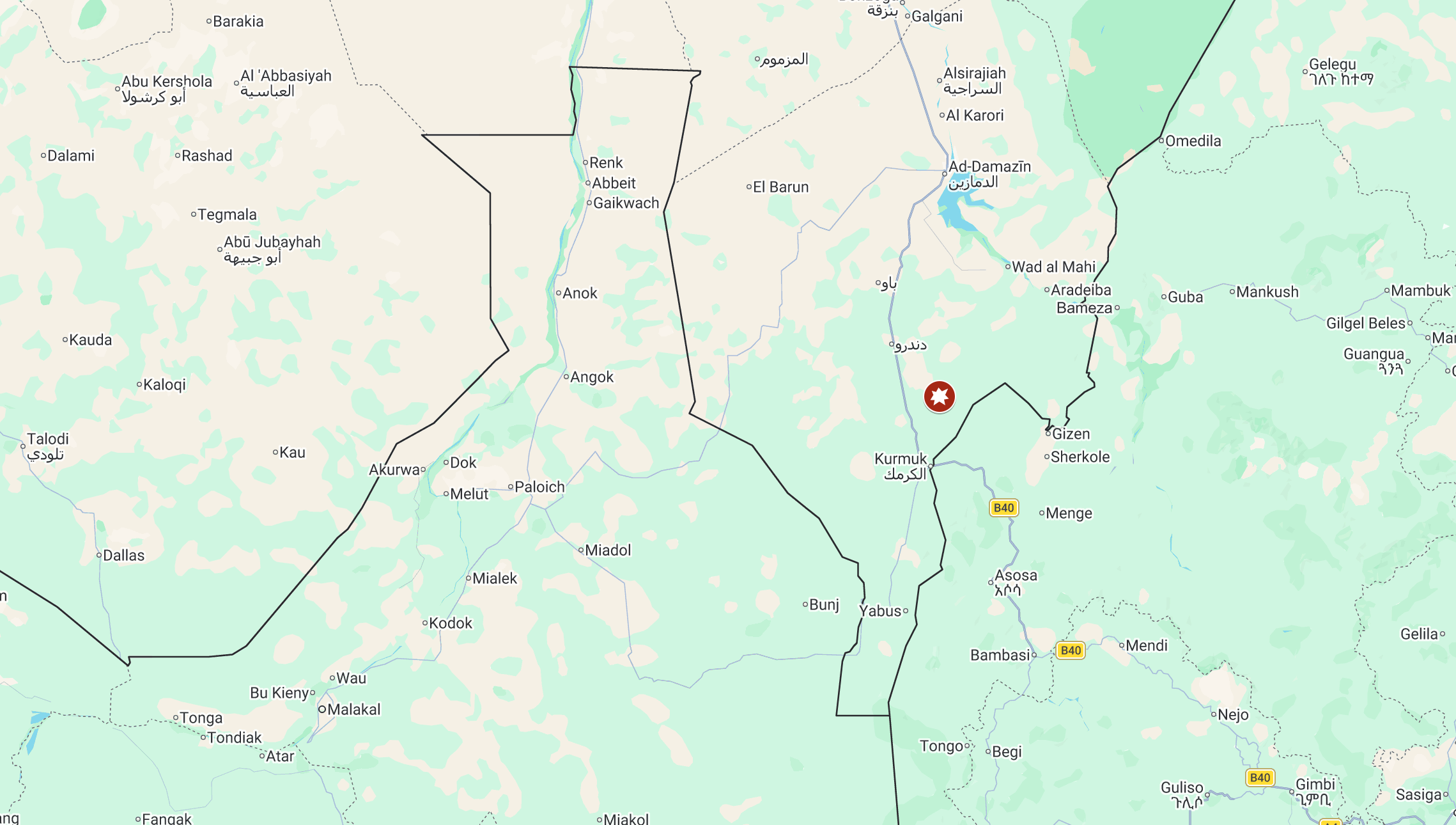
The garrisson, located in the town of Al-Keili, lies east of the Kurmuk–Damazin road and was among the forward defensive sites that remained under army control following the fall of Kurmuk in late March.
The small but strategic town is a part of Kurmuk locality of southern Blue Nile, and is approximately 33 kilometers north of Kurmuk town, the locality headquarters, and about 30 kilometers southeast of Dindiro, another key area along the road that remains under SAF control within the same locality.
The development puts rebel forces — acting under a coalition known as the Sudan Founding Alliance (Taasis) — significantly deeper inside southern Blue Nile than at any previous stage of the campaign.
Videos circulating on RSF social media channels show armed fighters inside and around the garrison. One clip geolocated by Sudan War Monitor places rebel elements within the core of the military installation here; 10°51’0.32”N 34°18’54.51”E.
A second video, filmed here 10°51’0.66”N 34°19’7.92”E, shows fighters celebrating just east of the same position. All footage verified by Sudan War Monitor corresponds to this same location, with no evidence of ongoing fighting, indicating the site had already fallen at the time of filming.
The fighters visible in the footage appear to be from the Rapid Support Forces (RSF), based on uniform patterns, vehicle markings, and previously documented identifiers. While the operation is formally conducted under the Taasis alliance — which also includes the Sudan People’s Liberation Movement–North (SPLM-N) — no SPLM-N units are visible in the verified material from the site.
The RSF issued a statement later in the day announcing control over the area and describing the operation as part of a broader advance into central Sudan from the southeast of the country.
The statement claimed to have inflicted heavy losses on SAF personnel and to have captured or destroyed military equipment, while forcing remaining forces to withdraw.
It also framed the advance as a strategic step toward expanding its control in the region and continuing operations against remaining army positions.
“The Taasis Alliance forces in the Blue Nile region have achieved qualitative victories, as our forces succeeded in breaking the backbone of the army of the terrorist Muslim Brotherhood group and inflicting heavy defeats on its elements and mercenaries, during decisive battles today, Saturday, which ended with full control over the strategic area of “Al-Keili” in Blue Nile State.”
“Field units continue to advance steadily to clear the remaining pockets, amid a clear state of collapse and confusion within the ranks of the hostile militias.”
“These advanced military operations and field victories represent an important shift in the theatre of operations and a strategic step moving confidently toward ending the dominance of terrorist groups and defeating their destructive project.”
“During today’s battles, the heroes of our forces demonstrated courage and boldness, inflicting heavy losses on the enemy in both lives and equipment, with a large number of their elements killed or captured, while the remaining remnants fled, leaving behind quantities of weapons and military equipment, allowing our forces to impose full control over the area,” the RSF statement reads.
The Sudanese Armed Forces, one the otherhand, did not issue any statement in response as of the time of publication.
The SPLM-North, the other partner in the alliance, has not issued any statement regarding the fall of the garrison and does not appear in verified visual material from the area.
In the afternoon, following the capture of Al-Keili, the RSF circulated a video showing individuals identified as SPLM-North soldiers welcoming a defecting commander from the SPLM-N faction led by Malik Agar, who serves as deputy to army chief Abdeltattah al-Burhan in the Transitional Sovereign Council.
The footage, however, does not show SPLM-North elements participating in combat operations at the garrison, and no verified material has emerged placing them at the frontline during the assault.
One explanation for the absence of SPLM-N in combat footage is that its units may have adopted a low-profile media posture despite possible participation alongside RSF on the ground.
However, previous sources speaking to Sudan War Monitor have indicated that SPLM-N involvement in recent operations has been limited, citing disagreements over weapons distribution within the alliance.
According to those accounts, RSF has retained control over the majority of heavy weapons and has not supplied SPLM-N units at the same scale. This dynamic has reinforced RSF’s position as the dominant force within the Taasis alliance.
RSF units have led the main assaults, controlled supply lines, and maintained access to external logistical support, including from the UAE and neighboring countries such as Chad and Ethiopia. By contrast, SPLM-N appears to be operating in a more constrained capacity, either by choice or due to limitations in equipment and coordination.
The fall of the garrison follows the capture of Kurmuk on March 23, when rebel forces overran SAF positions along the Ethiopian border in what marked the first major breakthrough on the Blue Nile front. That operation forced SAF units to withdraw northward along the Kurmuk–Damazin road, abandoning equipment and leaving several forward positions exposed.

Since then, rebel forces have continued to advance along this axis. The capture of the position north of Kurmuk indicates that SAF has not been able to re-establish a stable defensive line following its withdrawal. Instead, positions appear to be falling in sequence, with limited evidence of organized resistance.
Geographically, the offensive remains closely tied to the Ethiopian border. Kurmuk and surrounding areas lie just a few kilometers from Ethiopia’s Benishangul-Gumuz region, where RSF and its allies have previously established logistical and training presence. This proximity has allowed sustained movement of forces and materiel across the border.
The direction of the advance — north from Kurmuk — is consistent with earlier assessments that the offensive is being driven from the Ethiopian side rather than from deeper inside Blue Nile. The axis prioritizes key military positions along the main road network rather than smaller settlements.
Videos
RSF soldiers seen at the SAF garrison in Al-Keili. This video is geolocated to: 10°51’2.16”N 34°18’55.19”E
In this video, RSF soldiers are seen at the same location, here: 10°51’1.85”N 34°18’55.57”E.
Here, RSF soldiers are seen with a SAF officer around the same location. One soldier is heard saying that “this is their (SAF) commander.”
In this video, RSF soldiers are seen before a local health centre, here: 10°51’3.95”N 34°19’13.16”E.