
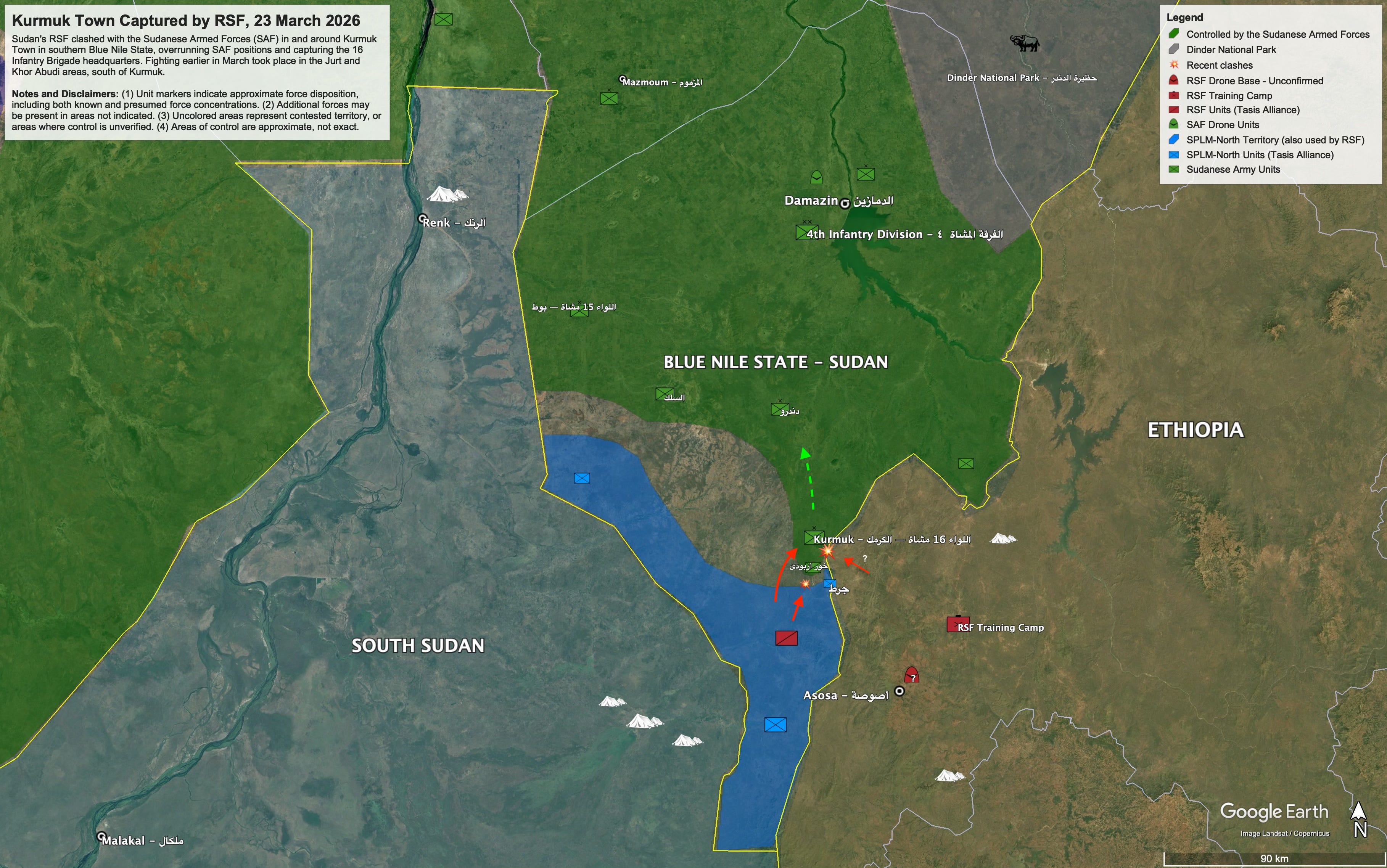
Tasis Alliance forces captured the town of Kurmuk in southeastern Blue Nile State yesterday, 23 March 2026, scattering army units, plundering supplies and equipment, and taking prisoners, including senior army officers.
The development marks the first major success of the Rapid Support Forces (RSF) and Sudan People’s Liberation Movement - North (SPLM-N) since they formed an alliance last year and jointly activated a new front in Blue Nile.
The rebel offensive is supported from Ethiopia’s Benishangul-Gumuz region, where the RSF and SPLM-North established a training camp and logistics hub last year, allegedly with covert assistance from the United Arab Emirates.
Though the RSF has no historic presence or constituency in Blue Nile State, it has moved fresh troops and equipment into SPLM-North territory in the southeast of Blue Nile. The two rebel groups maintain distinct command structures but are cooperating tactically in the offensive.
In the days preceding Kurmuk’s capture, SAF units came under attack south of Kurmuk, including at Jurut and Khor Arbudi, where the rebel coalition also claims to have overrun SAF outposts. Surviving forces from the Sudanese Armed Forces (SAF) retreated northwards along the Kurmuk-Damazin road.
Videos reviewed and geolocated by Sudan War Monitor show RSF fighters at multiple locations inside Kurmuk town following collapse of SAF defenses south of the city.
In one verified, for example, clip filmed on March 23, RSF fighters are seen inside the Sudanese military’s 16th Infantry Brigade compound, indicating a breach of one of the army’s primary defensive positions in the area.
This footage was geolocated to 10°33’18.65”N 34°16’55.33”E, confirming the presence of RSF units within the core military installation linked to the Sudanese military’s 4th Infantry Division headquartered in Damazin, the state capital.
Another footage suggests that SAF units withdrew in a disorganized manner, leaving behind armored assets, weapons, and logistical equipment. In one video, RSF fighters are seen filming near a destroyed tank and an abandoned tactical vehicle just south of Kurmuk.
In this video, RSF soldiers are seen on and around two abandoned T-55 tanks just south of Kurmuk town.
In a statement, the RSF said they had taken full control of Kurmuk after days of fighting, describing the Sudanese army as a “terrorist Muslim Brotherhood force” and claiming to have inflicted heavy casualties while seizing military equipment, including combat vehicles and tanks.
The RSF also said its allied forces had secured surrounding areas and were advancing toward new objectives, framing the offensive as part of a broader campaign to defeat what it called “forces of tyranny” and establish a new political order in Sudan.
“Successive victories by the Tasis Alliance forces have continued, achieving breakthroughs and advances on several axes in the Blue Nile Region/New Fung. Today, Tuesday, March 24, 2026, the valiant forces of the Rapid Support Forces and the Sudan People’s Liberation Army–North managed to fully liberate the strategic city of Kurmuk, along with the areas of Al-Baraka and Al-Keili, following fierce battles fought since yesterday against the terrorist Muslim Brotherhood army and militias of armed mercenary movements.”
“Enemy forces suffered heavy losses in those battles, with more than 400 killed and dozens wounded and captured, including senior officers. Our forces also seized large quantities of military equipment and hardware, including 47 combat vehicles fully equipped, 3 tanks, and large quantities of various weapons and artillery—still being counted. More than 60 combat vehicles and 5 tanks were destroyed, while the remaining militias of the Muslim Brotherhood army fled in defeat to various destinations after being dealt strong blows by our forces, adding to their record of battlefield heroism. Our forces have also established military positions around the city and other liberated areas, in a move that strengthens deployment, secures vital sites, provides protection for civilians, and advances toward new objectives.”
“The Tasis Alliance forces continue to advance steadily from various axes toward the last strongholds of terrorism, affirming that the moment of decisive victory over the gang of despotism and tyranny is approaching, heralding the dawn of a new Sudan built with the participation of all Sudanese peoples on the foundations of freedom, justice, and peace.”
Our reporting and analysis is made possible by the generous support of paying subscribers and donors. Please consider signing up for a paid subscription or make a one-time donation so that we can sustain our mission and continuously improve the quality of our reporting. Thanks!
The assault likely originated from the direction of the Ethiopian border rather than from settlements south of Kurmuk, though the RSF and its ally SPLM-North captured different areas south of the town in the days ahead of Kurmuk’s capture.
This assessment is consistent with prior reporting that SAF units maintained defensive positions in villages south of the town, including along key approaches leading toward Kurmuk. The apparent bypassing or rapid collapse of these positions suggests a coordinated offensive that may have leveraged cross-border mobility and logistical support.
Kurmuk’s proximity to Ethiopia—just a few kilometers from the border—has made it strategically vulnerable, particularly given the reported existence of a training camp and logistics hub in Ethiopia’s Benishangul-Gumuz region.
The site, exposed in recent weeks, had prompted the Sudanese military to deploy additional troops to the Blue Nile front. Despite these reinforcements, the fall of Kurmuk indicates that SAF defenses were insufficient to contain the expanding RSF–SPLM-N offensive along this axis.
To the south of southern Blue Nile lies South Sudan’s Maban County, which hosts SPLA-IO forces east of Bunj, the county capital. This geographic proximity introduces an additional layer of complexity to the conflict dynamics in the region, as multiple armed actors operate across interconnected border areas.
The presence of SPLA-IO elements in Maban further underscores the broader regional implications of the fighting around Kurmuk and the evolving alignment of forces along the Sudan–South Sudan frontier. It also suggest unlikelyhood of attack orginating from South Sudan rather than Ethiopia.
Individual and Organisational Subscriptions
Sudan War Monitor is used by NGOs, newsrooms, policy teams, and research institutions working on Sudan or related policy issues. We offer team subscriptions that cover your whole organisation under a single annual payment, managed through Substack and processed securely by Stripe. Seats can be added or reassigned at any time.
Videos
RSF soldiers seen at a health centre inside Kurmuk town. They say the date is 23rd March 2026.
RSF soldiers seen in posession of large abandoned ammunition stockpile at the SAF brigade headquarters inside Kurmuk town.
RSF soldiers driving along the road south of Kurmuk. It shows a burned tank and a pickup truck.
In this video, a SAF prisoner, likely a highranking officer, is interrogated by RSF soldiers apparently after attempting to flee the town.
RSF soldiers filming in front of Kurmuk Zakat office.
In this video, RSF soldiers are seen around two abandoned T-55 tanks, south of Kurmuk town.