
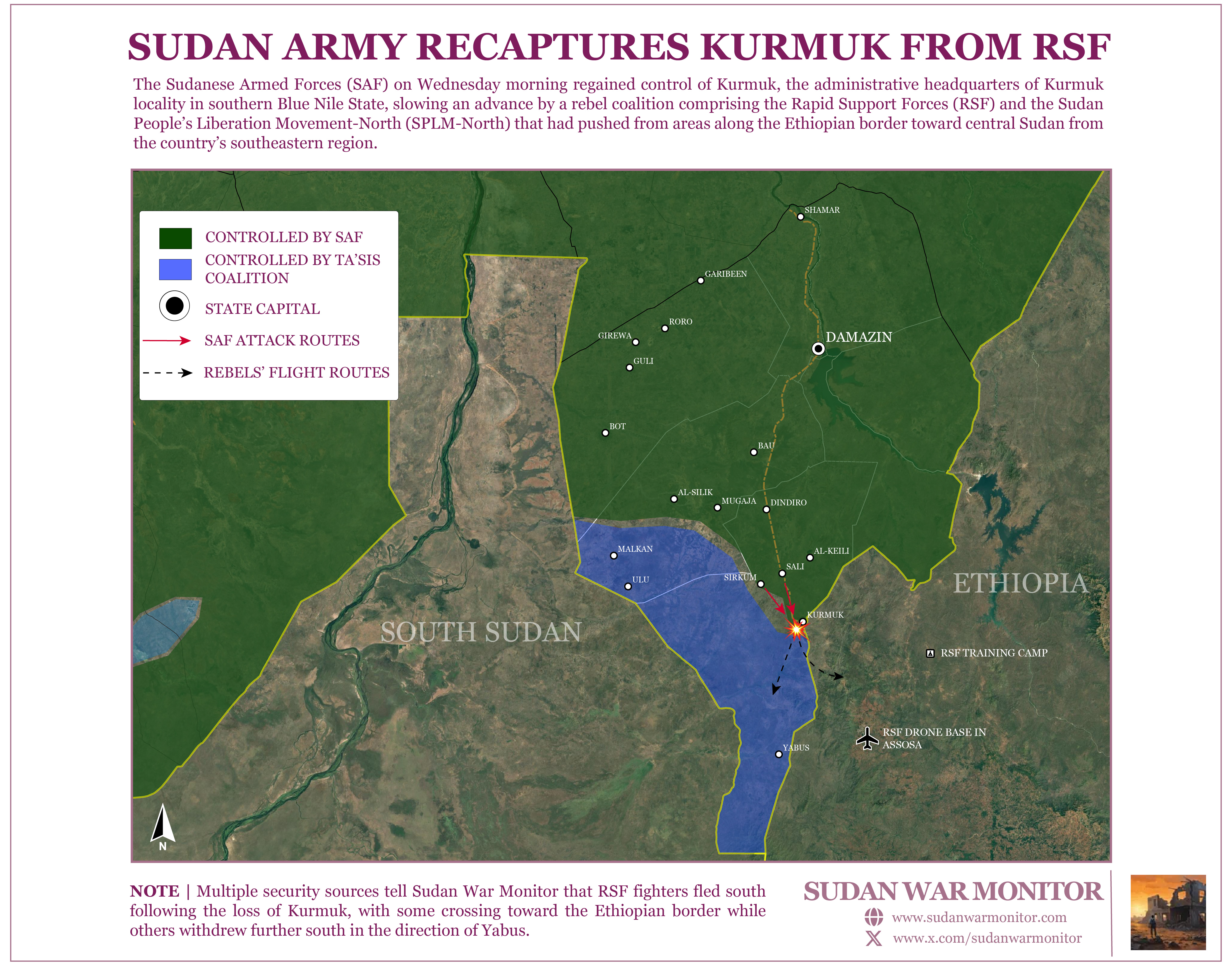
The Sudanese Armed Forces (SAF) regained control of Kurmuk town in southern Blue Nile, according to videos reviewed and geolocated by Sudan War Monitor, reversing one of the most significant gains made by a rebel coalition comprising the Rapid Support Forces (RSF) and the Sudan People’s Liberation Movement-North (SPLM-North) on the southeastern front.
The footage confirms SAF presence at two strategic locations inside the border town following a counteroffensive launched from army positions north of Kurmuk.
Security sources had told Sudan War Monitor in the early hours of Wednesday that SAF units advanced southward from Sali and Sirkum, which was only captured by the Sudanese military less than two weeks ago, along the Kurmuk-Damazin road before entering the town and establishing control at around 10:00 a.m. local time.
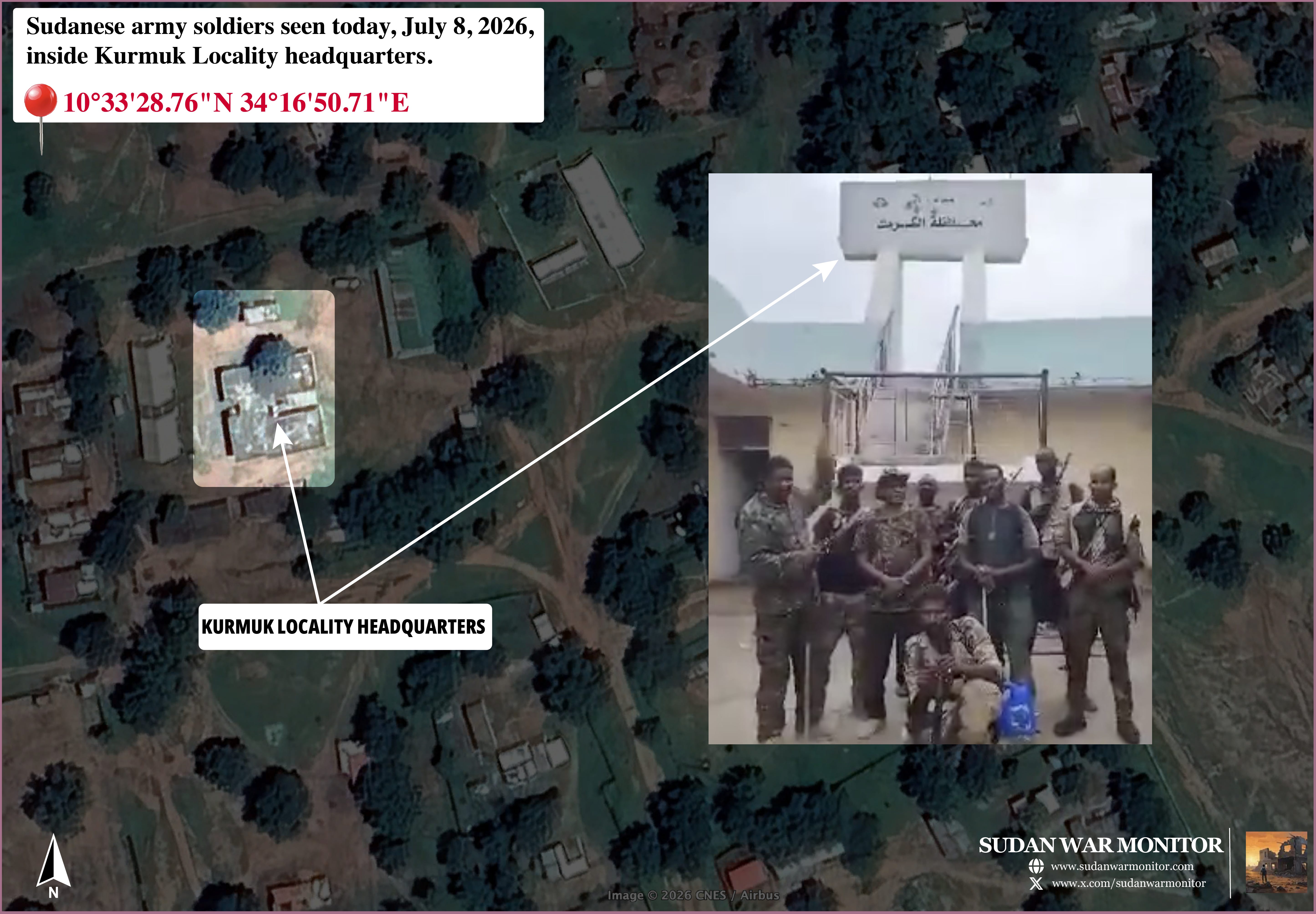
One video reviewed and geolocated by Sudan War Monitor shows SAF soldiers inside the Kurmuk locality headquarters compound. The footage was geolocated to 10°33’28.76”N 34°16’50.71”E, confirming the army’s presence inside the administrative center that had been under the control of the RSF-SPLM-North coalition since March.
Geolocation oif video showing Sudanese army soldiers inside the Kurmuk locality headquarter compound.
A second video places SAF forces inside the headquarters of the Sudanese military’s 16th Infantry Brigade compound. The footage was geolocated to 10°33’18.65”N 34°16’55.33”E, confirming that SAF had retaken one of its main military installations in southern Blue Nile after losing it nearly four months earlier.
The same brigade headquarters was among the locations where RSF fighters filmed themselves following the capture of Kurmuk on March 23, when the rebel coalition overran army positions, seized military equipment, and forced SAF units into a withdrawal northward toward Damazin.
In a statement, the Sudanese army said its forces and allied units had recaptured Kurmuk following heavy fighting with the Rapid Support Forces, saying the operation resulted in significant losses among the paramilitary group’s fighters and equipment.
“Sudanese Armed Forces Liberate Al-Kurmuk City in Blue Nile State from the Rapid Support Militia (Janjaweed). With Allah’s help and guidance, the Sudanese Armed Forces and supporting forces succeeded today in liberating the city of Al-Kurmuk in Blue Nile State through force and determination, following fierce battles that were brought to a decisive conclusion by Allah’s will, the determination of the fighters, and the bravery of the heroes.”
“The Al-Dagalo family militia and its mercenaries suffered heavy losses in lives and military equipment, while the remnants of their forces fled, carrying the signs of defeat and disarray, leaving behind their weapons and vehicles.”
“The Sudanese Armed Forces affirm that protecting civilians, working to restore essential services, and creating the conditions necessary for the return of normal life are priorities for the coming phase,” the statement added.
The latest counteroffensive represents a reversal of the March battle, which marked the first major battlefield success for the RSF and SPLM-North in southern Blue Nile after the two groups formed the Tasis Alliance and opened a new front against the Sudanese army in the state.
During the March offensive, RSF and SPLM-North fighters attacked several SAF positions south of Kurmuk, including around Jurut and Khor Arbudi, before advancing into the town on March 23.
The collapse of SAF’s forward defensive positions enabled the rebel coalition to enter Kurmuk, capture the locality headquarters, and overrun the 16th Infantry Brigade base, one of the army’s main military installations in southern Blue Nile.
It also raised concerns over a possible rebel push deeper toward central Sudan from the country’s southeastern frontier, an area that has historically served as a base of operations for the SPLM-North.
The RSF described the capture of Kurmuk at the time as part of a broader campaign by the Tasis Alliance, claiming that its forces and SPLM-North units had secured the town after several days of fighting and were preparing further operations from the area.
The fall of Kurmuk was significant because it gave the RSF its first major foothold in Blue Nile, a region where the paramilitary force historically had no strong local presence or established support base before its alliance with SPLM-North.
The RSF had moved fighters, vehicles, and equipment into SPLM-North-controlled areas in southeastern Blue Nile after reaching a military arrangement with the group. Although the two forces maintained separate command structures, they coordinated operations against SAF positions along the southern border region.
Sudanese army soldiers in celebratory mode outside the 16th Infantry Brigade headquarters in Kurmuk, Blue Nile State.
The rebel coalition’s operations were supported through areas near Ethiopia’s Benishangul-Gumuz region, where the RSF established a training camp and logistical network with covert support from the United Arab Emirates.
The existence of the cross-border support network had prompted SAF to reinforce positions in southern Blue Nile before the March offensive, but the rapid collapse of its defenses around Kurmuk showed the difficulty of securing the frontier against mobile forces operating from nearby areas.
Kurmuk’s geographic position has made it one of the most contested areas of the Blue Nile conflict. The town sits close to the Ethiopian border and controls access routes linking southeastern Sudan with the wider Damazin area.
Security sources said Wednesday’s army operation was launched after SAF regrouped north of Kurmuk and prepared a southward push along the same axis where its forces withdrew during the March battle.
The sources said army units moved from the Sali and Sirkum areas before entering Kurmuk, forcing RSF and allied fighters to abandon positions inside the town and surrounding military facilities.
Following the loss of Kurmuk, multiple security sources told Sudan War Monitor that RSF fighters withdrew south, with some elements moving toward the Ethiopian border while others retreated further south in the direction of Yabus, an SPLM-North stronghold near the Sudan-South Sudan frontier.
The retreat reduces the RSF-led coalition’s ability to project force northward along the Kurmuk-Damazin road, which had been viewed as a potential route for expanding operations deeper into Blue Nile and toward central Sudan.
The broader region remains complex because southern Blue Nile borders South Sudan’s Maban County, where other armed actors operate across interconnected border areas. The proximity of Ethiopia and South Sudan has historically made the region a corridor for armed movements, supply routes, and shifting alliances.
However, previous analysis by Sudan War Monitor indicated that the March assault on Kurmuk most likely originated from the Ethiopian side rather than from South Sudan, given the presence of RSF-SPLM-North logistical infrastructure in Benishangul-Gumuz and the direction of rebel movements before the attack.
The recapture of Kurmuk restores SAF control over a strategic border town and removes one of the RSF alliance’s most important positions on the southeastern front, although SPLM-North forces remain active in parts of southern Blue Nile.
Videos
RSF soldiers seen withdrawing south of Kurmuk as gunfire continue.
Sudanese army soldiers showcasing a vehicle allegedly captured from the RSF after capture of Kurmuk.
SAF officer resting and speaking under a tree just before entering the town. This officer is the same as the one who later appeared at the locality building inside Kurmuk.
In this video published by the Sudanese army, Blue Nile governor is seen celebrating with military officers inside the 4th Infantry Division headquarters inside the state capital Damazin.