
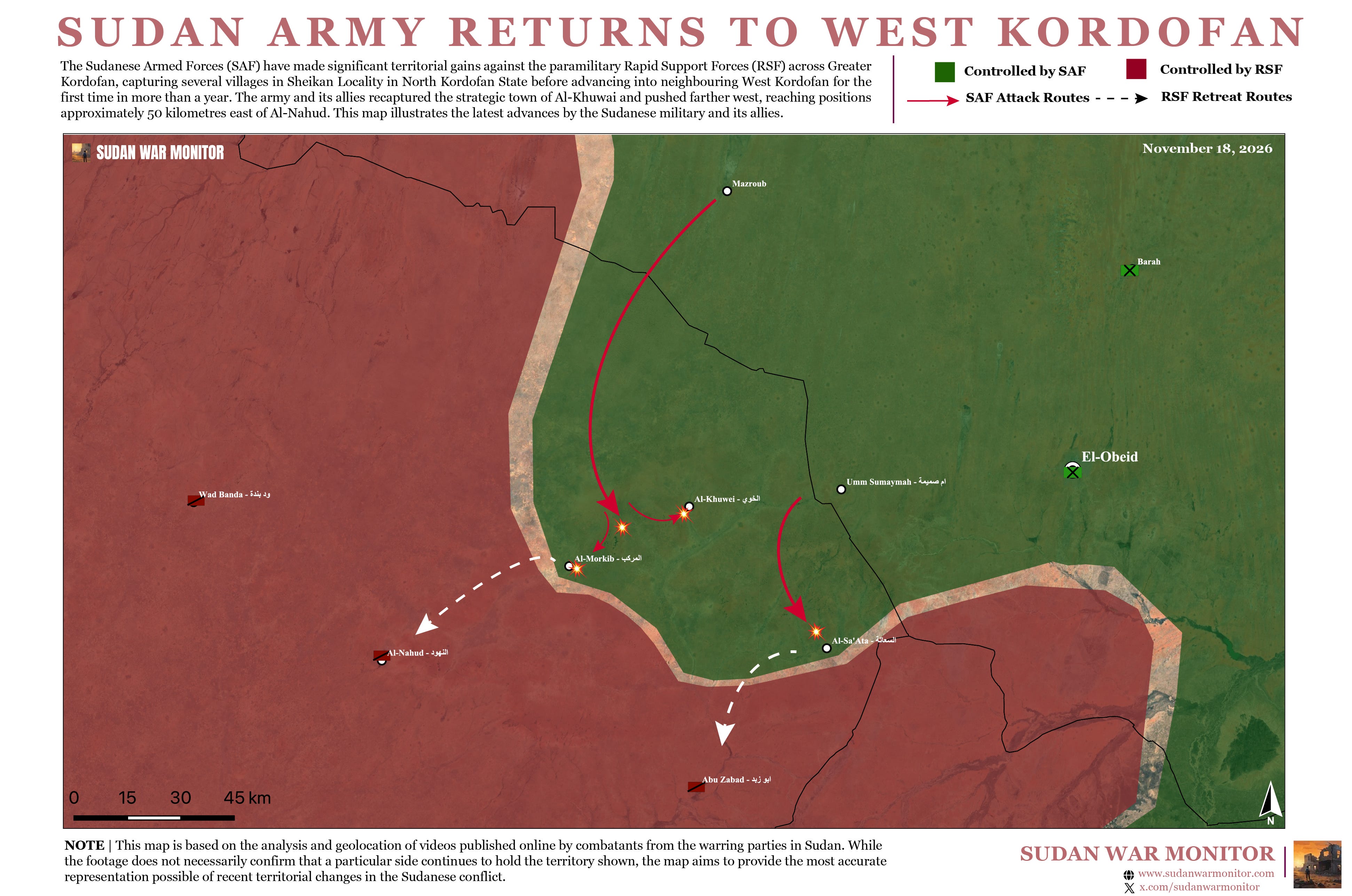
The Sudanese Armed Forces (SAF) and allied armed groups have returned to West Kordofan State after more than a year, capturing Al-Khuwai and advancing toward Al-Nahud in an offensive that has forced the Rapid Support Forces (RSF) to withdraw from several positions west and southwest of El-Obeid.
The offensive began on November 5, when the army, the Joint Force of former Darfur rebel movements and allied Islamist militias attacked RSF positions along two routes outside El-Obeid, the capital of North Kordofan State.
The western attack reached Umm Sumayma, while another force advanced south through Kazgil toward Al-Hamadi. The army subsequently expanded its operations from northern North Kordofan, moving southwest toward Al-Khuwai and Al-Morkib.
By November 13, government forces had entered Al-Khuwai, the administrative headquarters of Al-Khuwai Locality, which the RSF had controlled since May 2025. The army and its allies also captured Serif Ankoush, Umm Labana, Al-Dudiya and other villages around the town.
The advance continued the following day toward Al-Morkib, approximately 60 kilometres east of Al-Nahud, where the RSF maintains one of its main positions in West Kordofan.
Fighters from the Joint Force of Armed Struggle Movements outside Al-Khuwai Locality headquarters following the capture of the town on November 13. The footage was geolocated to 13°05′19.77″N, 29°12′58.60″E.
A separate video shows members of the Islamist Al-Baraa Ibn Malik militia outside Al-Khuwai Police Headquarters, at 13°05′24.63″N, 29°13′04.15″E. The two recordings place government-aligned fighters at administrative and security buildings inside the town.
The capture of Al-Khuwai followed several days of fighting in northern North Kordofan, where the army had advanced through villages previously held by the RSF. On November 7, government-aligned forces captured Ayal Bakhit, northwest of Al-Khuwai, before continuing toward the state boundary.
Another route led from Umm Sumayma, west of El-Obeid, toward the settlements connecting North Kordofan with West Kordofan. The army’s movements along these routes brought its forces into territory that had remained under RSF control since the paramilitary group’s offensive in May 2025.
The fighting has not ended across North Kordofan. The Sudanese military today captured Abu Haraz in southern Sheikan Locality, indicating that the paramilitary group continues to maintain positions in villages south and southwest of El-Obeid despite the army’s advances farther west.
Sudanese army fighters in Abu Haraz, Sheikan Locality, North Kordofan, today, here: 12°57’53.33”N 29°51’23.99”E. Their presence shows that government control of the wider area south and southwest of El-Obeid remains incomplete and this is as far as they can reach southwest of Sheikan locality.
The situation is particularly complicated along the southern road from El-Obeid toward South Kordofan, where the army’s November 5 offensive failed to secure lasting control.
On that day, army troops advanced through Kazgil, approximately 40 kilometres south of El-Obeid, and reached Al-Hamadi. Videos geolocated by Sudan War Monitor showed government soldiers moving through the area during the afternoon.
By the evening, however, RSF fighters had returned to Kazgil after counterattacking the advancing troops. The paramilitary group published footage showing destroyed army vehicles and captured soldiers.
The fighting around Kazgil demonstrated that the army’s progress west of El-Obeid had not been matched by a sustained advance along the southern route.
Kazgil has repeatedly changed hands during the war. The army entered the town in September 2025 and again during an offensive in April 2026, but failed to hold its positions following RSF counterattacks.
The November 5 operation followed the same pattern. Although the army reached Al-Hamadi, its forces were pushed back, leaving the road toward Dilling under the control if the Rapid Support Forces.
On November 13, the Joint Force announced that its fighters and the army had captured Al-Khuwai following heavy fighting with the RSF.
In a statement signed by spokesperson Major Mutawakkil Abu Jaga, the Joint Force said the operation had resulted in the capture of Al-Khuwai, Serif Ankoush, Umm Labana, Al-Dudiya and other areas around the town.
“As part of military operations on the Kordofan front, the Joint Force and the Sudanese Armed Forces fought fierce battles this morning, resulting in territorial advances and the capture of several areas, most notably Al-Khuwai Locality, Serif Ankoush, Umm Labana, Al-Dudiya, and other areas around Al-Khuwai in West Kordofan.”
“The Rapid Support Forces (RSF) militia suffered heavy losses in personnel and equipment, including the death of the commander of the opposing force and several of its members. Twenty (20) fully equipped combat vehicles were destroyed, while another forty (40) combat vehicles were captured.”
“As we salute the bravery and sacrifices of our forces, we assure the Sudanese people, both at home and abroad, that our forces remain determined and steadfast in carrying out their national duty alongside the Sudanese Armed Forces until security and stability are restored and the dignity of the nation and its citizens is preserved,” said the statement.
The group claimed that an RSF commander and several fighters had been killed. It also reported destroying 20 combat vehicles and capturing another 40.
The Joint Force has played a prominent role in the offensive, alongside regular army units and allied Islamist formations. Its fighters appeared in videos from Al-Khuwai, while the force issued the main public statement announcing the town’s capture.
The Sudanese army did not issue a separate statement on the operation at the time, although its troops were reported to have participated in the fighting. The capture of Al-Khuwai marked the army’s return to one of West Kordofan’s northern localities after the RSF had driven government forces out of the area more than a year earlier.
The RSF seized Al-Khuwai during its May 2025 offensive, which also brought Al-Nahud under paramilitary control. The army briefly returned to Al-Khuwai later that month, but the RSF subsequently regained the town.
Al-Nahud fell on May 1, 2025, after RSF fighters attacked the city and overran the headquarters of the army’s 18th Infantry Brigade. The city had served as West Kordofan’s temporary administrative capital following the RSF’s capture of Al-Fula in June 2024.
The loss of Al-Nahud deprived the army of one of its most important positions in western Sudan and gave the RSF control of a major road junction linking Kordofan with Darfur.
The paramilitary group subsequently consolidated its presence across West Kordofan, including the main towns farther south. The army’s latest advance has reversed part of those gains, although the RSF continues to control Al-Nahud, Abu Zabad, Al-Fula, Babanusa, Al-Muglad and Heglig.
Following the capture of Al-Khuwai, government-aligned forces advanced toward Al-Morkib and the settlements east of Al-Nahud. On November 14, the army and its allies captured Al-Morkib, Khamasat and Umm Oweisha, along with several surrounding villages.
The Joint Force subsequently announced the capture of eight areas in Al-Khuwai Locality, identifying them as Khumas Halab, Khumas Al-Donki, Khumas Al-Nayer, Khumas Hajar, Khumas Hameer, Khumas Umm Ariq, Khumas Abu Hantouta and Al-Morkib.
The advances brought government-aligned forces closer to Al-Nahud, although the RSF continued to hold the city and the road farther west toward Wad Banda and North Darfur.
The fighting also spread toward Abu Zabad, southeast of Al-Nahud.
On November 16, Mohamed Didan, a spokesperson for the army’s special operations forces, announced that government troops had captured Al-Sa’atat, an area comprising five settlements northeast of Abu Zabad.
Didan said the army had overrun RSF positions in the area and continued advancing toward Abu Zabad. The five settlements were not individually identified in the available statement, but they are part of “Al-Sa’atat” which is the collective names of areas individually known as “Al-Sa’ata”.
The latest advances have placed the RSF under pressure along the northern and northeastern approaches to West Kordofan, but the paramilitary group retains substantial territory farther west and south.
Al-Nahud remains the main obstacle to an army advance toward Darfur. The city lies on the Al-Sadarat Highway, also known as Al-Inqaz Al-Qarbi, which connects El-Obeid with Al-Nahud and continues through Wad Banda locality toward North Darfur.
The highway has served as an important route for the movement of military supplies, commercial goods and civilian traffic between central and western Sudan. For the army, recapturing Al-Nahud would restore access to a major road junction lost in May 2025 and provide a possible route for further operations toward (North) Darfur.
The Joint Force has particular interest in such an advance. Its constituent movements previously operated in Darfur, where the RSF has captured most major towns, including El-Fasher in October 2025.
However, an advance from Al-Khuwai toward Darfur would require the army to secure Al-Nahud and maintain control of the road beyond the city. The RSF could also attempt to counterattack from its positions around Al-Nahud and Abu Zabad, or target the army’s supply routes leading back toward El-Obeid.
The fighting has already forced civilians to leave several towns in West Kordofan. Residents have fled Al-Nahud, Abu Zabad and surrounding villages toward Darfur amid army drone strikes and fears of further ground fighting. Local emergency groups have reported worsening humanitarian conditions and shortages of essential supplies.
In Al-Khuwai, the Dar Hamar Emergency Committee appealed for food, medicine and other assistance following the change in control. The committee reported that government forces had recovered eight administrative areas in the locality and urged authorities and traders to arrange deliveries of essential goods.