
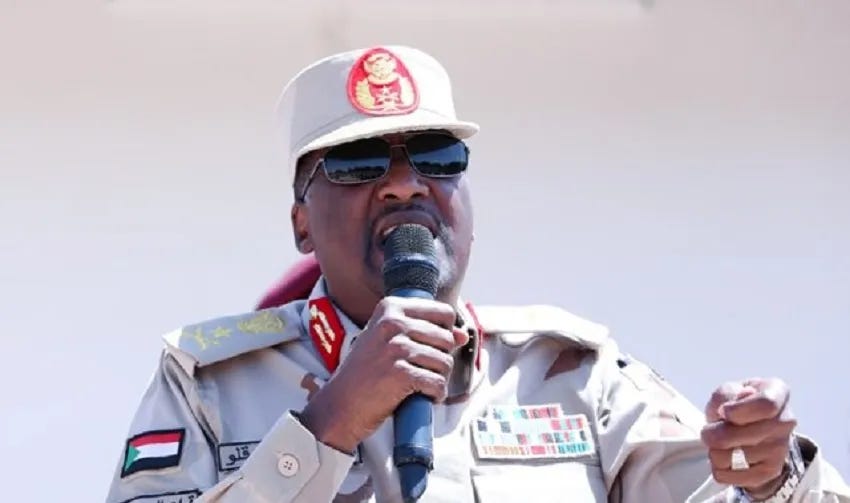
The United Nations Security Council has sanctioned Rapid Support Forces (RSF) Deputy Commander Abdelrahim Hamdan Dagalo and three senior field commanders — Al-Fateh Abdullah Idris, also known as “Abu Lulu”, Tijani Ibrahim Moussa Mohamed also known as “Al Zeir Salem”, and Gedo Hamdan Ahmed, also known as “Abu Nashuk” — for their roles in the October 26, 2025 takeover of El Fasher and associated atrocities.
The listings, made public on February 24, 2026, cite acts that threaten the peace, security and stability of Darfur, including mass killings, ethnically targeted executions, sexual violence, and hostage-taking during and after the RSF seizure of the Sudanese Armed Forces (SAF) 6th Infantry Division base in North Darfur’s capital.
Dagalo, the deputy commander of the RSF and brother of RSF leader Mohamed Hamdan “Hemedti” Dagalo, was identified as being present at the SAF 6th Infantry Division headquarters on the day of the takeover. Sudan War Monitor has previously reviewed a footage showing the deputy RSF commander issuing direct orders to fighters not to take captives but to kill those encountered.
The committee said RSF forces committed mass killings at El Fasher University and the Saudi Hospital and carried out shootings in areas northwest of the city. The violence included executions targeting members of the Zaghawa and other non-Arab communities, including the Fur.
The UN summaries cite reports of widespread sexual violence, including gang rape, and the abduction of medical personnel for ransom. Four doctors, a pharmacist and a nurse were reportedly kidnapped, with ransoms exceeding $150,000.
“On 26 October, the RSF committed atrocities including the mass killings of civilians at El Fasher university and the Saudi hospital, and shootings northwest of Darfur. The violence in El Fasher also included ethnically targeted executions of Zaghawa and other non-Arab groups.”
“There are reports of widespread sexual violence including gang rape in front of relatives, and other gender-based sexual violence. RSF troops are reported to be holding medical staff hostage for ransom, kidnapping four doctors, a pharmacist and a nurse -for ransoms in excess of $150,000,” the UN listing said.
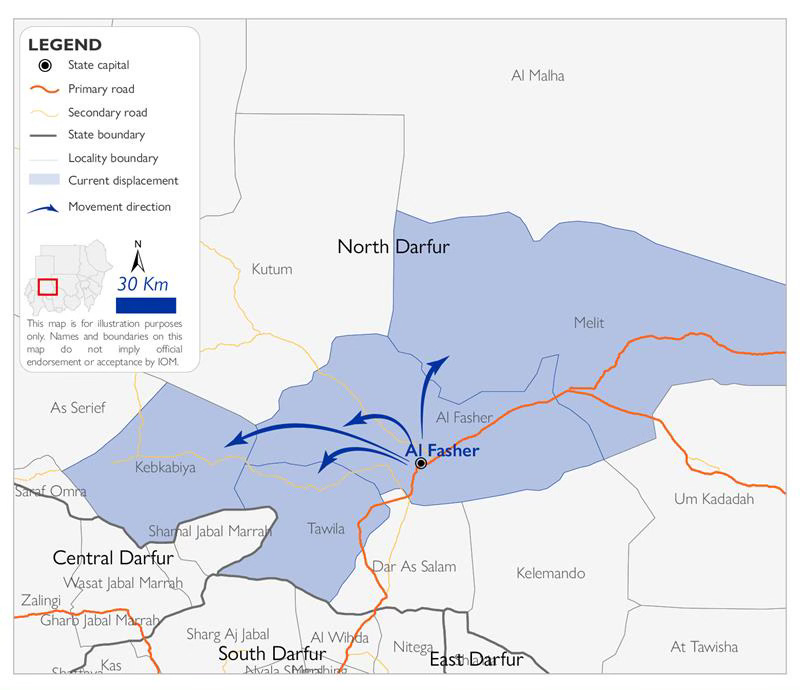
The events triggered the displacement of approximately 70,000 civilians from El Fasher since October 26, with others reported trapped, missing or detained inside the city. The war in Sudan, which began in April 2023, has killed more than 150,000 people and displaced over 14 million, according to humanitarian estimates.
Execution footage and command presence
Open-source intelligence (OSINT) investigations conducted by Sudan War Monitor and partner researchers corroborate the presence of multiple sanctioned commanders at the SAF’s 6th Infantry Division base following its capture.
Verified video footage shows Abu Lulu interrogating detainees about their tribal affiliation before executing unarmed men at close range. In several recordings circulated online, he is seen posing near bodies and claiming responsibility for large-scale killings. The UN summary describes him as a key perpetrator in the October 26 violence.
Al Zeir Salem was also identified at the 6th Infantry Division base on the day of the takeover. In one video dated October 26, he appears addressing a group of detained individuals in civilian clothing inside a captured military compound.
Abu Nashuk was filmed alongside Dagalo in El Fasher on the same date, according to the committee’s findings. The UN summary states that six RSF generals were present in the city during the takeover.
Satellite imagery and field reporting confirm that from May 2024 to October 2025, RSF forces encircled El Fasher with defensive berms, cutting supply routes and restricting humanitarian access. Approximately 260,000 civilians were trapped inside the city during the 18-month siege.
Following the fall of the SAF base, RSF units conducted search operations across residential areas. Geolocated footage and drone imagery show bodies along main escape corridors toward Tawila, around 60 km east of the city. Survivor accounts describe interception of fleeing civilians, separation of men from families, and execution or ransom detention.
A UN Independent International Fact-Finding Mission concluded earlier this month that RSF operations in El Fasher bore the “hallmarks of genocide,” citing systematic targeting of the Zaghawa and Fur communities, enforced starvation and widespread sexual violence.
Global vs. Regional Sanctions Implications
Abdelrahim had previously been sanctioned by the European Union and the United Kingdom, but not by the United Nations. These sanctions mark the first UN designation against him and follow recent measures imposed by the United States, the European Union and the United Kingdom against the same field commanders.
The U.S. Treasury sanctioned Abu Lulu, Abu Nashuk and Al Zeir Salem on February 19, 2026, citing executions, torture and post-capture abuses. The EU and UK had previously listed the same individuals for grave violations linked to the El Fasher campaign.
Western sanctions primarily function as instruments of legal attribution and political pressure. They freeze any assets under their jurisdiction and restrict travel to those countries. However, the practical battlefield impact is likely limited.
Field commanders operating inside Darfur rarely maintain assets in Western financial systems and do not rely on formal international banking. RSF logistics are sustained through local resource networks, gold-linked financing channels, regional trade corridors and internal supply chains. Movement within RSF-controlled territory is not dependent on Western travel systems.
As a result, U.S., EU and UK sanctions are unlikely to directly constrain the day-to-day operational authority of the sanctioned commanders inside Sudan. Their primary effect lies in documenting command responsibility, increasing diplomatic isolation and laying groundwork for future prosecutions.
The UN sanctions framework differs in scope. Measures adopted under resolution 1591 are binding on all 193 UN member states. In theory, this mandates universal asset freezes and travel bans, extending beyond Western jurisdictions.
Enforcement remains uneven, particularly in regional states where the RSF maintains logistical or financial ties. However, the UN mechanism constitutes the only sanctions tool with formally global reach, potentially restricting the international mobility and financial networks of RSF leadership even in states not aligned with Western policy.
Support our journalism

Sudan War Monitor is a collaborative of journalists and open source researchers tracking the events of Sudan’s war and the search for solutions. We’re building a platform to battle disinformation and warmongering and amplify the voices of victims, humanitarians and peacemakers.