
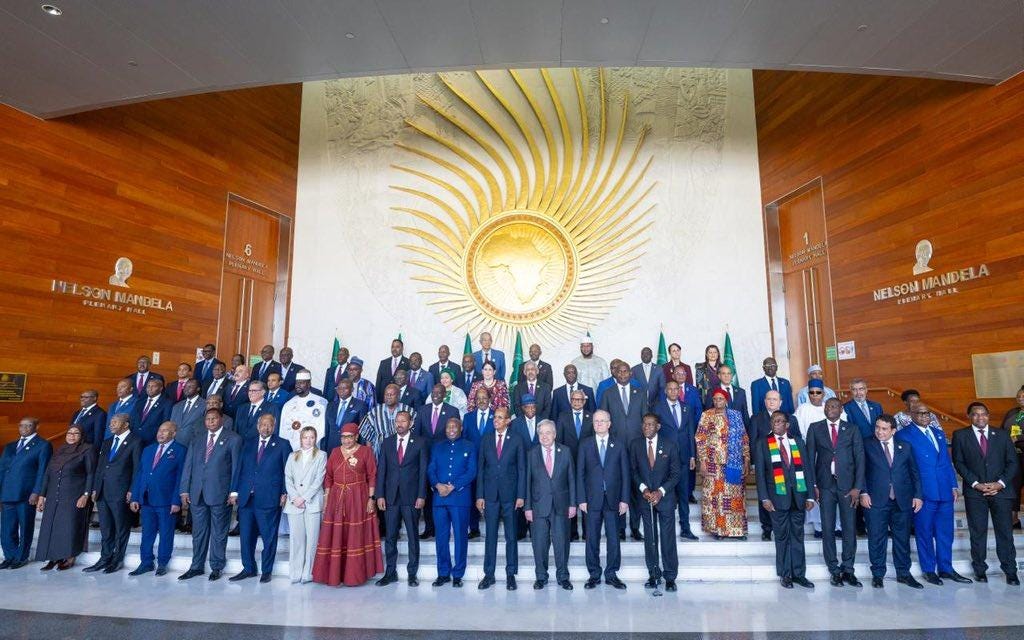
The African Union Peace and Security Council (PSC) has rejected the creation of a parallel governing authority in Sudan by the Rapid Support Forces (RSF) and its political allies, calling on all member states and international partners not to recognize the rival administration.
The decision, adopted at the PSC’s 1330th ministerial-level meeting on February 12, reflects growing concern among African leaders over Sudan’s deepening political fragmentation as the war between the RSF and the Sudanese Armed Forces (SAF) approaches its third year.
The council reaffirmed its commitment to Sudan’s sovereignty, territorial integrity, and national unity, warning that the establishment of rival governing structures risks undermining the country’s state institutions.
Sudan has been engulfed in a civil war since April 2023, when fighting erupted between the SAF and the RSF following a breakdown in relations between the two forces, which had previously shared power after a military coup which topled a civilian administration in October 2021.
In its communiqué issued ahead of the African Union’s 39th Ordinary Session of Assembly of Heads of State and Government, the PSC strongly condemned violations against civilians and specifically cited systematic killings, ethnic targeting, mass displacement, and destruction of infrastructure attributed to RSF forces, particularly in El Fasher, the capital of North Darfur.
The council warned that those responsible for violations of international humanitarian and human rights law would be held accountable and called for the protection of civilians and humanitarian personnel.
The AU also renewed its call for an immediate ceasefire and the launch of an inclusive Sudanese-led political dialogue, stressing that there can be no military solution to the conflict.
It warned against external interference and called on foreign actors to refrain from actions that could prolong the war. The council also instructed its sanctions subcommittee to identify actors providing military, financial, or political support to the warring parties.
“[The AU] Restates the AU’s strong condemnation and total rejection of the creation, in the Republic of Sudan, of the so-called ‘parallel government’ by the Sudan Founding Alliance (Tasis) led by the paramilitary RSF and requests all Member States and partners not to recognize the so-called ‘parallel government’; while reaffirming its support for the sovereignty and territorial integrity of Sudan within its internationally recognized borders,” the statement said.
The Sudan Founding Alliance, a political alliance of armed groups and political organizations led by the RSF and also known as Ta’sis, announced the formation of a parallel administration in July 2025.
RSF leader Mohamed Hamdan Dagalo, widely known as Hemedti, was named head of the parallel government, while Abdelaziz Adam al-Hilu, leader of the SPLM-North faction, was named his deputy. The alliance also appointed Mohamed Hassan Al-Ta’aishi, a former member of Sudan’s Transitional Sovereignty Council, as prime minister.
The AU’s rejection of the RSF-linked administration represents a significant diplomatic setback for the paramilitary group’s broader political strategy, which has sought to translate battlefield territorial control, especially in Darfur, into formal governing authority.
Sudan’s membership in the African Union remains suspended following the October 2021 military takeover, when army chief Abdelfattah al-Burhan and Hemedti overthrew the civilian-led transitional government of Prime Minister Abdallah Hamdok.
The two generals were part of the military establishment that was compelled to remove longtime Islamist ruler Omar al-Bashir from power following a popular uprising in April 2019.
The AU has nevertheless maintained engagement with Sudan and is preparing to reopen its liaison office in Khartoum, following an assessment mission authorized by the Peace and Security Council.
While the move does not automatically restore Sudan’s membership, it signals a gradual normalization of institutional engagement and could be interpreted as a step toward eventual reinstatement, which would require a formal decision by AU member states once constitutional order is deemed to have been restored.
The body condemned atrocities against civilians in Sudan, placing particular emphasis on abuses committed in conflict zones across Darfur, warning that violations against noncombatants continue to worsen the humanitarian crisis and undermine prospects for peace, and stressed that those responsible would face accountability under international law.
“[The AU] Strongly condemns all forms of violations committed against the civilian population by the parties to the armed conflict including in El Fasher by the paramilitary RSF, including systematic killings, mass displacement, ethnic targeting, and the destruction of infrastructure, while stressing that those responsible will be held accountable for serious violations of International Humanitarian Law and International Human Rights Law,” the communique said.
While the communiqué condemned violations by “all parties” to the conflict, it explicitly detailed RSF abuses, particularly in Darfur, without listing specific incidents involving SAF operations. Independent investigations, including findings documented by Sudan War Monitor, have reported civilian killings in Khartoum and Al-Jazira State in January last year.
Sudanese military aerial bombardments have also struck rural neighborhoods in Darfur, which the military widely view as RSF social strongholds, resulting in civilian casualties and infrastructure damage.
Sudan War Monitor is an independent publication covering Sudan’s civil war through OSINT, reporting, Arabic-language sources, and political-military analysis. It publishes maps, verified videos, news, and investigative reporting. Please consider subscribing or sharing this article to help sustain our work.
AU Sanctions Effort Weakened by Internal Splits
The PSC called for accelerated implementation of sanctions mechanisms targeting actors fueling the war, including those providing military, financial, or political support to the warring parties.
The council tasked AU security and intelligence bodies with identifying external supporters and proposing containment measures within a three-month timeframe. However, implementation of such measures faces significant political and structural constraints.
“[The AU] strongly condemns the external interference in the internal affairs of Sudan and calls on all the external actors to refrain from actions that will continue to fuel the conflict; and requests the PSC Sub-committee on Sanctions, to expedite the implementation of the PSC Communiqué [PSC/AHG/COMM.1218 (2024)] adopted on 21 June 2024, working in collaboration with the Committee of Intelligence and Security Services of Africa (CISSA) and AU Mechanism for Police Cooperation (AFRIPOL), to identify all external actors supporting the parties to the armed conflict militarily, financially and politically, and make proposals on how to contain each of them within a stipulated timeframe, not exceeding three months from February 2026,” the Council said.
The African Union itself remains divided over Sudan, with differing positions among member states complicating consensus enforcement. SAF officials have publicly accused several African countries, including Kenya, Ethiopia, and Uganda, of supporting RSF political and logistical efforts, allegations those governments have denied.
These divisions complicate the AU’s ability to enforce coordinated sanctions or diplomatic isolation.
The location of the AU headquarters in Ethiopia has also drawn scrutiny amid ongoing regional tensions, particularly as Ethiopia maintains diplomatic relations with actors that Sudanese authorities have accused of supporting the RSF, including the United Arab Emirates.
A recent Reuters investigation reported the existence of an RSF training camp in western Ethiopia, raising further questions about cross-border military activity and the role of neighboring states in Sudan’s conflict.

Sudan War Monitor is an independent publication covering Sudan’s civil war through OSINT, reporting, Arabic-language sources, and political-military analysis. We publish maps, verified videos, news, and investigative reporting. If you have the means, please consider subscribing to support this effort.