

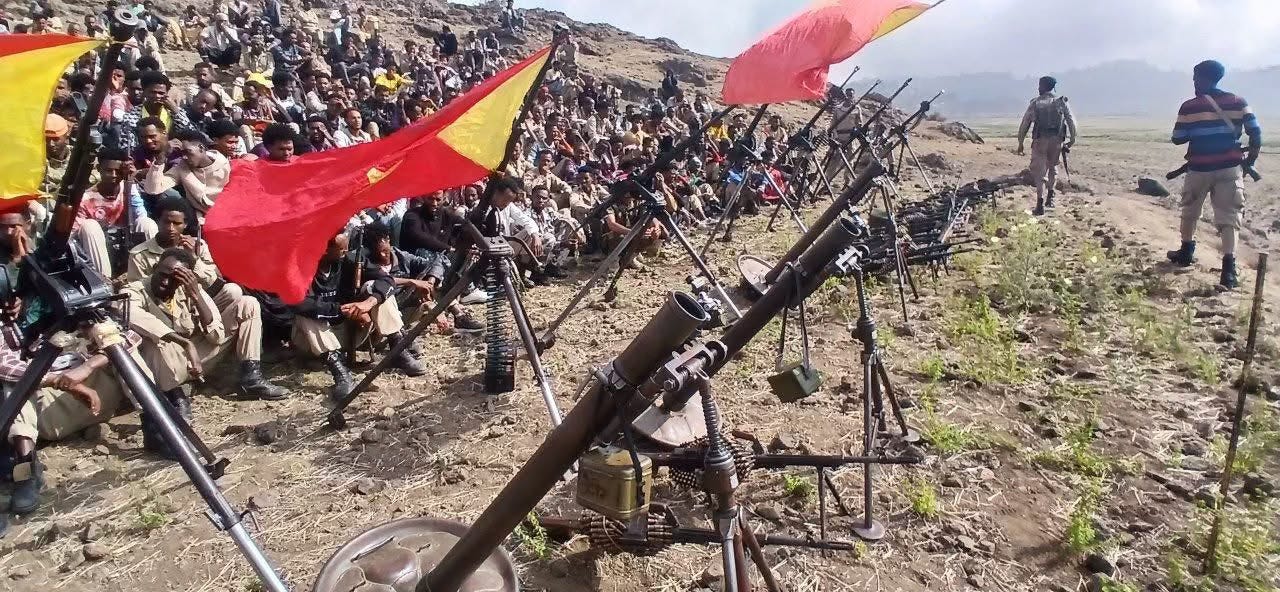
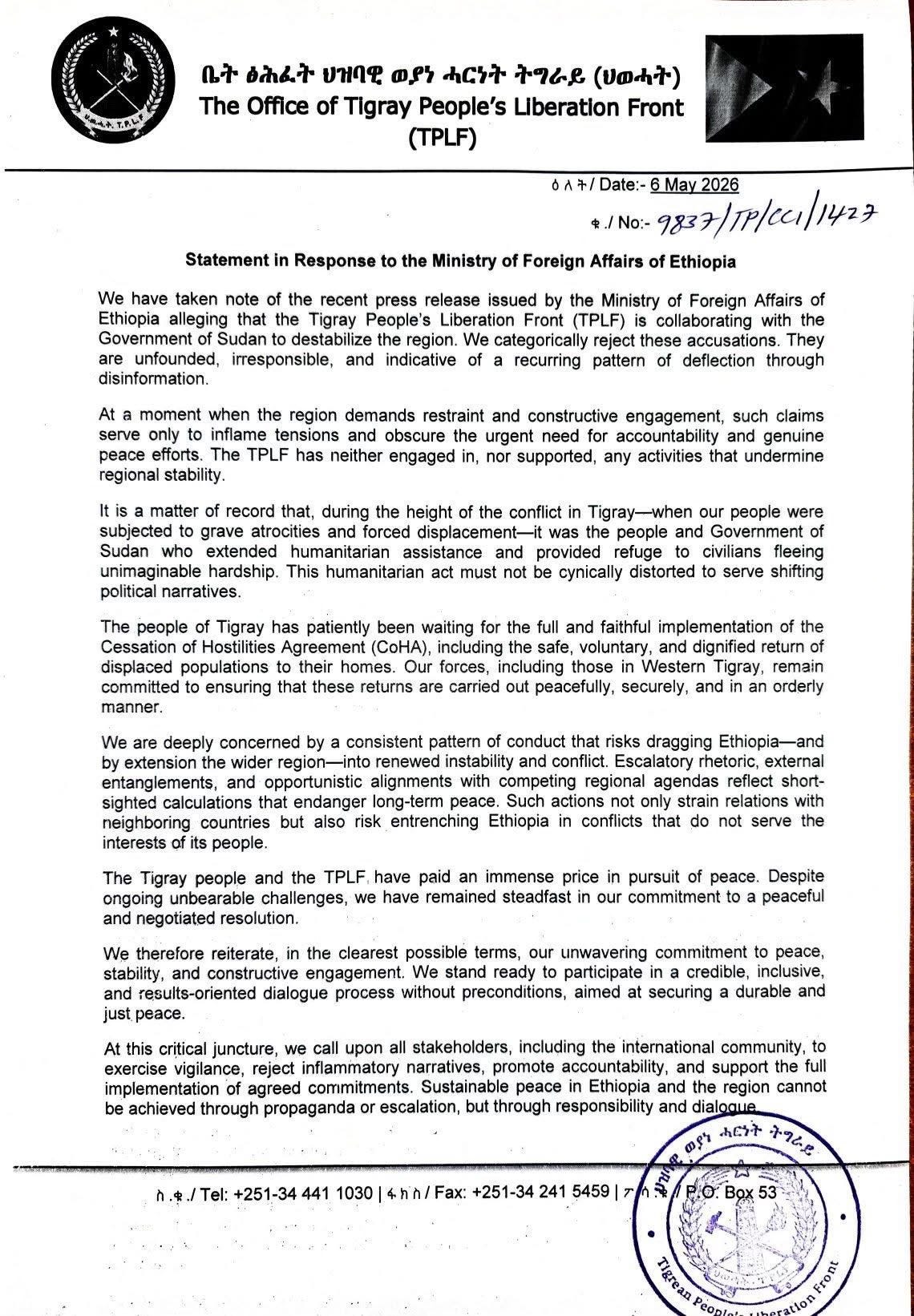
The Tigray People’s Liberation Front (TPLF) has categorically rejected accusations from Ethiopia’s Ministry of Foreign Affairs that it is collaborating with the Sudanese Armed Forces (SAF) to destabilize the region, as the group simultaneously moves to restore its pre-war political structures — a step that observers warn could reignite one of this century’s deadliest conflicts.
In a statement dated May 6, the TPLF called the Sudanese collaboration allegations “unfounded, irresponsible, and indicative of a recurring pattern of deflection through disinformation.” The group accused Addis Ababa of inflaming tensions at a moment when the region demands restraint, arguing that its forces have neither engaged in nor supported any activities undermining regional stability.
However, the statement acknowledged a historical relationship with Sudan’s government, framing it as “humanitarian.”
The Ethiopian Foreign Ministry had accused Sudan of arming and financing TPLF and employing TPLF fighters as mercenaries in its military: “The activities of TPLF mercenaries in Sudan are a matter of public record, and there is ample and credible evidence showing that Sudan is serving as a hub for various anti-Ethiopian forces.”
On the same day, May 5, TPLF took the dramatic step of restoring the Tigray legislative council that existed before the 2020–2022 civil war, with the council electing TPLF chair Debretsion Gebremichael as regional president. The move directly challenges the interim administration established under the 2022 Pretoria Agreement — the peace deal that ended Ethiopia’s civil war — and creates two rival political authorities in the region.
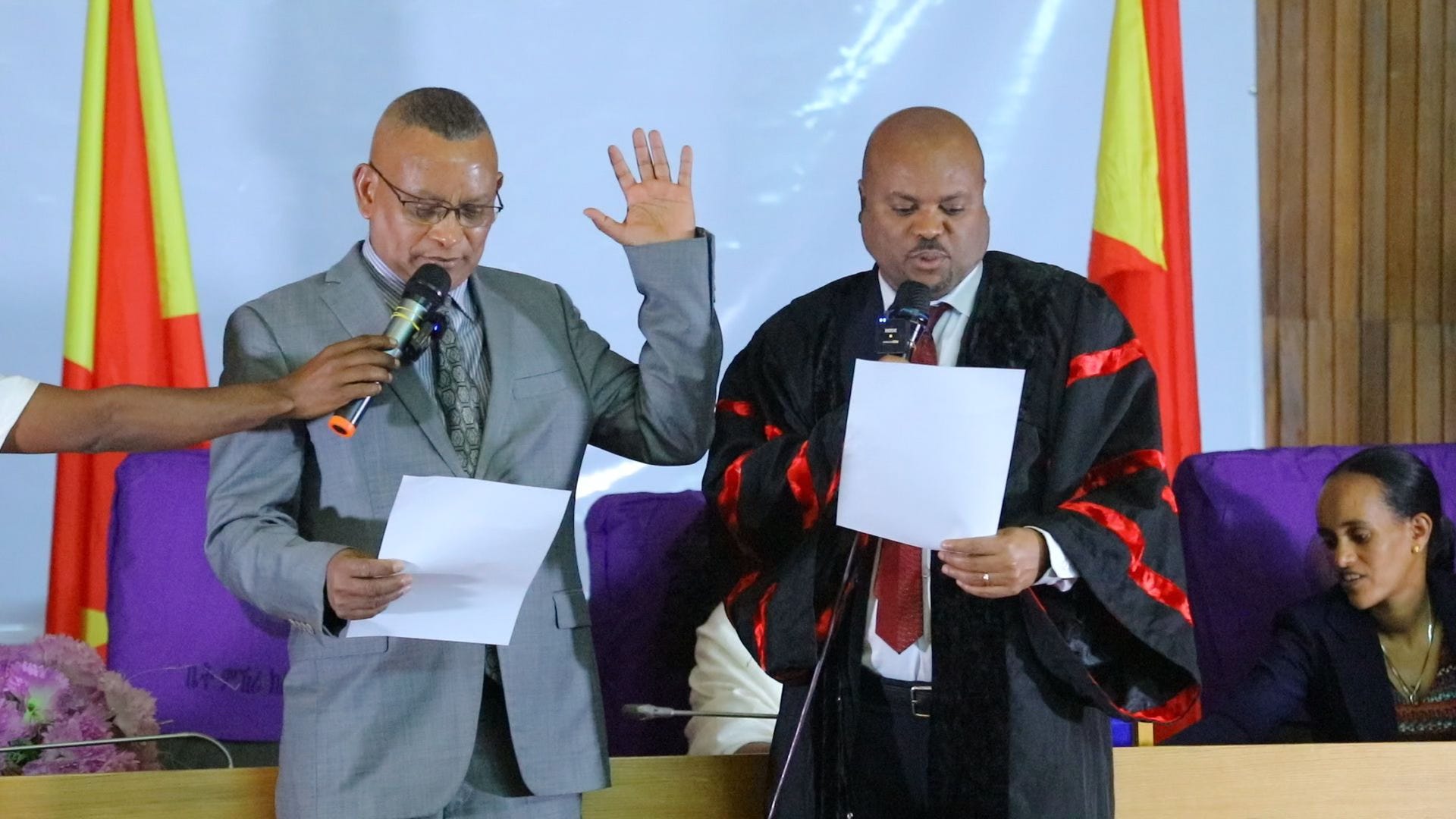
The TPLF had telegraphed the move last month, accusing the federal government of provoking armed conflict, withholding funds for civil servants, and extending the interim administration president’s tenure without consultation. An adviser to Prime Minister Abiy Ahmed responded with a stark warning that “catastrophic conflict” could return to the region.
Kjetil Tronvoll, a professor of peace and conflict studies at Oslo New University College and a scholar of the TPLF, told Reuters the implications were severe. “The decision by TPLF is clearly a major escalation. If mitigating efforts and a process of de-escalation are not introduced quickly, this may trigger the outbreak of new armed conflict,” he said.
The Pretoria Agreement had already been under strain before this week’s announcement, with armed skirmishes breaking out since January between TPLF forces and the federal army and government-aligned fighters. Fighter jets have been seen over Mekelle at least twice in recent weeks, and on Monday, an explosion — reportedly caused by a hand grenade — occurred near the interim administration’s offices in the regional capital Mekelle, though no casualties were reported and no group claimed responsibility.
The latest diplomatic row between Addis Ababa and Khartoum is unfolding against an already fraught regional backdrop. The Sudanese military has accused Ethiopia of allowing the Rapid Support Forces (RSF) and United Arab Emirates (UAE) to conduct drone operations from its territory — including a strike on Khartoum’s airport — while Ethiopia has in turn accused the SAF of backing rebels in northern Tigray. In recent days, Sudan has deployed additional troops and military hardware to the Al-Fashaga border region and Gedaref state following a surge in tensions with Ethiopia.
Compounding the political crisis is a dire economic and humanitarian situation. Dr. Sarah Miller, a Senior Fellow at Refugees International, warned on Tuesday that “conditions in Tigray are beginning to dangerously resemble the humanitarian blockade we saw enacted during the last war.”
“Amid rising tensions between the Tigray People’s Liberation Front (TPLF) and Ethiopian federal authorities ahead of June elections, Federal Government authorities are withholding critical funding, which limits humanitarian assistance and services for civilians in Tigray. Health and education authorities in Tigray have sounded the alarm that they cannot pay staff or continue critical work. “
Miller noted that nearly one million people remain internally displaced from the previous conflict, many sheltering in schools and other inadequate facilities and dependent on dwindling aid.
The European Union and United Kingdom have called for de-escalation over the past week. On the other hand, the United States has announced a change of policy favoring Eritrea and (indirectly) the TPLF, leaking plans to the press that it will soon lift longstanding sanctions on Eritrea. The move, motivated by maritime concerns, also signals to Ethiopia that it should not go to war with Eritrea, according to analysts and diplomats cited by Reuters.
One unintended consequence of this decision, however, could be to embolden Eritrea to strengthen covert cooperation with the TPLF. Although the Eritrean military and TPLF were at odds during the last war in Ethiopia, they have realigned and appear poised to fight together against the Ethiopian government in the event of a regional war.
Refugees International is urging the African Union to join pressure both Abiy and Tigrayan officials to pull back from the brink. Miller also called on Washington to resume humanitarian assistance in Ethiopia and to ensure Tigray is not cut off from support.
Sudan War Monitor is an in-depth resource for tracking the world’s largest humanitarian crisis and the conflict that has caused it. We’ve been able to sustain and grow this initiative thanks to a global network of supporters. You can help by upgrading to a paid subscription, which gives you access to subscriber-only extras, as well as our full archive of reporting and analysis.
Sudan Army Alleges UAE-Linked Drone Sorties Staged From Ethiopian Territory
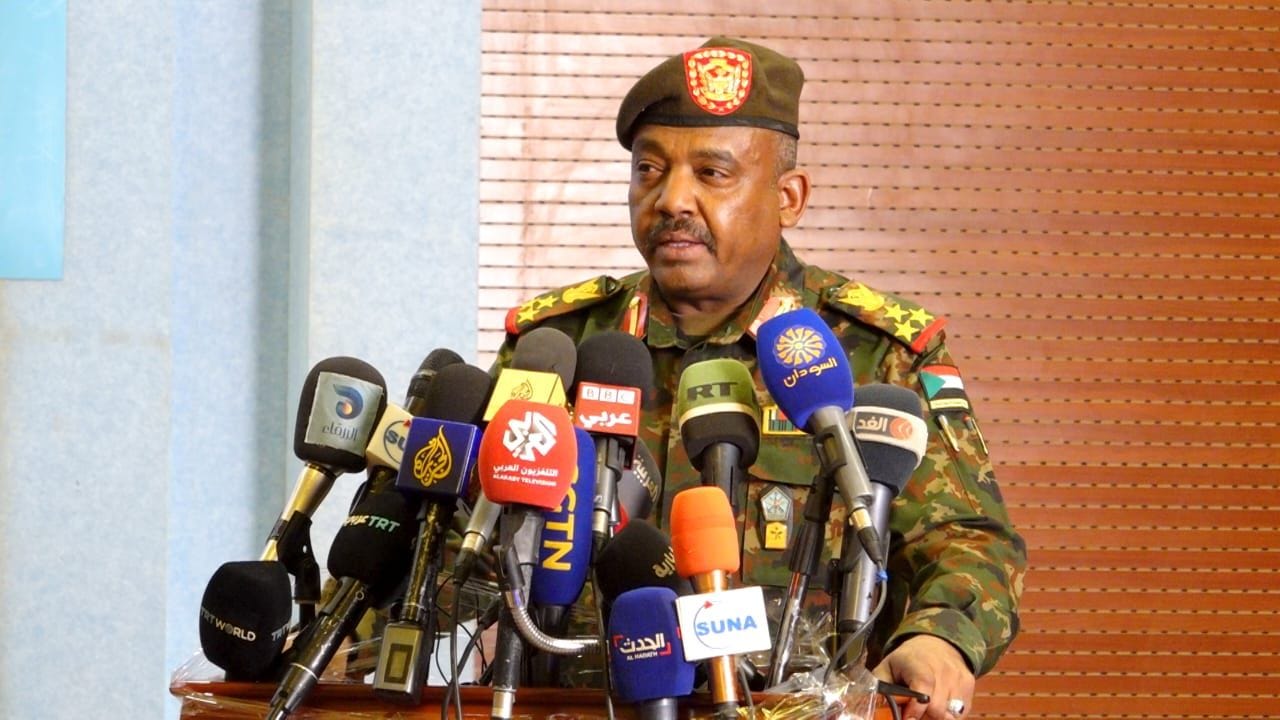
As tensions escalate inside Ethiopia, the Sudanese Armed Forces (SAF) is accusing the Ethiopian government of facilitating RSF drone operations on its territory, following a renewed wave of long-range strikes that hit Khartoum International Airport and other sites across the capital region last week.
Speaking in a press briefing in Khartoum on Monday evening, Brigadier General Essam Awad Abdelwahab, the army spokesman, said aerial operations involving multiple UAVs began in early March, with flight paths extending from eastern Ethiopia into Sudanese airspace.
“Today we present before our resilient people, and to regional and international public opinion, a set of documented evidence proving the involvement of two states—the United Arab Emirates and Ethiopia—in aggression against Sudan, constituting a grave violation of our country’s sovereignty and a clear breach of international law.”
“Based on documented information and conclusive evidence obtained by our official agencies and various means, on March 1, 2026, hostile aerial sorties began, involving three drones launched from Ethiopia’s Bahir Dar Airport, targeting White Nile State, Blue Nile State, and the states of North and South Kordofan. On March 17, 2026, one of these drones was engaged and brought down by our air defenses.”
“The drone, bearing serial number (S-88), belongs to the United Arab Emirates and was operated from Ethiopian territory, specifically Bahir Dar Airport. The data shows that it took off from the hangar displayed before you. Extracted data further indicates that the drone entered Sudanese airspace along the route shown. Our forces engaged it multiple times in Al-Kurmuk and other areas in Blue Nile, and it also attacked our forces in North and South Kordofan. It was ultimately shot down north of the city of El Obeid on March 17, 2026,” he said.
According to the briefing, additional UAV activity was recorded beginning on May 1, with at least one drone tracked from its alleged launch point toward central Sudan, where it conducted strikes near Jebel Aulia, on Saturday, and Khartoum International Airport, on Monday.
The recurrence of similar flight paths was presented by the military as evidence of a consistent launch axis originating outside Sudanese territory.
The remarks came hours after drone strikes targeted Khartoum International Airport and other locations across the capital region, disrupting operations at a facility that had only recently resumed international flights. Authorities evacuated staff and suspended incoming flights, while footage circulated online showed smoke rising from within the airport perimeter.
Sudan’s foreign minister said Khartoum has recalled its ambassador for consultations, describing the step as a routine diplomatic measure while signaling potential escalation through regional and international channels if the alleged activities persist.
He said Sudan remains open to engagement with regional organizations but warned that the government is prepared to respond if external involvement continues.
“We have decided to recall our ambassador for consultations as a routine diplomatic measure. We also have access to all regional and international organizations to which we belong, and we will pursue those channels if this behavior continues. The Government of Sudan is a rational government that knows how to deal with such matters. We have faced similar situations before, whether in this imposed war or throughout our history.”
“We call on all those who wish to see peace prevail in the Horn of Africa, Central Africa, and East Africa—regions to which we belong—to engage seriously. Sudan is ready to play an active role in establishing peace and security. In this troubled world, people need to sit together and resolve issues in a conscious manner that respects the interests of their peoples.”
“However, if circumstances force us into an open confrontation that others seek, then we—our army and our people—are ready. The dignity of the Sudanese people is more valuable than anything. I will not elaborate further. Every situation has its appropriate words. If these parties cease interfering in our internal affairs—as we have not interfered in the internal affairs of any neighboring country since this cursed war began—then matters can stabilize.”
Separately, additional evidence has emerged of RSF operations on Ethiopian territory. The Yale Humanitarian Research Lab last month released a report detailing RSF operations near the Ethiopia-Sudan border. The report stated:
“The Yale School of Public Health’s Humanitarian Research Lab (HRL) has concluded with high confidence that there is activity consistent with military assistance to the Rapid Support Forces (RSF) occurring at an ENDF (Ethiopia National Defense Force) base in Asosa Town in the Benishengul-Gumuz region of Ethiopia between 29 December – 29 March 2026.”
“Yale HRL also identifies air activity and defensive hardening at the airport in the form of defensive fighting positions as well as expansion of airport facilities, including a new hangar and concrete pad. The construction findings at Asosa airport corroborate recent reporting by Reuters. These findings represent clear visual evidence over a five-month period that RSF is basing its attacks on Blue Nile State, Sudan from inside Ethiopian sovereign territory.”
The RSF’s new base in Ethiopia has allowed it to open a new eastern front in Blue Nile State, forcing the Sudanese military to man a new line of defenses and drawing resources away from the western front. The base in Ethiopia also allows the RSF to launch drone attacks into central and eastern Sudan.
Since losing ground in Central Sudan in early 2025, the RSF has increasingly relied on drones to project force into SAF-controlled areas. The shift reflects a move away from large-scale ground offensives toward long-range strikes aimed at infrastructure, logistics, and symbolic targets. These strikes have not significantly altered frontlines but have imposed sustained pressure on government-held areas by disrupting infrastructure and complicating recovery efforts. In Khartoum, where authorities have begun tentative steps toward restoring government functions and encouraging civilian return, renewed drone activity has reinforced perceptions of insecurity.
The decision by Sudanese authorities to publicly name Ethiopia marks a departure from earlier phases of the war, when allegations of the country’s involvement were made indirectly and unofficially.
Ground operations in Blue Nile have escalated in recent months. The RSF and SPLM-N captured the town of Kurmuk in March after an assault that allegedly originated from across the Ethiopian border. This was followed by a northward advance by the rebel coalition capturing Keili garrison.
Support our journalism

Thank you for reading Sudan War Monitor. We do this work because we believe that journalism is one accountability mechanism that ultimately can contribute toward peace and justice in Sudan—however distant that hope may be. Our work is intended to be a resource for humanitarians, civil society, ordinary Sudanese, diplomats, and news media. Subscribe or share to support our work and help “Keep Eyes on Sudan.”