
South Sudan’s government yesterday tried to walk back comments by a senior general, after a viral video showed him ordering frontline troops to exterminate “even the chickens” in the territory of the Lou Nuer ethnic group.
The country’s descent back into civil war coincides with the passing of 1,000 days of war in neighboring Sudan and the first cross-border clashes between Sudan and Chad forces last week, marking a new era of grave regional instability not seen since the 1990s.
South Sudan separated from Sudan after a referendum in 2011 and gained international recognition as an independent country with a population of about 10 million and a territory larger than Ukraine.
The new nation portrayed itself as a democracy and initially attracted foreign investment and development funding. Among Western backers and South Sudanese themselves, it was widely hoped that independence would end a long history of ethnic, religious, and political conflict that had plagued Sudan—particularly its southern region—since its independence in 1956.
These hopes were shattered by the sudden outbreak of fighting between Dinka and Nuer soldiers in the South Sudanese national capital in December 2013. Troops loyal to President Salva Kiir, an ethnic Dinka, massacred thousands of Nuer civilians in the capital Juba, after which reprisal attacks and fighting spread to other parts of the country.
Five years of civil war followed, fought largely along ethnic lines, until an agreement in 2018 brought the rebel SPLM-IO into government. The peace deal quelled the violence but failed to restore prosperity or political stability. Recent years were marked by governmental dysfunction, repression, distrust between the supposed peace partners, and diminishing international interest.
Now, the old war is essentially resuming, albeit in different economic and international circumstances, with new weapons and communication tools, and with somewhat different political coalitions.
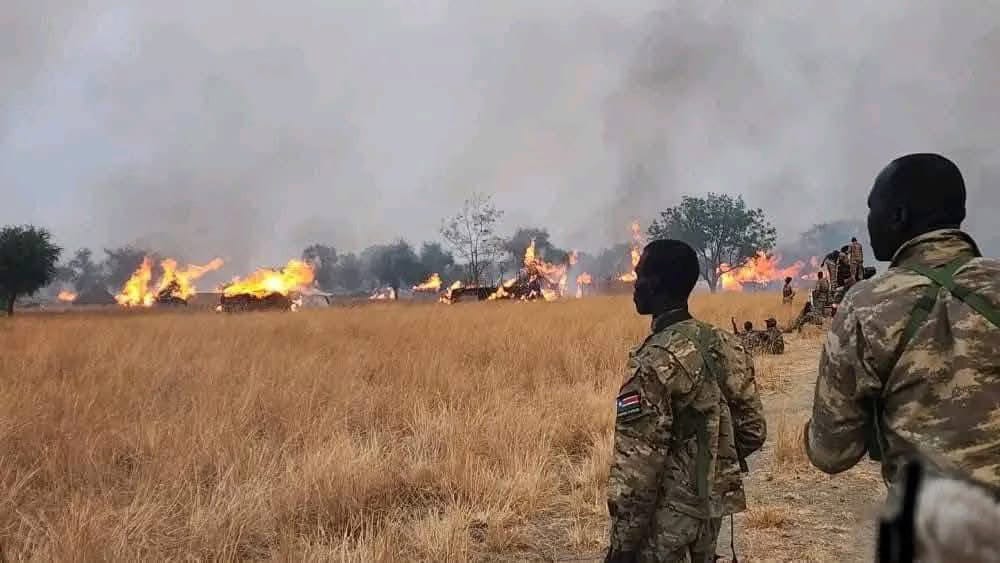
If the outbreak of the previous war could be described as an explosion that rocked in the nation’s largest city, Juba, this new conflict is better understood as spreading wildfire, which began more slowly but is growing in force and fury as it burns across the grasslands of Jonglei and the forests of Equatoria.
The conflict began last year when a long-running political breakdown, stemming from non-implementation of the 2018 peace agreement, broke into the open. Army and opposition fought a series of clashes, while remaining nominally at peace with each other. Meanwhile, the government arrested, fired, or forced in to exile many opposition leaders, who were supposed to be part of the government under the terms of the peace deal.
In a major escalation in March 2025, President Salva Kiir fired and arrested his vice president, Riek Machar, the leading politician among the Nuer and the chairman of the SPLM-in-Opposition. Machar is now on trial in Juba but remains a key figurehead within SPLM-IO, even as younger politicians and commanders take the lead in the escalating rebellion.
After months of conflict last year, the International Committee of the Red Cross said in November 2025 that its surgical teams in South Sudan had treated nearly 1,000 war-wounded people since the start of the year, the highest figure since 2018. The ICRC noted, “Health facilities, especially in remote areas, are under extreme pressure, with many patients arriving after long delays that drastically reduce their chances of survival.”
Since then, the military confrontation has continued to worsen. SPLM-IO troops overran army installations in Yuai and Pajut in Jongle State, launched attacks in Central and Eastern Equatoria, and announced a general offensive aiming to seize the capital and topple the national government.
In response, the government has declared a major counter-offensive to retake areas that it has lost, assembling troops in western parts of Jonglei. In Duk County, General Johnson Olony told fighters preparing to invade opposition-held areas,
“When we reach there, there won’t remain even one [surviving] elder, not even one chicken, not one house or anything. We are tired of problems — every year until we have gotten old in problems.”
Olony was speaking in Juba Arabic, the shared military language of South Sudan. He is the Assistant Chief of Defence Forces, serving in the top tier of South Sudan’s military command, below the military’s chief and deputy Chief of Defence Forces. Formerly an opposition commander who played a significant role in the previous civil war, Olony reconciled with the government in 2023 and received a promotion in 2025.
He belongs to the Chollo (Shilluk) ethnic group of Upper Nile State, and led the Agwelek militia, consisting of ethnic Chollo, which fought against SPLA, Padang Dinka militias, and Nuer forces in Upper Nile State at various times.
Subsequently, Minister of Information Ateny Wek held a press conference to inform the public that Olony’s comment was “a slip of the tongue.” He said,“The recent statement attributed to Lt Gen. Johnson Olony Thabo do not represent the policy and the position of the government of the Republic South Sudan… it might have been a slip of the tongue.”
“There is no government anywhere in the world that can authorize the killing even of chickens.”
South Sudanese news media have translated Olony’s remarks a handful of ways. Contrary to what was reported elsewhere, the general did not explicitly order troops to “show no mercy” or to “spare no one,” nor did he order the killing of women and children. But some listeners interpreted his remarks to imply that, especially given the broader context of incitement and the government’s history of violence against Nuer civilians.
Nuer community groups condemened Olony’s threat as “hate speech,” and European diplomats expressed concern. “The threat of indiscriminate violence against civilians, brought forward by a senior military leader in South Sudan, is very worrying and dangerous. We call on President Kiir to return to dialogue immediately,” said Gesa Bräutigam, Africa Director at the Germran Foreign Office, writing on social media.
Similarly, the chair of the UN Commission on Human Rights in South Sudan, Yasmin Sooka, wrote in a statement,
“In South Sudan’s past, such rhetoric has preceded mass atrocities. When such language is issued or tolerated by those in positions of command, it signals permission to commit violence and removes any expectation of retstraint.”
The Commission stressed that General Olony’s statements are not isolated but are “part of a wider political breakdown driven by sustained violations of the peace agreement, and the erosion of command discipline in an already volatile and fractured environment.”
Meanwhile, the South Sudanese army on Sunday issued a sweeping evacuation order for Lou Nuer territory, which, if complied with, would force hundreds of thousands of people from their homes. “With the imminent start of Operation Enduring Peace, all civil population in SPLA-IO-controlled areas of Nyirol, Uror, and Akobo [counties] are directed to evacuate immediately for safety to government-controlled areas as soon as possible,” said Maj-Gen. Lul Ruai Koang, spokesman of the South Sudan People’s Defence Forces (SSPDF).
“Armed civilians not interested in fighting with government forces must immediately hand over their weapons to the nearest SSPDF garrison without further deleays. Youth that are not part and parcel of the ‘White Army’ [opposition force affiliated with SPLA-IO] should move with their families and livestock to the nearest government controlled areas…. Finally, all NGOs and UNMISS personnel operating and working in Nyirol, Uror, and Akobo counties are given 48 hours to leave.”
Already, fighting in northern Jonlgei State over the past month has displaced approximately 100,000 people, according to UN estimates.
Human Rights Watch criticized the government’s evacuation order, saying it could be used to justify violence against civilians:
“While international humanitarian law requires that parties give civilians effective warnings where possible, such warnings never justify indiscriminate attacks on civilians or unlawful forced displacement. The directives leave older people, people with disabilities, and anyone unable or unwilling to flee at particular risk…
“Targeting civilians and wantonly destructing or pillaging civilian property are war crimes, and all superiors and commanders are responsible for preventing and punishing war crimes by subordinates or may be criminally liable for not doing so. While the government has walked back General Olony’s comments, it should ensure credible disciplinary measures.”
As the crisis worsens, diplomats and regional leaders are still pinning their hopes on the 2018 peace agreement, aiming to salvage it. The chair of the African Union Commission, Mahmoud Ali Youssouf, yesterday called on all the parties to “exercise maximum restraint, immediately de-escalate tensions, and fully comply with their obligations under the R-ARCSS [Revitalised Agreement on the Resolution of the Conflict in the Republic of South Sudan]. This includes strict adherence to ceasefire arrangements, respect for agreed power-sharing mechanisms, and a return to inclusive, consensus-based decision-making.”
The AU Chairperson further urged South Sudanese stakeholders “to place the interests of the people of South Sudan above all other considerations and to resolve outstanding differences through dialogue and peaceful means, with a view to ensuring the successful completion of the Transitional Period.”
Thank you for reading Sudan War Monitor. We are an independent group of researchers using OSINT and journalism methods to verify conflict videos and produce news, maps, political-military analysis.
Video: General Olony’s Full Remarks
Related Coverage:
New Rebel Offensive Tests Fractured South Sudan Regime

Opposition forces are on the move in South Sudan, striking army outposts across four states and stirring growing unease in the national capital, Juba, where the president sacked top security officials, the deputy governor of a conflict state, and the interior minister in a series of decrees Monday.
Heavy gunfire erupts in South Sudan capital Juba

Heavy and sustained gunfire erupted in South Sudan’s capital Juba on Thursday, sending shockwaves across the city after elements of the South Sudan People’s Defense Forces (SSPDF) reportedly acted on orders to transfer former security chief General Akol Koor Kuc to a detention center at the army headquarters in Bilpam.
Greater Sudan and the Risk of Regional War

Curious to learn more? Sign up to receive 2-4 weekly emails containing maps, videos, fact-based reporting, and incisive insights from an independent perspective.
Sudan's RSF clashes with South Sudan’s SPLA-IO

Sudan’s paramilitary Rapid Support Forces (RSF) fought a two-day battle against the Sudan People’s Liberation Army in Opposition (SPLA-IO), a South Sudanese opposition group, near the border between the two countries.