
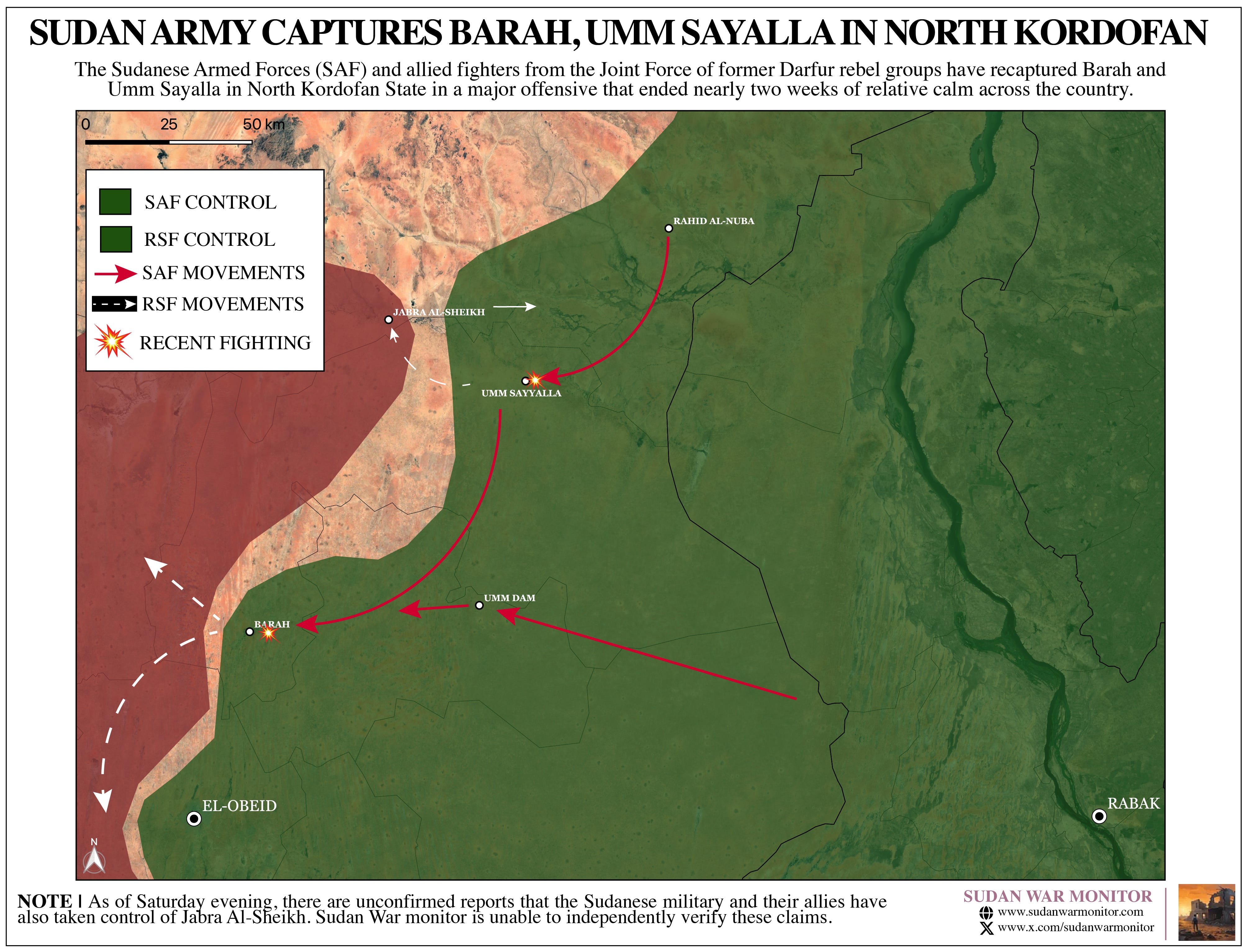
The Sudanese Armed Forces (SAF) and allied auxiliary forces have retaken Bara and Umm Sayalla in North Kordofan State as part of an offensive aimed at securing the Al-Sadarat Highway between Khartoum and El Obeid. The operation follows two weeks of relative calm in ground fighting across most of Sudan’s major frontlines.
Multiple videos posted by pro-Sudanese army accounts on social media yesterday and geolocated by Sudan War Monitor confirm the presence of Sudanese military units in these towns.
Commanders from the Joint Force of Armed Struggle Movements, which is fighting alongside the military, claimed in social media posts that their forces had also captured Umm Girfa and Jabrat al-Sheikh. However, the full extent of the territorial gains remained difficult to establish independently.
For most of the war, the Rapid Support Forces (RSF) has controlled these towns, which lie along the Al-Sadarat (Export) Highway, also known as Al-Inqaz Al-Gharbi Highway. The seizure of these four towns, if confirmed, would be a setback for the RSF, which has tried to isolate the North Kordofan State capital El Obeid, partially besieging it and threatening to attack.
However, some previous SAF maneuver operations in North Kordofan have proven short-lived, with SAF or Joint Force units eventually withdrawing after attacking and seizing territory, ceding ground back to the RSF. Therefore it remains to be seen if the operation represents a major breakthrough.
The offensive began on Saturday afternoon from the direction of Rahid al-Nuba, according to military-aligned sources who spoke to Sudan War Monitor. SAF units, fighters from the Joint Force and other allied formations advanced across several positions held by the paramilitary RSF, which mutinied from the Sudanese military in 2023.
Sudan War Monitor is a reader-supported publication covering humanitarian and military events, as well as human rights violations and war crimes. We publish conflict analysis, journalism, maps, videos, and open-source investigations. Thank you to all our subscribers for your interest and support.
The attack ended nearly two weeks of relative calm across many of Sudan’s main frontlines. During that period, much of the fighting had been limited to drone attacks, artillery strikes and smaller movements by both sides rather than major attempts to seize territory.
The renewed fighting in North Kordofan indicates that the military and its allies are again trying to relieve pressure on the partly besieged city of El Obeid and establish control over the highway corridor linking it to Omdurman. This route has been cut by the RSF since the start of the war and several Sudanese military attempts to control it all ended in defeats.
One video reviewed by Sudan War Monitor showed SAF soldiers in Umm Sayalla at coordinates 14°23’46.60”N 31° 8’44.38”E. The footage was posted online at around 4:00 p.m., shortly before the army regained control of Bara.
In this video, Sudanese army soldiers are seen northeast of Umm Sayalla, here: 14°23’46.60”N 31° 8’44.38”E.
After announcing the capture of Umm Sayalla, the force moved southwest and linked up near Umm Dam with another SAF-aligned column advancing from the direction of El Obeid. Umm Dam had not been firmly controlled by either the SAF or the RSF. The combined forces then marched toward Bara and eventually seized the town.
Another video showed a Sudanese army soldier outside the Bara Hotel, located north of a fuel station at which Sudan War Monitor also geolocated Joint Force soldiers driving on a pickup vehicle.
In this video, a Sudanese army soldier is seen outside a local hotel in Bara, here: 13°42’5.71”N 30°21’58.31”E.
Sudan War Monitor was unable to verify a video in which Sudanese military personnel claimed they were outside Jabrat al-Sheikh. The footage contained no identifiable buildings, road features or other landmarks that could be matched with satellite imagery.
Sudan War Monitor could not also independently verify the capture of Umm Girfa from the available footage. Neither the SAF General Command nor the RSF had issued a formal statement on the fighting at the time of publication. The RSF has not acknowledged losing Bara, Umm Sayalla or positions farther north along the highway.
The most detailed claims came from leaders of the Joint Force and political leaders aligned with the Sudanese military. Joint Force commander Juma Haggar said SAF-aligned troops had regained control of Bara, Umm Girfa, Umm Sayalla and Jabra al-Sheikh following what he described as carefully planned operations. He claimed the operation inflicted heavy losses on the RSF and said surviving fighters had fled from the advancing forces. Haggar also urged military supporters not to circulate information about ongoing operations except through official channels.
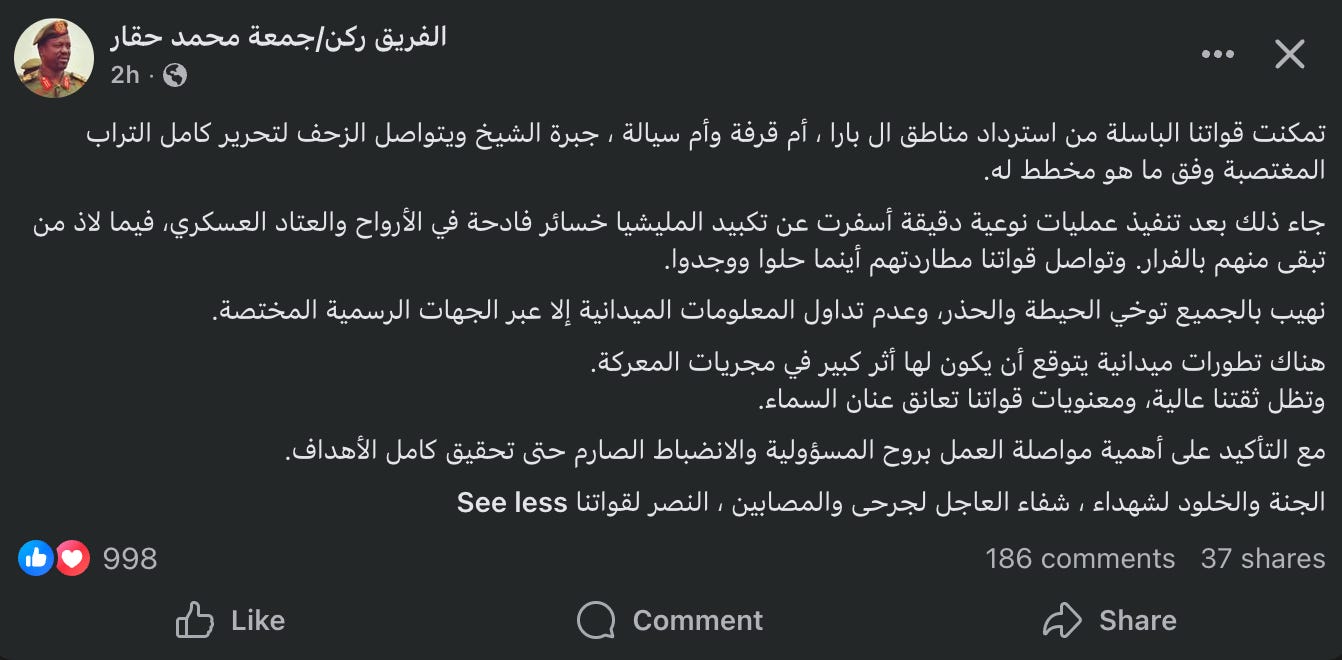
Sudan War Monitor could not independently determine the number of fighters killed, wounded or captured during the offensive. Claims regarding destroyed or seized military equipment also remained unverified.
Darfur Governor Minni Arko Minnawi, who leads the Sudan Liberation Movement (a major component of the Joint Force) and is one of the most prominent commanders aligned with the army, also announced the capture of the four towns. Minnawi described the advance as the beginning of a new stage in the fighting rather than the conclusion of the operation.
He said the SAF, the Joint Force and fighters from the “Popular Resistance” had taken Bara, Umm Girfa, Umm Sayalla and Jabra al-Sheikh after operations that disrupted RSF defensive positions.
“What was achieved today does not mark the end of the battle, but rather the beginning of a new and decisive phase… The militia suffered heavy losses in personnel and equipment, while its defensive positions collapsed in the face of advancing fighters who know no outcome other than victory or martyrdom. May God have mercy on our righteous martyrs and grant a speedy recovery to the wounded and injured,” Minnawi wrote on Facebook.
While footage supports the presence of army-aligned troops in Bara, Umm Sayalla and Jabra al-Sheikh, the situation in parts of the wider area remained unclear. It was also not immediately known whether RSF units had withdrawn northward, dispersed into surrounding rural areas, or were preparing a counterattack. The RSF has repeatedly regained towns in North Kordofan after losing them to SAF-led offensives. Control of a settlement does not always mean control of the roads, villages and desert tracks surrounding it.
Importance of the Highway
Since the conflict began in April 2023, the RSF has used towns north of El Obeid as forward positions for attacks and pressure on the state capital, and for operations closer to Omdurman. For the SAF, securing the road would shorten the distance between its positions in Khartoum and El Obeid and reduce its reliance on longer routes through White Nile State.
Military reinforcements and supplies traveling from central Sudan have often been forced to move through White Nile before turning west toward North Kordofan. That route increases travel time and exposes convoys to attacks across a wider area.
A secure Al-Sadarat Highway would allow the military to move personnel, ammunition, fuel and equipment more directly between Omdurman and El Obeid. It could also reopen a major civilian commercial route. Before the war, the highway was used to transport agricultural products, livestock, food and other goods between Kordofan and markets in Khartoum.
Related Coverage:


However, the military would need to hold the towns and the surrounding countryside before the route could be considered secure. RSF units have frequently operated away from main settlements, using desert tracks to attack convoys and cut roads even after losing urban positions.
If RSF units remain in Jabrat al-Sheikh, Umm Girfa, and desert areas north of the highway, they could still threaten the route between Khartoum and El Obeid. For now, the available evidence does not establish that the entire highway is open or safe for regular military and civilian traffic.
Bara has become one of the most contested towns in the Kordofan theater and has changed hands several times during the war. The town lies approximately 55 kilometers north of El Obeid and occupies a central position along the highway. Its location makes it important for any force seeking to move between North Kordofan and the Khartoum region.
SAF and allied formations captured Bara in September 2025 after a major assault on RSF positions around the town. The takeover temporarily opened the road between Bara and El-Obeid was celebrated by military supporters as a major defeat for the RSF; the RSF later regrouped and returned to the town, reversing the army’s gains and restoring its control over part of the highway.
SAF-aligned forces again entered Bara on March 5, 2026. The RSF recaptured Bara within days. The latest takeover is therefore at least the third SAF entry into Bara since last year and the fourth since the civil war began in April 2023.
Also Read:

The RSF’s mobility allows it to withdraw from urban positions under pressure and later return once SAF-aligned units are stretched across a wider area. The military and the Joint Force will now face the challenge of consolidating their latest gains and preventing another counterattack.
The offensive appears to have involved significant participation by the Joint Force of Armed Struggle Movements. The coalition includes former Darfur rebel groups that signed the 2020 Juba Peace Agreement and later aligned themselves with the SAF against the RSF.
Its main components include Minnawi’s Sudan Liberation Movement and the Justice and Equality Movement led by Finance Minister Jibril Ibrahim.
Joint Force fighters have increasingly taken a frontline role in Kordofan, where combat often occurs across open desert and semi-arid terrain. Many of the fighters have decades of experience in mobile warfare in Darfur, including operations involving pickup trucks, rapid flanking movements and attacks across areas with few paved roads. These methods are similar to tactics used by the RSF, whose forces also rely heavily on fast-moving vehicles and dispersed formations.
The Sudanese military has therefore relied on the Joint Force to spearhead or support operations in areas where conventional army formations may struggle to pursue mobile RSF units. Footage from the latest offensive showed both regular SAF soldiers and Joint Force fighters in captured areas, indicating a coordinated operation.
Videos
Head of the pro-SAF Sudan Shield Force milita Abu Aqla Keikel in Bara following the fall of the town to the Sudanese military. This video was filmed here: 13°42’4.24”N 30°21’59.57”E. He said that the police should start operating from tomorrow.
In this video also filmed around the same location where Keikel filmed, a SAF soldier is seen speaking in a selfie video.
In this video, members of the Joint Force are seen driving through the main road in central Bara saying they are inside the town.
In this video, a member of the Joint Force speaks in the middle of the road south of Bara (13°41’12.80”N 30°21’55.19”E). He describes the RSF as consisting of mercenaries from Chad, Libya, and Ethiopia, backed by the UAE — a common theme of RSF opponents, who seek to portray the RSF as foreign and not a legitimate rival to the existing Sudanese authorities.