
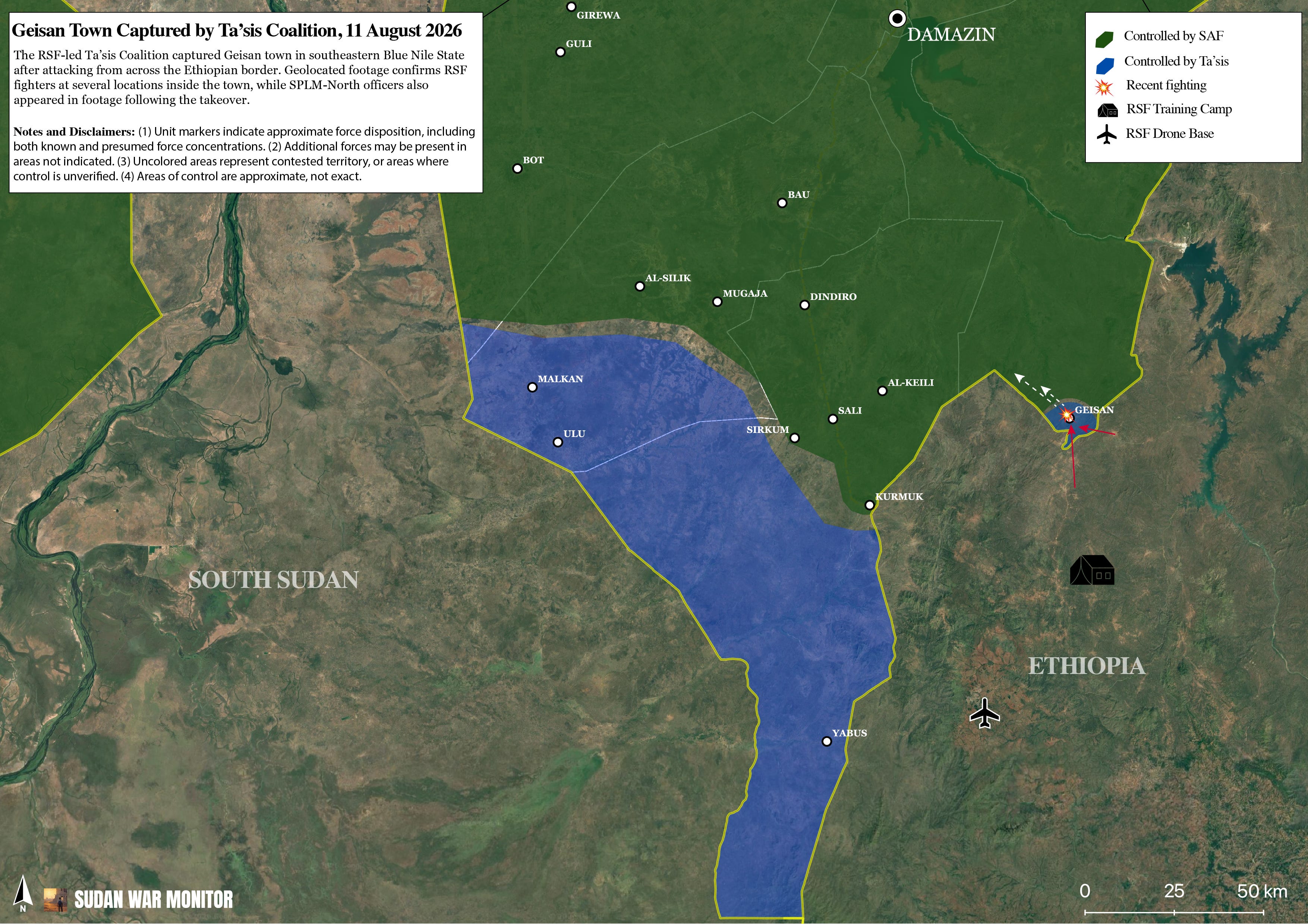
The rebel Ta’sis coalition overran Geisan, the capital of Geisan Locality in southeastern Blue Nile State, on Tuesday morning after launching a fresh offensive against the Sudanese Armed Forces (SAF) from across the Ethiopian border.
Videos reviewed and geolocated by Sudan War Monitor show rebel fighters at several locations inside the town, including Rapid Support Forces (RSF) personnel outside Geisan Health Centre, confirming that the attacking forces had penetrated the locality capital after crossing into an area previously held by the army.
One video reviewed and geolocated by Sudan War Monitor shows RSF fighters outside Geisan Health Centre at 10°46’13.93”N, 34°47’31.98”E, placing the paramilitary force well inside the town following the assault.
RSF officer speaks to camera (on August 11, 2026) and is flanked by an SPLM-N officer (right) in front of the Geisan Health Centre. This video is geolocated by Sudan War Monitor to this location in central Geisan: 10°46’13.93”N, 34°47’31.98”E.
Geisan lies only a few kilometers north of the Ethiopian border and occupies an important position in southeastern Blue Nile. Geisan Locality borders Kurmuk Locality to the southwest and Al-Roseires and Damazin localities to the north, while Ethiopia lies immediately to the south of the town.
Formally known as the Sudan Founding Alliance (SFA), the Ta’sis coalition is led by the RSF and includes the Sudan People’s Liberation Movement-North (SPLM-N) alongside several smaller armed and political groups.
The alliance opened an active front in Blue Nile earlier this year, bringing the RSF into a region where it historically had little independent presence through its military partnership with the SPLM-N, which has maintained forces and territory across parts of the state for decades. The two forces retain separate command structures but cooperate tactically in operations against SAF.

The latest footage from Geisan provides particularly significant evidence of that partnership. An SPLM-N officer and several soldiers from the movement appear openly in videos filmed inside the town, alongside RSF personnel, in one of the clearest recent visual confirmations that SPLM-N combat units were directly involved in a Ta’sis offensive.
During several recent battles involving the coalition, SPLM-N personnel either did not appear to take part directly or avoided appearing in footage circulated from captured positions, leaving RSF fighters as the most visible component of the coalition on the battlefield.
Their appearance in Geisan is therefore important in assessing the makeup of the force that carried out Tuesday’s attack. The footage indicates that the offensive involved personnel from both of Ta’sis’ principal military components rather than simply RSF units operating through SPLM-N territory.
⚠️ Warning: Graphic Content
In this video, slain Sudanese army soldiers are seen on the ground being filmed and mocked against by RSF soldiers. Sudan War Monitor Geolocated this footage to the Geisan Sudanese army Garrison located here: 10°48’44.79”N 34°46’33.88”E.
It also offers rare visual evidence of SPLM-N soldiers participating openly alongside their allies at a time when the movement’s precise role in several previous coalition operations had been harder to establish from publicly available videos.
In a statement issued after the takeover, the RSF-led Ta’sis coalition said its forces had established full control of Geisan after pursuing SAF troops and seizing military positions, weapons and equipment.
“Continuing the successive victories and battlefield advances across all fronts, the valiant fighters of the Ta’sis Alliance forces today liberated the strategic city of Geisan, located 170 kilometers southeast of Damazin, and established full control over it. They also pursued the remnants of what the statement described as the ‘army of the terrorist Islamic Movement’ and mercenaries, inflicting heavy losses in personnel and equipment.”
“Today, in the battle to liberate Geisan, our valiant fighters wrote a new chapter of sacrifice and devotion, reaffirming their full determination to press ahead and bring this war to a decisive end in favor of the Sudanese peoples, and to build the state on new and just foundations.”
“Our forces succeeded in seizing all military positions in the city and captured large quantities of weapons and military equipment, which are currently being inventoried and documented.”
“Our forces affirm that the liberation of Geisan is only one stage and a new launching point on the path toward complete victory, and that your forces will continue steadfastly to clear the entire territory of the homeland and restore security, stability, and justice to our Sudanese people,” the RSF statement reads.
The Sudanese military had not issued a statement on the loss of Geisan at the time of publication. SAF had also not publicly commented on the Ta’sis coalition’s claims regarding casualties, captured weapons and military equipment, although geolocated footage reviewed by Sudan War Monitor independently confirmed rebel forces at key locations inside the town, including the SAF garrison.
The direction of the attack is equally significant, because the Sudan army currently controls Kurmuk and the main road running north from the border town toward Damazin, having rebuilt its positions along that axis after retaking Kurmuk in July.
Geisan lies east of this army-controlled corridor and only a short distance from the Ethiopian border. Given the disposition of SAF forces and the absence of a Ta’sis-controlled route into Geisan from the Kurmuk-Damazin axis, Sudan War Monitor assesses that the attacking force came from inside Ethiopian territory rather than advancing through army-held areas to the southwest or north.
The geography makes the Ethiopian frontier the most plausible route for the assault. Geisan lies east of the main Kurmuk-Damazin axis, while Damazin and Al-Roseires to the north remain firmly under SAF control.
For Ta’sis forces to approach from southwestern Blue Nile, they would first have had to pass through Kurmuk itself, which is under SAF control, and then cross or cut the army-controlled road leading north toward Damazin before reaching the southeastern side of the state where Geisan lies.
By contrast, Ethiopia lies directly south of Geisan, providing a much more direct approach to the town without requiring the attacking force to break through SAF’s main positions along the Kurmuk-Damazin corridor.
The assessment is consistent with the pattern seen during the coalition’s earlier campaign in southern Blue Nile. When Ta’sis forces captured Kurmuk in March, the assault originated from the Ethiopian side rather than from South Sudan or settlements farther south inside Sudan such as Yabus.
SAF maintained positions on several approaches to Kurmuk, but rebel forces nevertheless reached the town and overran its main military installations, suggesting that cross-border mobility had allowed them to bypass or outmaneuver parts of the army’s defensive network.
The Ethiopian side of the frontier has become increasingly important to the coalition’s Blue Nile campaign. The RSF and SPLM-N established a training camp and logistics hub in Ethiopia’s Benishangul-Gumuz region, providing the alliance with infrastructure close to the southeastern Sudanese battlefield. The network allows the RSF to move fighters and equipment toward a theater in which it had no significant local military structure before entering its alliance with the SPLM-N.
A Reuters investigation published in February provided further details about that infrastructure. Reuters reported that a large camp had been established in Ethiopia’s Benishangul-Gumuz region near the Sudanese border and that an internal Ethiopian security document said about 4,300 RSF fighters were undergoing training there in early January.
Satellite imagery taken on January 22, 2026 shows a camp with hundreds of tents and an area to the north where trucks come and go in Benishangul-Gumuz, Ethiopia. | © Vantor aia REUTERS.
The Ethiopian government has rejected allegations that it is allowing its territory to be used for attacks against Sudan. An Ethiopian source quoted by Sudan Tribune in December described reports of RSF camps as baseless and said Ethiopia would not permit hostile activity against a neighboring country.
Sudanese officials, however, had warned months before the latest battle that preparations were underway for attacks on both Kurmuk and Geisan from inside Ethiopia and alleged that military equipment was being moved through the Benishangul-Gumuz region.
Tuesday’s assault therefore follows a longer buildup along the border rather than representing an isolated attack. The coalition first achieved a major breakthrough on the Blue Nile front in March, when its forces overran Kurmuk after SAF positions around Jurut, Khor Arbudi and other locations south of the town came under attack. Surviving army units withdrew northward along the Kurmuk-Damazin road, allowing the rebel force to enter the strategically important border town.
SAF gradually reversed those gains. In May, troops from the 4th Infantry Division and supporting forces retook Al-Keili, east of the main Kurmuk-Damazin road, after the area had fallen to Ta’sis forces in late April. The army simultaneously increased the movement of reinforcements and supplies southward from Damazin, seeking to stabilize the southeastern front and prevent the coalition from advancing farther north.
The military then launched a larger counteroffensive in July, advancing south from Sali and Sirkum before retaking Kurmuk. Following the loss of Kurmuk, RSF fighters withdrew toward the Ethiopian border and farther south toward Yabus, an SPLM-N stronghold near the border with South Sudan.
The retreat substantially reduced the coalition’s ability to project forces northward along the Kurmuk-Damazin road, which had previously been viewed as its most direct route toward the center of Blue Nile. SAF’s recovery of the corridor made another northward push from Kurmuk considerably more difficult.
Related Coverage:


The attack on Geisan appears to have provided Ta’sis with an alternative. Instead of challenging SAF again along the heavily defended Kurmuk-Damazin corridor, the coalition shifted the point of attack eastward toward a locality directly exposed to the Ethiopian frontier. That maneuver allowed the rebel force to create a new pressure point while the army remained deployed along the main north-south road, demonstrating how the length and geography of the border complicate SAF attempts to seal southeastern Blue Nile.
For the army, the problem is not simply holding individual towns. A military presence in Kurmuk and along the road to Damazin protects the most important conventional route through southern Blue Nile, but it does not close the long border farther east. Mobile forces able to stage close to the frontier can potentially bypass fixed positions, forcing SAF either to disperse troops across a wider area or accept the risk of attacks against less heavily defended localities such as Geisan.
Shine a Light on Sudan’s Crisis
Sudan War Monitor is dedicated to tracking the world’s largest humanitarian crisis and the conflict that has caused it. We’ve been able to sustain and grow this initiative thanks to a global network of supporters. You can help by upgrading to a paid subscription, which gives you access to subscriber-only extras, as well as our full archive of reporting and analysis.
Is it too much to assume organised collusion between RSF, Ethiopia, and other third party countries?