
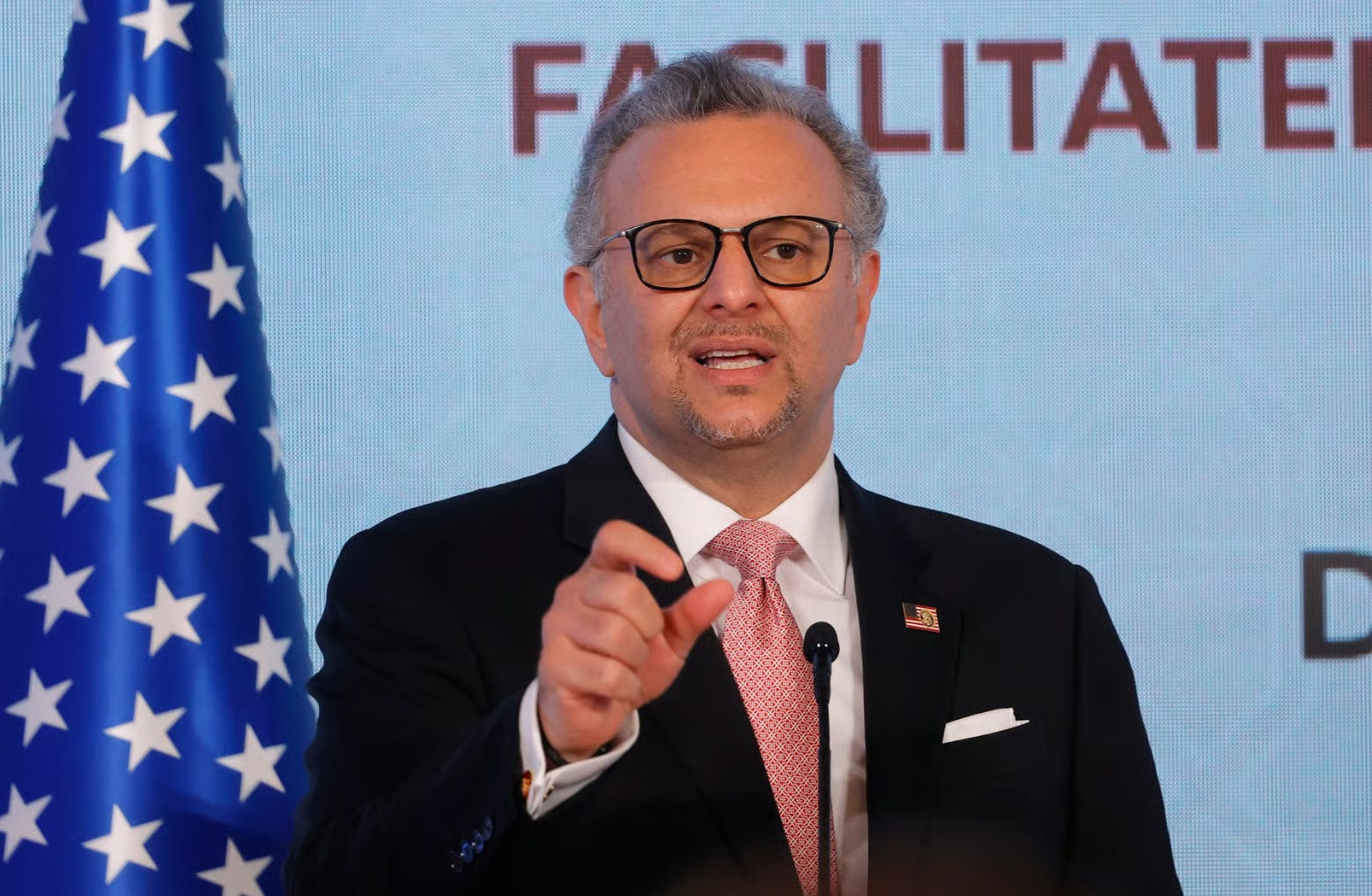
Senior U.S. official Massad Boulos has publicly reaffirmed Washington’s recognition of the Sudanese Armed Forces (SAF)-led administration in Port Sudan as Sudan’s “existing government,” marking the clearest American statement to date rejecting rival governing structures linked to the Rapid Support Forces (RSF).
Speaking to Al Arabiya News Channel on Tuesday, Boulos — the U.S. Senior Advisor for Africa at the State Department — said Washington “will never recognize” any parallel government in Sudan and described the SAF as a “constitutional institution” that must be preserved to avoid state collapse.
“We are against any vacuum. We are against the division of Sudan. We are against the Libyan scenario in Sudan. We do not recognize, and will never recognize, any parallel government. Even the current government we deal with it as the existing government [of Sudan], but we do not recognize any parallel government,” Boulos said.
The remarks amount to a significant rhetorical shift in U.S. positioning toward the military authorities in Port Sudan after more than three years of strained relations, indirect diplomacy, and public disputes between Washington and Sudan’s military leadership.
Since the outbreak of war in April 2023, the United States had largely avoided explicitly framing the SAF-led administration as Sudan’s legitimate governing authority, preferring instead to maintain formal distance from both the military junta and the RSF while pursuing mediation efforts through Saudi Arabia and other regional partners.
That ambiguity repeatedly angered the Sudanese military leadership, which viewed previous U.S. diplomacy as placing the army and the RSF on equal political footing despite the RSF’s rebellion against the state.
Boulos’s latest comments suggest Washington is now moving toward a more openly state-centric approach centered on preserving Sudan’s remaining formal institutions, even while continuing to criticize both sides for obstructing peace efforts.
“No, the real obstruction comes from both sides,” Boulos said when asked whether delays in peace efforts were caused solely by the army, contradicting a frequent RSF narrative that casts the SAF as the sole party blocking negotiations.
Still, his emphasis on preserving “constitutional institutions” and preventing a “Libyan scenario” represented a clear rejection of RSF political ambitions and parallel governance projects.
The RSF and allied political groups have in recent months intensified efforts to institutionalize parallel governing structures through the Sudan Founding Alliance, commonly known as the Taasis coalition, which announced a rival “Transitional Peace Government” headed by RSF commander Mohamed Hamdan Daglo “Hemedti” from the South Darfur capital Nyala in July 2025.
The move deepened fears of a Libya-style fragmentation scenario in which rival military authorities administer separate parts of the country under competing political structures.
Washington has previously rejected attempts to establish parallel governments in Sudan. However, Boulos’s latest remarks went further by explicitly describing the SAF-led administration as Sudan’s “existing government,” directly undercutting one of the RSF’s central long-term political objectives of transforming battlefield territorial control into international political recognition.
The comments also stand in sharp contrast to the hostile relationship that existed between Boulos and Sudan’s military ruler, General Abdelfattah al-Burhan, only months earlier.
In November 2025, Al-Burhan publicly attacked Boulos during a speech before military officers in Port Sudan, accusing the American official of bias and alleging he had become “a channel for RSF narratives.”
At the time, the SAF leadership was furious over a U.S.-backed diplomatic proposal that envisioned a ceasefire freezing territorial frontlines and opening political negotiations involving both belligerents.
Sudan’s military viewed the proposal as a mechanism that would effectively legitimize RSF territorial gains across Darfur and parts of Kordofan. Al-Burhan accused Boulos of attempting to impose terms favorable to the RSF and rejected the initiative outright.
“We consider the mediator biased,” Burhan said at the time. “Especially the U.S. envoy Massad Boulos. He talks to us as if imposing conditions.”
The military ruler also rejected any future arrangement that recognized the RSF as a political or military actor within the Sudanese state.
At the time, relations between Washington and Port Sudan had deteriorated significantly. The SAF repeatedly accused the United States of equating the army with the RSF despite the latter’s mutiny in April 2023.
That distrust had already deepened under former U.S. envoy Tom Perriello, whose refusal to formally recognize either side while advocating negotiated settlement frameworks generated growing hostility from the military government.
The United States evacuated its embassy in Khartoum shortly after fighting erupted in April 2023, effectively ending its diplomatic presence inside Sudan and shifting engagement to regional capitals and indirect negotiation channels.
The embassy closure created a vacuum in direct U.S.-Sudan state relations and reinforced perceptions inside Port Sudan that Washington was unwilling to fully engage the SAF-led authorities as a sovereign government.
Even after Perriello made his first wartime visit to Port Sudan in November 2024, the Biden administration continued balancing engagement with public criticism of SAF conduct, particularly regarding humanitarian access restrictions and alleged abuses by army-aligned forces.
The Trump administration inherited those strained relations while simultaneously scaling back broader U.S. diplomatic infrastructure related to Sudan. No dedicated special envoy was appointed after Perriello’s departure, leaving Boulos — whose portfolio spans all of Africa — to manage the Sudan file alongside several other regional crises.
Yet despite reduced institutional attention, the administration appears increasingly concerned about the risk of state fragmentation in Sudan as the war hardens into territorial partition.
That concern has become more pronounced following the RSF’s consolidation across Darfur and the emergence of separate governance structures tied to different armed actors.
Boulos’s reference to the “Libyan scenario” reflected longstanding fears among diplomats that Sudan could evolve into a permanently divided state controlled by rival military administrations backed by competing foreign sponsors.
Washington’s evolving position now appears to reflect a pragmatic calculation that maintaining Sudan’s remaining state institutions may take precedence over earlier efforts to avoid legitimizing military rule.
That does not mean the United States has abandoned sanctions or criticism directed at the SAF.
Washington has imposed targeted sanctions on both SAF- and RSF-linked figures, accused both sides of obstructing humanitarian access, and repeatedly documented abuses committed by the belligerents.
The U.S. Treasury Department sanctioned several entities linked to the SAF’s wartime procurement networks, while also sanctioning RSF commanders and businesses accused of fueling atrocities in Darfur.
American officials continue publicly insisting that neither side can achieve a military victory and that both parties bear responsibility for prolonging the war. Still, Boulos’s latest remarks signal that Washington no longer sees strict political ambiguity toward the Port Sudan administration as sustainable amid deepening fragmentation risks.
The comments drew immediate skepticism from some former American officials familiar with Sudan policy.
Cameron Hudson, a former U.S. diplomat and longtime Sudan analyst, responded bluntly to the remarks, writing that “Most actions and policies of the Trump administration toward Sudan run contrary to [Massad Boulos’] statement.”
Hudson’s reaction reflects broader uncertainty over whether Boulos’s comments represent a coherent strategic shift or simply tactical messaging aimed at preventing further state collapse without fundamentally altering U.S. policy.
The Sudanese military has consistently argued that recognition of the SAF-led administration is necessary to preserve Sudanese sovereignty and prevent external actors from legitimizing RSF territorial control.
Support our journalism

Thank you for reading Sudan War Monitor. We do this work because we believe that journalism is one accountability mechanism that ultimately can contribute toward peace and justice in Sudan—however distant that hope may be. Our work is intended to be a resource for humanitarians, civil society, ordinary Sudanese, diplomats, and news media. Subscribe or share to support our work and #KeepEyesonSudan.
The US stance does nothing to end the war and violence in Sudan. The US also appears unwilling to force the Saudis or the UAE to step back and enable both sides to seek a negotiated settlement. The war only continues because major sponsoring countries feed the warring parties with weapons and money to continue the war and with it War Crimes and violence against the civilian population.
I have liked and I will re-stack to hopefully give your reports more coverage ... God Willing.