

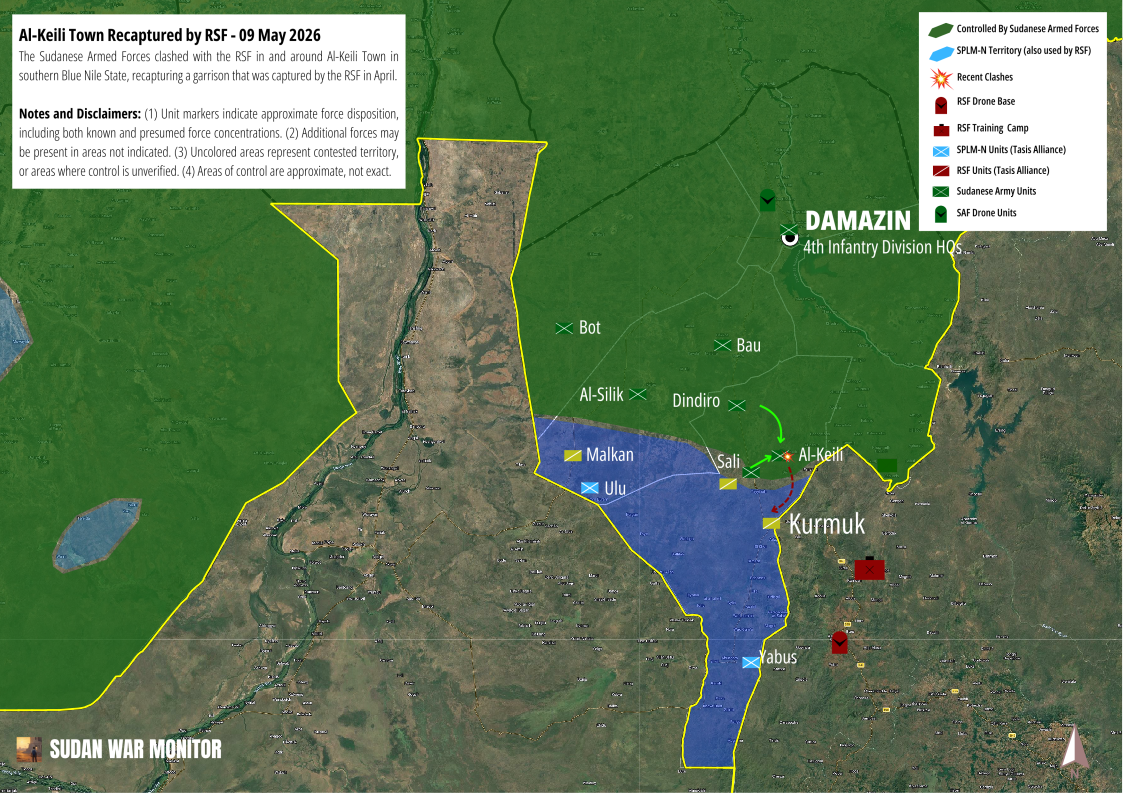
The Sudanese Armed Forces (SAF) said Saturday that its troops had recaptured the military garrison at Al-Keili in southern Blue Nile State, marking the first known reversal of recent territorial gains made by rebel Founding Alliance (Ta’sees) in the region.
Videos circulating on social media show Sudanese soldiers inside Al-Keili following the operation. Sudan War Monitor geolocated one video to a medical facility inside the town, confirming that SAF recaptured it from the RSF-led Ta’sees Alliance, which had overran the SAF garrison late last month.
Another clip published by official military media showed Blue Nile Governor Ahmed Al-Omda Badi alongside several members of the military, claiming that Al-Keili had been “liberated” from the Rapid Support Forces (RSF).
RSF troops have spearheaded a four-month offensive in Blue Nile State, operating from the territory of their SPLM-North allies, with logistical and aerial support from bases in neighboring Ethiopia.
The rebel alliance operates under the patronage of the United Arab Emirates (UAE), which opposes Sudan’s government for a mix of ideological and economic reasons. The UAE has provided the rebels with advanced drones, combat vehicles, financing, military training, and logistical support.
On Saturday, the Sudanese military issued an official statement announcing the recapture of Al-Keili, describing the operation as part of ongoing efforts by the 4th Infantry Division and allied forces to clear remaining rebel positions near Kurmuk along the Ethiopian border:
“Forces of the 4th Infantry Division and supporting units succeeded in liberating the Al-Keili area, located on the outskirts of Kurmuk town on the southern axis, following what the army described as heroic battles against the terrorist Rapid Support Forces militia and the rebel forces of Joseph Tuka [SPLM-North].”
The army claimed rebel forces suffered heavy casualties in both personnel and equipment and said remaining fighters withdrew from the area under pressure from advancing SAF units.
Related coverage:


Al-Keili lies east of the main Kurmuk–Damazin road in southern Blue Nile and occupies a tactically important position between Kurmuk and Dindiro. The area fell to RSF-led coalition forces in late April during a broader rebel push northward from Kurmuk following the collapse of SAF defenses along the Ethiopian frontier in March.
The recapture of Al-Keili now suggests the military is attempting to stabilize a front that had appeared increasingly vulnerable over the past six weeks.
Help us cover a neglected conflict
Sudan War Monitor is a collaborative of Sudanese and international journalists and open source researchers covering Sudan’s civil war through OSINT, reporting, Arabic-language sources, and political-military analysis. We publish maps, verified videos, news, and investigative reporting.
The operation comes amid a visible buildup of Sudanese military reinforcements into Blue Nile State. Videos reviewed by Sudan War Monitor in recent days indicate the army has increased logistical movements southward from Damazin, with convoys carrying troops and supplies toward frontline areas north of Kurmuk. The buildup appears aimed at preventing further RSF advances deeper into Blue Nile after rebel forces exploited the collapse of forward SAF positions near the Ethiopian border earlier this year.
Separately, Sudan’s army is also redeploying troops to Northern State for fear of cross-border attacks from Libya. These redeployments could weaken SAF’s efforts in the central front, Kordofan, where the RSF maintains its sieges of Kadugli and Dilling, and a partial siege of El Obeid.
Kordofan remains the RSF’s most direct route toward Khartoum and central Sudan. Fighting there has centered around key roads linking Darfur to El Obeid and the capital region. However, RSF advances in Kordofan have slowed in recent months amid heavy concentrations of SAF troops, allied armed movements, and local militias deployed across the region.
The pressure in Blue Nile appears partly intended to reduce that concentration by forcing the army to reinforce the southeastern front. By opening another active theater near the Ethiopian frontier, RSF commanders may be seeking to thin SAF deployments in Kordofan while also creating a second route toward central Sudan from the east.
The Blue Nile operations also align with the RSF’s ongoing efforts to shed its image as a regional paramilitary from the western Darfur region, and remake itself as a national rebel force and government-in-waiting. Last year, the RSF and SPLM-North, together with several minor political factions, announced the creation of the “Government of Peace and Unity,” which claims sovereignty over all of Sudan but exercises control only in parts of the country’s south and west.
The Government of Peace and Unity maintains strong unofficial relationships with Uganda, Chad, South Sudan, and Ethiopia, but is not officially recognized by any country. Its leaders also operate from Kenya, Libya, and the UAE.
Egypt is expanding its geopolitical influence