
The armed group that controls western Sudan, the Rapid Support Forces (RSF), has acquired new drones and armored vehicles as it continues its four-year war against the Sudanese Armed Forces (SAF), which previously supported the group and fought alongside it.
The new weaponry is an indication that the Rapid Support Forces (RSF) continues to receive support from the United Arab Emirates, despite the economic shock that has hit the UAE as a result of the Middle East war.
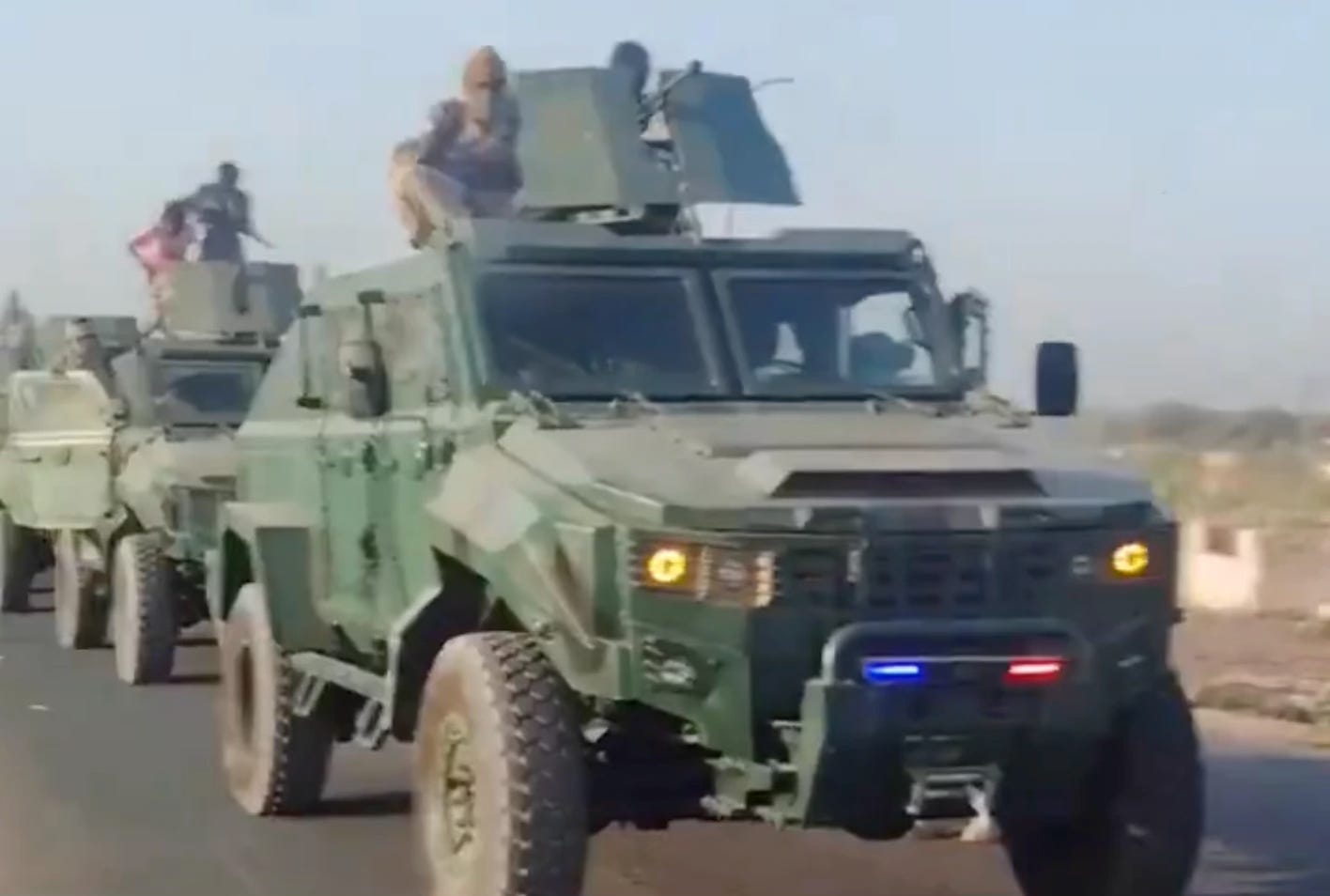
Last week in Nyala, the capital of South Darfur, the Rapid Support Forces (RSF) paraded about 20 newly manufactured armored cars and 20 refitted Toyota ‘technicals’ in the same paint scheme.
Although the armored vehicles do not exactly match any variant publicly advertised for sale, analysts who reviewed footage of the parade concluded that the vehicles resembled armored cars previously manufactured by UAE-based manufacturer Minerva Special Purpose Vehicles (MSPV).
Canadian political scientist Chris W.J. Roberts, who reviewed the footage and compared it to previous UAE models, said he was “95% sure” that the new vehicles were manufactured in the Emirates, citing resemblances to MSPV vehicles and variants produced by other Emirati defense firms. Given the lack of a publicly known name, he dubbed the variant the “Hajeen Desert Raider.”
He said, “The UAE armoured vehicle ecosystem borrows ideas and develops new versions rapidly... Existing parts, suppliers, and plans can be brought together quickly to make a ‘new’ vehicle for a specific customer.”
Roberts concluded that the UAE government commissioned these vehicles expressly for the RSF and the Libyan National Army (LNA), another UAE client in the region:
“For now, I’d say this relatively cheap Desert Raider started production last year expressly for Emirati supply to LNA and RSF and is designed for specific operational purposes: essentially a protected, long-range ‘technical’ with gun mount, small crew, and rear cargo capacity for fuel, ammunition, supplies, or pillaging.”
“It was a top-down ‘this is what we need so build it’ order from UAE authorities, not a ‘build it and they will come’ scenario.”
Another open-source analyst, Rich Tedd, said that the new RSF technical vehicles seen in the recent parade in Nyala “appear to be linked to the shipments that recently entered Sudan from Haftar-controlled south-eastern Libya. Their paint schemes and field modifications appear consistent.”
Video 1: RSF armored vehicles in Nyala, 28 May 2026. Music added by uploader.
Video 2: TikTok video of RSF vehicles in southeastern Libya, preparing to cross into Sudan carrying barrels of water or fuel. Audio added by uploader.
Video 3: RSF technicals in southeastern Libya preparing to cross into Sudan.
Meanwhile, Janes Information Services, a company specializing in military analysis, revealed that the RSF has also acquired “a new type of unmanned aerial vehicle,” which it identified as a BZK-005, developed by Beihang UAS Technology and widely used by the Chinese military.
The Yale Humanitarian Research Lab corroborated this finding in a report Tuesday, releasing a satellite photo of a parked drone with a wingspan of 19 meters at the Nyala Airport on May 6, 2026. The report included analysis discussing the reasons for identifying the drone as a BZK-005.
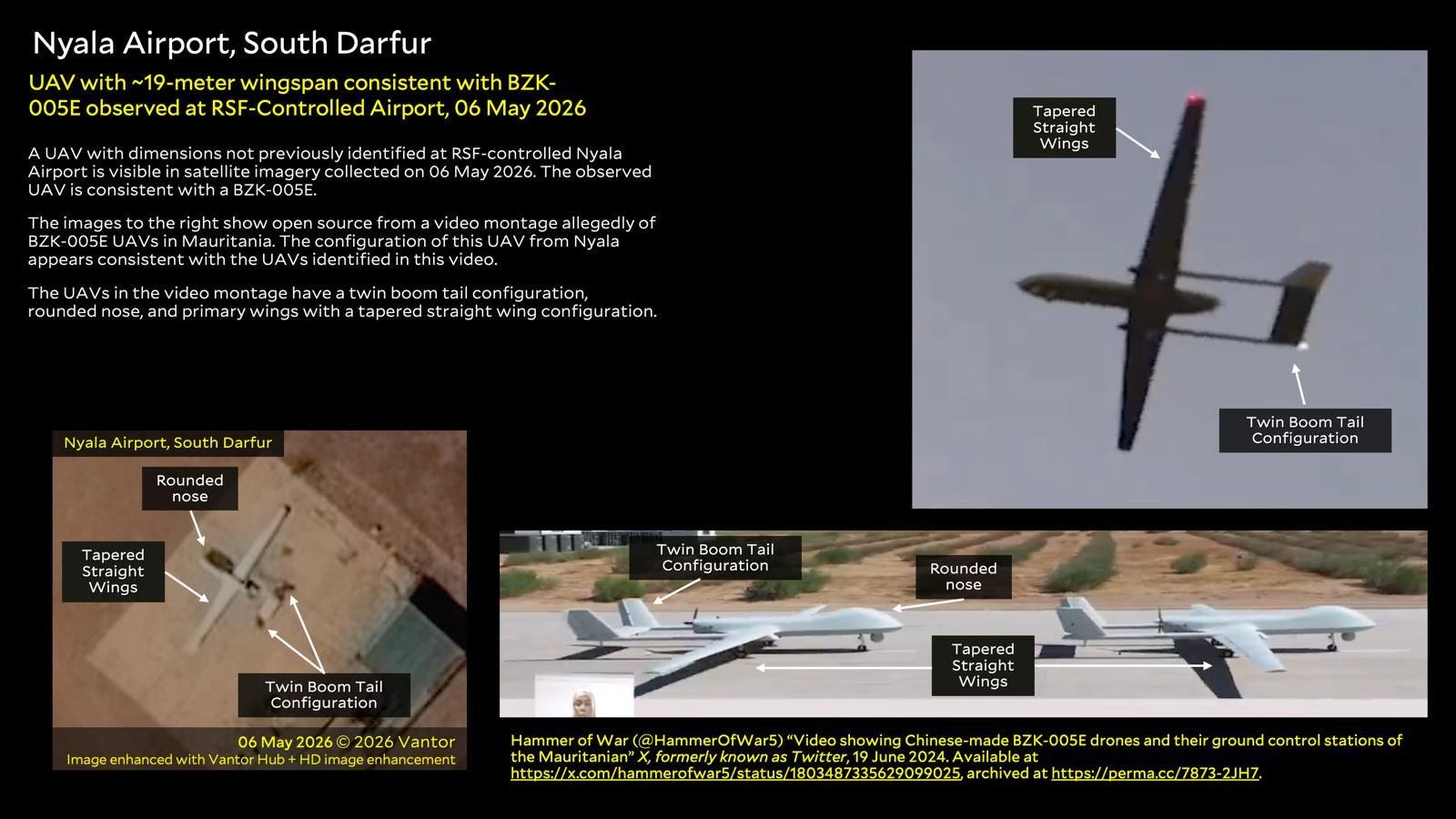
This would be the largest drone acquired by the RSF to-date, surpassing the CH-95 variants previously confirmed in use, which have a wingspan of 12 meters. The BZK-005 is designed for surveillance and aerial attacks. It has a range of approximately 2400 kilometers and a payload of up to 370 kg.
The report by the Yale researchers noted that this type of Chinese drone was displayed at defense trade shows in Abu Dhabi in the UAE in 2022 and 2024. It cited links between the Chinese manufacturer and UAE defense firms, including joint ventures and joint projects.
“The UAE’s EDGE Group and the International Golden Group have been linked to multiple advanced weapons transfers to the Rapid Support Forces, including munitions and light and heavy artillery. The transfer of this BZK-005E-consistent UAV to the Rapid Support Forces may constitute a violation of the United Nations Security Council Resolution 1591.”
Darfur is under a UN arms embargo dating to the early 2000s, when the region was devastated by another civil war and a campaign of ethnic cleansing. The embargo technically remains in effect but is not enforced.
Yale Humanitarian Research Lab wrote, “It is incumbent upon China as the producer and main operator of the BZK-005 to account for how it arrived in RSF’s arsenal. China is a permanent member of the UN Security Council.”
Sudan War Monitor is a reader-funded, independent news outlet. Please consider becoming a paid subscriber to fund reporting & analysis of a conflict that is widely ignored, underreported, and misunderstood.
As the drone war in Sudan escalates, both sides have also invested in new anti-aircraft equipment. These have had mixed success, shooting down some drones but also being targeted themselves. Last month, the RSF destroyed a Turkish-made Hisar-A air defense system in the Rehed al-Nuba area, west of Omdurman, as seen in the video below, which was published by the RSF on the Telegram app.
A similar advanced air defense system employed by the RSF was destroyed in February in South Kordofan State near a key frontline. Although the two sides employ similar drones and anti-drone systems, they source them from different countries, with SAF relying more on Egypt, Pakistan, and Türkiye, while the RSF relies on the UAE and China.
In addition to employing long-range fixed-wing drones, which launch precision guided munitions, the warring parties also use more basic quadcopter commercial drones, which drop simple mortar bombs. Below is a video of an RSF fighter arming a quadcopter drone with an 82mm mortar bomb (music added by uploader).
The Sudanese military uses similar quadcopter drones. These are often used for short-range tactical missions against military targets, in contrast to the long-range strategic drones provided by regional powers, which more often are used against civilian targets such as markets, power plants, and hospitals.
Humanitarian and human rights groups consistently have warned that the drone war in Sudan is endangering critical economic infrastructure while also killing and maiming hundreds of citizens every month.
News in Brief
A military drone hit two commercial vehicles in Umm Badr in North Kordofan State on May 31, killing 18 civilians including two children, according to Emergency Lawyers, a human rights group. The town is controlled by the RSF and has suffered previous aerial attacks by SAF, including a February 2025 airstrike on a gold mine in area.
Preparations are ongoing for a Sudanese political dialogue in the Ethiopian capital Addis Ababa, convened by the Quintet group of diplomats (the UN, Arab League, EU, African Union, and IGAD). However, a group of SAF-allied politicians, the “Democratic Bloc,” announced that they would not participate, citing a lack of agreement on procedures for the meeting and a lack of separation between security and political tracks.
The Tasis government has begun printing and issuing new currency in areas under its control, following the appointment of a “Transitional Monetary Council” led by former Bank of Sudan Governor Hussein Yahya Jangol. Merchants in Nyala reported a flood of new bank notes in circulation bearing Jangol’s signature. RSF soldiers reportedly are being paid in this currency for the first time, rather than US dollars. The bank notes resemble older Sudanese currency and are dated “May 2022.”
A suspected RSF drone bombed the city of Um Ruwaba in North Kordofan, a SAF-controlled city, resulting in the killing of three men identified as Engineer Jaafar Hasan, Engineer Burair Al-Desouqi, and Police Assistant Hassan Musa Hassan.
Tribal clashes erupted in the Kubum area of South Darfur State between the Salamat and Beni Halba tribes, with both sides reportedly using RSF military equipment. The RSF had mediated a reconciliation agreement between the two Arab tribes after a previous round of fighting in 2025.
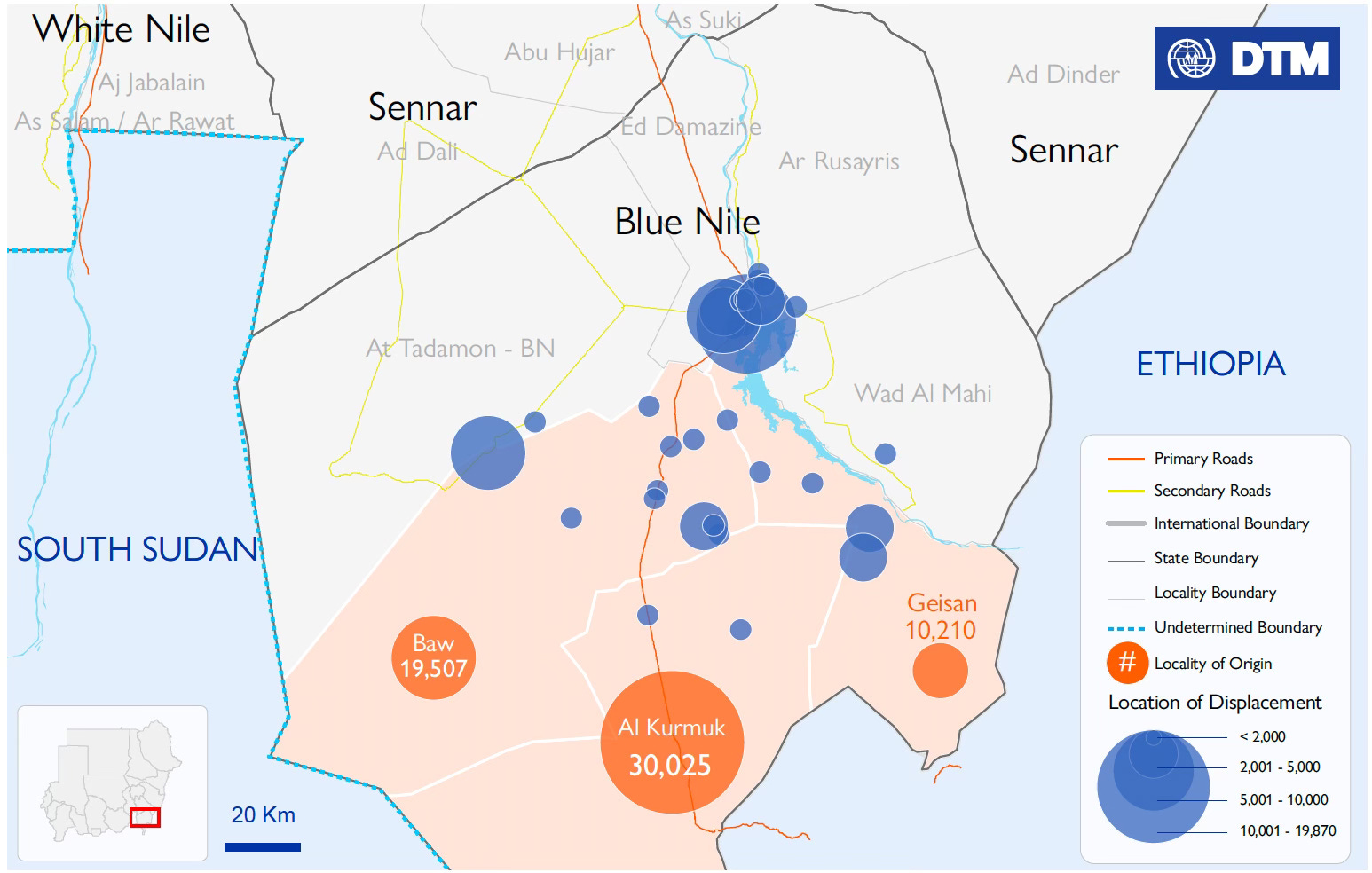
The International Organization for Migration estimated that nearly 60,000 individuals were displaced from locations across Blue Nile State between 11 January and 21 May 2026, following escalation of fighting. About half of these individuals arrived in the capital region, Damazin. The vast majority of newly displaced individuals sought shelter at informal gathering sites (72%), while others stayed with host families (21%) or were hosted in schools and other public buildings (7%). Approximately 53% of displaced were female, compared to 47% male, and 50% were children.
The Commander-in-Chief of the Sudan Armed Forces and de facto ruler of (eastern) Sudan, Abdel Fattah Al-Burhan, met Tuesday in Ankara with President Recep Tayyip Erdoğan, a key ally of the Sudanese military and its leading supplier of drones, anti-drone systems, and other military hardware. Sudanese state media reported, “The meeting addressed various areas of joint cooperation and ways to further develop them to serve the mutual interests of the two brotherly peoples, in addition to discussing a number of regional and international issues....”
RSF Deputy Commander-in-Chief Abdelrahim Dagalo appeared in a video interview released by RSF-affiliated media, answering questions about the takeover of El Fasher, atrocities committed by RSF forces, and past contacts with the Joint Force and SAF leaders. Dagalo claimed that he had had positive talks with the now sidelined SAF Deputy Commander-in-Chief Shams al-Din Kabbashi in Manama, Bahrain, in 2024, but that Islamists in the Sudanese military had sabotaged the talks. Dagalo also detailed talks held with Joint Force commanders (including JEM and SLM) before they abandoned their neutrality in early 2025.
Individual and Organisational Subscriptions
Sudan War Monitor is used by NGOs, newsrooms, policy teams, and research institutions working on Sudan or related policy issues. We offer team subscriptions that cover your whole organisation under a single annual payment, managed through Substack and processed securely by Stripe. Seats can be added or reassigned at any time.


